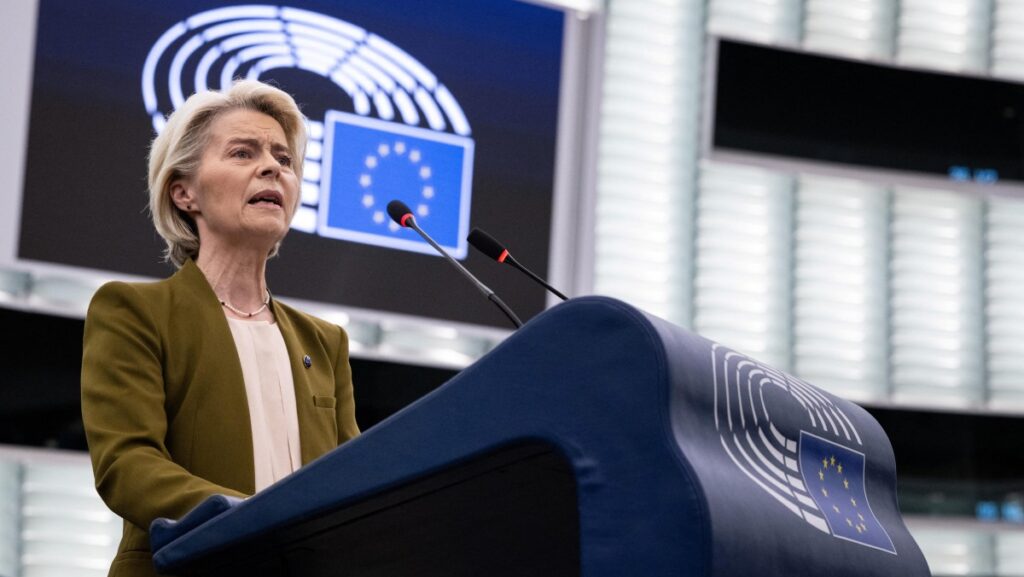
EU Commission President Ursula von der Leyen gives her annual State of the Union address during a plenary session at the European Parliament in Strasbourg, eastern France, on September 10, 2025.
Sebastien Bozon / AFP
Ursula von der Leyen’s much-anticipated State of the Union address with following debate confirmed what many inside and outside the institutions have long suspected: her leadership rests on a script of empty words contradicting the Commission’s actions. In the name of “European independence,” the Commission president proclaimed the need to protect industrial competitiveness, safeguard food security, and defend farmers—while simultaneously championing trade agreements that undermine those goals.
This paradox defines von der Leyen’s political style. She promises more investment in Europe while striking deals that funnel capital to the United States; she pledges to defend European agriculture while advancing Mercosur and the India deal; she calls for “media resilience” while creating an information control center, raising press freedom concerns.
Parliament’s president, Roberta Metsola, introduced von der Leyen with the slogan: “For safe streets for our children.” But mass immigration, overwhelmed reception systems, and rising crime in European capitals made the words ring hollow. The official rhetoric collides with the facts—and Europeans know it.
Even more striking was von der Leyen’s insistence on speaking about Ukraine as if it were still 2022: promises of more funds, more sanctions, more “resilience,” ignoring war fatigue and economic strain across the EU.
What began with applause ended with boos. The more Von der Leyen spoke, the more evident the hypocrisy of her words became.
Iratxe García, leader of the Socialists & Democrats (S&D), was among the most critical voices. She pointed out the obvious: von der Leyen talks about investing in Europe but signs a “Trump deal” that commits up to €750 billion to U.S. energy—that she called far more polluting and beyond the EU’s competencies. For García and much of the Left, this approach undermines Brussels’ ‘green’ rhetoric and the EU’s credibility.
The socialist struck at von der Leyen’s weakest point: “Your worst enemy is Manfred Weber, Madam President.” García knew this would sting inside the centrist European People’s Party (EPP).
The other major clash came from just the EPP. Manfred Weber defended further EU centralization, saying: “The idea of national sovereignty is a Potemkin village; it no longer exists.” For Weber, only an EU whose unity in foreign policy and defense is “irreversible”—no turning back to nation states—can survive today.
But his intervention went beyond calls for more Europe: he attacked the right-wing Patriots of Europe harshly, accusing them of being “friends of Musk, of Washington, and even of Moscow,” and of wanting to turn Europe into a “technological colony of Silicon Valley and the Kremlin.” This rhetoric confirms that the EPP no longer conceives itself as a center-right party, but as the manager of the federalist project embodied by von der Leyen. The long-expected conservative turn of the EPP is nothing more than wishful thinking. We will not see the EPP aligning with the Patriots to change Brussels’ direction.
From the Patriots for Europe, Jordan Bardella seized the chance to attack the incoherence of both the EPP and the Commission. He denounced how Brussels claims to defend farmers while signing deals that dismantle the sector, and to seek autonomy while handing energy and investment to Washington.
One of von der Leyen’s most controversial proposals was the creation of a European Center for Democratic Resilience, tasked with monitoring “manipulation and disinformation.” In reality, this would be an office to control speech even as governments themselves spread disinformation.
The parallel with the old USSR is inevitable: centralized control presented as security and democracy.
The debate made one thing clear: von der Leyen no longer convinces even her own allies. To the Socialists, she invests in the U.S. while promising to strengthen Europe; to the establishment center-right, she is a president who needs to transfer more national sovereignty to Brussels to survive; and to the Patriots, she is the symbol of a Europe surrendered to foreign interests, drifting away from its farmers, its industry, and its people.
The debate over the EU’s future is far from over, but the Commission’s current course increasingly resembles a centralist, homogenizing project disconnected from reality. Brussels may repeat that we live in “Europe’s independence moment,” but to many Europeans, what is being built looks far more like a new Soviet Union.