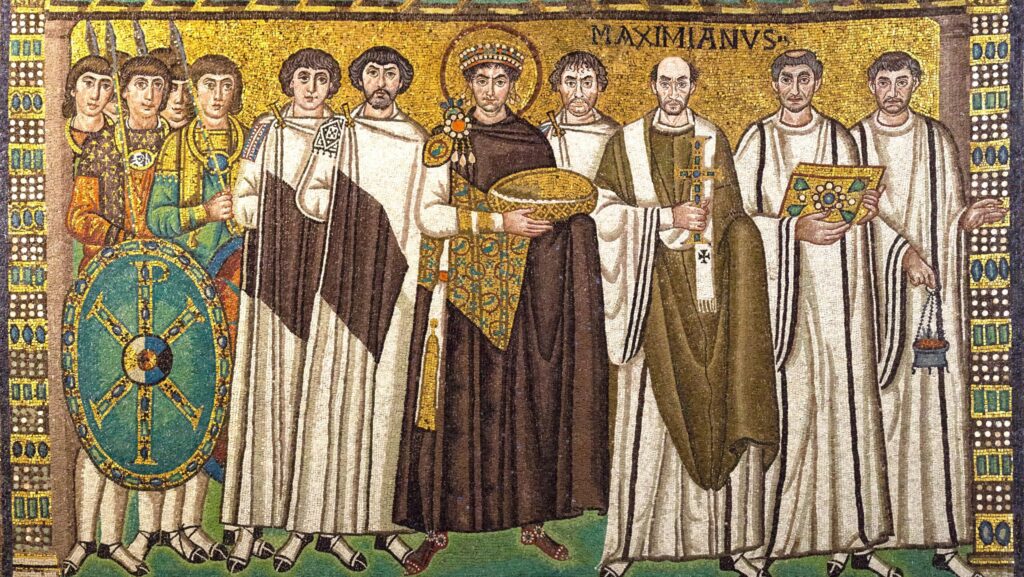
Court of Emperor Justinian with Archbishop Maximian of Ravenna and three other clerics on Justinian’s right, and two court officials and his guards on his left. Apse mosaic, Basilica of San Vitale, Ravenna, Emilia-Romagna, Ital7.
Roger Culos, CC BY-SA 3.0, via Wikimedia Commons
“The priesthood and the Empire are the two greatest gifts which God, in His infinite clemency, has bestowed upon mortals; the former has reference to Divine matters, the latter presides over and directs human affairs, and both, proceeding from the same principle, adorn the life of mankind.”
— Justinian I, Novella VI, Preface (tr. S.P. Scott, The Civil Law, 1932).
On 30 March 2026, Ecumenical Patriarch Bartholomew took his seat at the Institut de France in Paris, in the chair once held by Joseph Ratzinger. French President Emmanuel Macron had signed the decree of appointment. The audience before him was the assembled membership of the Académie des Sciences Morales et Politiques, the secular intellectual establishment of France, in its own house. The vocabulary Bartholomew deployed was theosis, Logos ontology, and the crisis of truth.
Six weeks later, on 15 May 2026, Pope Leo XIV signed Magnifica Humanitas. Published on the 135th anniversary of Rerum Novarum, it is Leo XIV’s first encyclical, his formal entry into the governance of artificial intelligence. Leo XIII addressed the disorder created by industrial capital. Leo XIV addresses the disorder created by machines that process, predict, and increasingly replace human judgement. The dateline is not coincidental: it is a consciously inherited tradition.
What the two events share is something no major commentary on the encyclical has yet named. They are the second and third movements of a concert that opened at the Phanar on November 29, 2025. The temporal order has attended none of the performances.
Magnifica Humanitas is a precise canonical document. Its central anthropological claim is unambiguous: humanity must not be “reduced to mere data and commodities.” It renews the Church’s condemnation of every form of commodification of the person. It situates human dignity beyond algorithmic determination. It warns that artificial intelligence, severed from ethics, risks “render[ing] decisions about life and death more rapid and impersonal.” It carries the full canonical weight of a papal encyclical, binding Catholic teaching globally.
What it cannot do is compel a government, bind a corporation, or amend the European Union Artificial Intelligence Act of 2024.
A papal encyclical is not designed to function as a legislative instrument. It is the spiritual arm of governance exercising its proper authority: addressing souls, naming disorder, teaching doctrine. The encyclical is an exemplary exercise of that authority. The question is not whether Leo XIV has spoken well. It is whether the institutional architecture exists for any temporal authority to answer, and whether any European institution has been authorised to ask the anthropological question the encyclical raises.
The answer is no.
The story of Magnifica Humanitas did not begin in May 2026. It opened at the Phanar on 29 November 2025, the eve of the Feast of Saint Andrew, when Leo XIV and Patriarch Bartholomew signed a joint declaration in the city where the symphonia once governed. The declaration invoked the sacredness of the human person, the unity of the Church, and the shared obligation to peace: the Eastern and Western arms of Christian governance speaking together in the first formal common document of the new pontificate.
The second movement came at the Institut de France on March 30, 2026. Bartholomew, in Ratzinger’s chair, did not deliver a theological homily. He delivered a constitutional diagnosis. The crisis of contemporary society, he told the French Academy, “is not primarily a moral crisis, but a crisis of truth.” Without that truth, “liberty becomes arbitrary, equality devolves into mere levelling, and fraternity becomes a mere moral exhortation devoid of any unifying power.” He was addressing the intellectual guardians of the French Republic’s founding vocabulary, in their own temple, and dismantling the anthropological premises on which that vocabulary rests.
The third movement is Magnifica Humanitas.
The temporal order has heard all three. It has not responded to any of them.
The constitutional architecture was codified fifteen centuries ago. Novella VI is unambiguous: the priesthood governs the soul; the imperial authority governs the city. Neither is sufficient alone. The priesthood without the temporal arm has no instrument of enforcement in the order of law. The temporal arm without the priesthood has no constitutive anthropology for the laws it enacts. The symphonia, their concert, is the governance model for a civilisation that takes the human person seriously as more than a rights-bearing unit.
Justinian stated the reciprocal obligation with equal precision: “hence nothing should be such a source of care to the emperors as the honor of the priests who constantly pray to God for their salvation.” The emperor’s first duty was not to the treasury but to the integrity of the priesthood.
The genealogy connecting Justinian’s chancery to Leo XIV’s encyclical is not theological metaphor. It is jurisprudential fact. Gratian’s Decretum of c. 1140, the foundation of Western canonical jurisprudence, was structured on the analytical model of Justinian’s Digest. When Leo XIV exercises canonical authority, he exercises an authority whose legal form traces directly back to the Corpus Juris Civilis. The two arms share the same ancestor. They have forgotten they are related.
Leo XIII understood this architecture. Immortale Dei (1885) was his articulation of the Church–state relationship for the age of constitutions: a Western translation of the Byzantine symphonia, adapted for sovereign nation-states that had inherited Justinian’s legal grammar while discarding his governance theology. Leo XIV inherited that tradition. Magnifica Humanitas is the spiritual arm speaking at full authority. The civil arm has not been invited to answer.
The tradition that never abandoned the symphonia model has been speaking on this question longer than the encyclical’s news cycle suggests.
At the Parliamentary Assembly of the Council of Europe in January 2025, Bartholomew addressed the Council of Europe’s Framework Convention on Artificial Intelligence directly: “technical progress must support human development and serve the welfare of all.” In Riga, in September 2025, he was more precise: AI “must be placed in the service of man and of creation, and not in the service of impersonal forces.” At the Institut de France, in March 2026, he deployed the Logos ontology that Benedict XVI had made the Western Church’s own: truth “is not an abstract idea, but a person — Christ himself.” And he anchored the argument in the one category the EU AI Act structurally cannot accommodate: “the human person created in the image of God and called, through theosis, to become a reflection of the divine within history.”
Theosis, the Orthodox tradition’s term for the soul’s participation in divine life, is not a liturgical ornament. It is an anthropological claim with direct governance consequences. If the human person’s destination is communion with God, then the soul’s governance is irreducible to code, to conformity assessment, or to constitutional category. The regulatory question “what risks does this AI system pose to this rights-bearer?” presupposes a radically thinner account of the human person than either the encyclical or the Patriarch’s address will accept.
Magnifica Humanitas approaches this register. The November 2025 joint declaration and the Paris address confirm that the spiritual arms of East and West are reconstituting the concert. The concert now has two voices and three documented movements. It needs a third arm, the temporal one, to complete the symphonia.
The EU Artificial Intelligence Act is a serious legislative achievement. It categorises AI systems by risk, prohibits certain applications, mandates conformity assessments, and builds a governance infrastructure across member states. It was three years in the making.
It was not drafted with reference to any spiritual authority. It does not cite Justinian. It does not invoke the symphonia. Its concept of “dignity” derives from the Charter of Fundamental Rights, a document designed to be acceptable to twenty-seven member states and therefore committed
to the word without supplying its foundation. The Charter names dignity. The EU AI Act protects it. Neither asks what grounds it.
This is not a defect unique to this legislation. It is the structural consequence of a decision the West has been making since 1945 and codifying progressively through EU institutional architecture: to govern without a constitutive anthropology. The symphonia’s genius was precisely the translation of doctrinal claims about the human person into the grammar of law and institutional order. Without that translation, the encyclical is addressed to no institution with the authority or mandate to act.
Algorithms do not wait for encyclicals. The anthropological question (what is the human person in the age of artificial intelligence?) is being answered, by default, by the architecture of the systems already deployed. Every training dataset, every alignment protocol, every commercial objective function constitutes an implicit answer to a question no European institution has been authorised to ask.
Justinian named the remedy fifteen centuries ago. Leo XIV and Patriarch Bartholomew have reconstituted the concert. The cost of Brussels’s silence is not spiritual. It is constitutional.