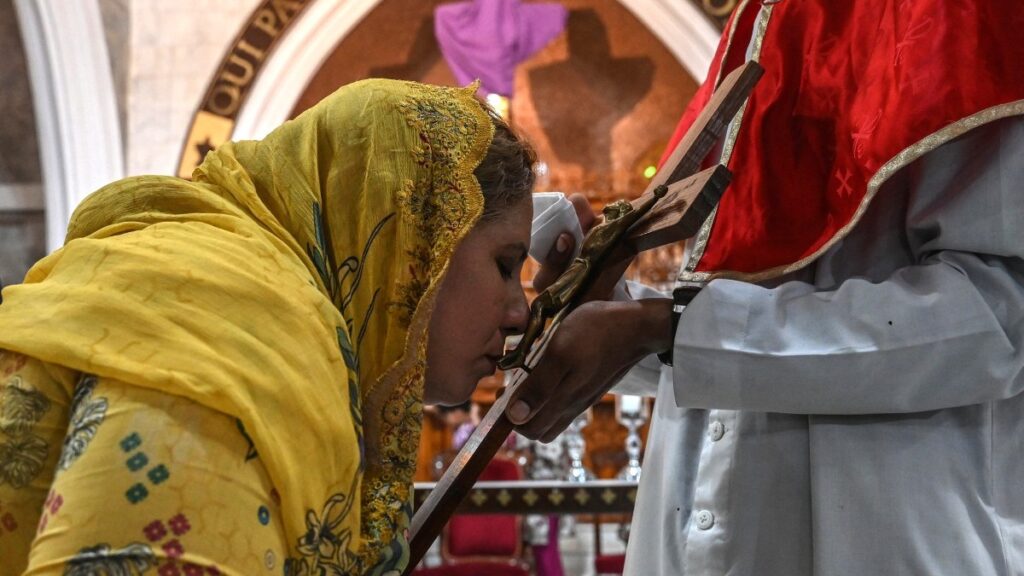
A Christian woman kisses a crucifix during a Good Friday service at St. Anthony’s Church in Lahore, Pakistan on April 18, 2025.
Arif Ali / AFP
After 23 years on death row, a 72-year-old Christian in Pakistan, Anwar Kenneth, was acquitted of blasphemy this past June by the country’s Supreme Court.
Kenneth, a Catholic, was arrested in 2001 for sending letters deemed blasphemous towards Islam’s Prophet Mohammad and the Quran. He was charged under Section 295-C of Pakistan’s blasphemy law, which carries a mandatory death sentence.
In July 2002, a Lahore court sentenced him to death after he pleaded guilty, declaring, “God is my counsel.”
In June, Anwar’s case was heard by the Supreme Court. Three judges declared that “a person of unsound mind could not be held liable for such a crime.” Afterwards, defense counsel Rana Abdul Hameed told reporters, “It is very unfortunate that an elderly man has languished in various prisons for over two decades despite his mental health condition.” Kenneth was due for release in July.
Kenneth may have escaped execution, but the human rights organization Open Doors has reported that the decision to acquit him has been met with anger by Islamist activists. And the trend of using blasphemy laws to target Christians (as well as other minorities) is increasing.
Pakistani Christians continue to be arrested and receive harsh sentences, including life imprisonment and even death sentences, for “blasphemy” accusations. On July 19, for instance, police arrested and charged another Catholic, Amir Peter (60 years old), with blasphemy after he accused a Muslim shopkeeper of overcharging, reported the news website Christian Daily.
Peter of Nishat Colony in Lahore, capital of Punjab Province, was charged under Section 295-C of the country’s blasphemy laws pertaining to disrespect of Islam’s prophet, Muhammad (a charge punishable with death) following the complaint of a Muslim, Sanor Ali.
Another recent case involving Pervaiz Masih, a Christian, revolved around an accusation that he wrote blasphemous content that later sparked violent riots in Jaranwala in August 2023. He was sentenced to death along with other harsh penalties this past Good Friday (April 18). The anti-terrorism judge sentenced him to the death penalty under Section 295-C.
The Jaranwala incident that destroyed at least 20 churches and forcibly displaced hundreds of Christians in August 2023 is just one illustration of violence resulting from the blasphemy laws.
This trend of intolerance and persecution of other religions can be traced back to Pakistan’s adopting of an Islamic Constitution in 1973 and Sharia law in its civil code. According to the constitution, the right to free speech is subject to the restrictions necessary to ensure “the glory of Islam.”
The most recent Islamization process began with the 1986 introduction of blasphemy laws, which predominately impact religious minorities and are often used for settling personal scores.
In 2023, Pakistan’s Senate passed a bill to tighten the country’s blasphemy law by (among other things) increasing the punishment from three to ten years’ imprisonment for using “derogatory” remarks against Mohammed’s family, wives and companions, and the four Islamic caliphs.
According to Open Doors,
“Pakistan’s notorious blasphemy laws are often used to target minority groups, but Christians are disproportionately affected. Indeed, roughly a quarter of all blasphemy accusations target Christians, who make up just 1.8% [of the population.] Blasphemy laws carry a death sentence. While this is seldom carried out, people accused of blasphemy are vulnerable to attack or murder by mobs. In June 2024, an elderly man was killed by mob violence after being accused of desecrating the Quran.”
In addition, a new report by Human Rights Watch entitled ‘A Conspiracy to Grab the Land’: Exploiting Pakistan’s Blasphemy Laws for Blackmail and Profit, documents the use of blasphemy accusations for personal economic gain. HRW says:
Accusers have long used blasphemy charges to incite mob violence that has forced entire communities to flee their homes, leaving their property vulnerable to land grabs … A mere accusation of blasphemy can be a death sentence: in the past decade, vigilantes have killed dozens of people in mob violence following blasphemy accusations.
In a 2025 report, the Centre for Social Justice (CSJ) chronicled a record of 344 new blasphemy cases in Pakistan in 2024, highlighting increased abuse of the country’s blasphemy laws. The data compiled by the organization showed that,
“The blatant weaponization of blasphemy laws continued to enable persecution, religious intolerance, and widespread human rights violations,” the report added.
The EU executive, however, is still enabling Pakistan’s persecution of Christians through policies such as the Generalized Scheme of Preferences Plus (GSP+). While in July Pakistan’s Senate passed legislation removing the death penalty for two specific crimes, with Islamabad officials openly acknowledging it as a calculated move to preserve billions in European trade benefits, the blasphemy laws that have sent dozens of Christians to death row remain untouched. To make matters worse, the EU is also importing the same destructive, anti-Christian culture that is prevalent in Pakistan to Europe through mass Muslim migration.
As George Orwell said: “If you want a picture of the future, imagine a boot stamping on a human face—forever.” The Islamic boot on the faces of Europeans is the future facing Europe if Islam takes over the continent.