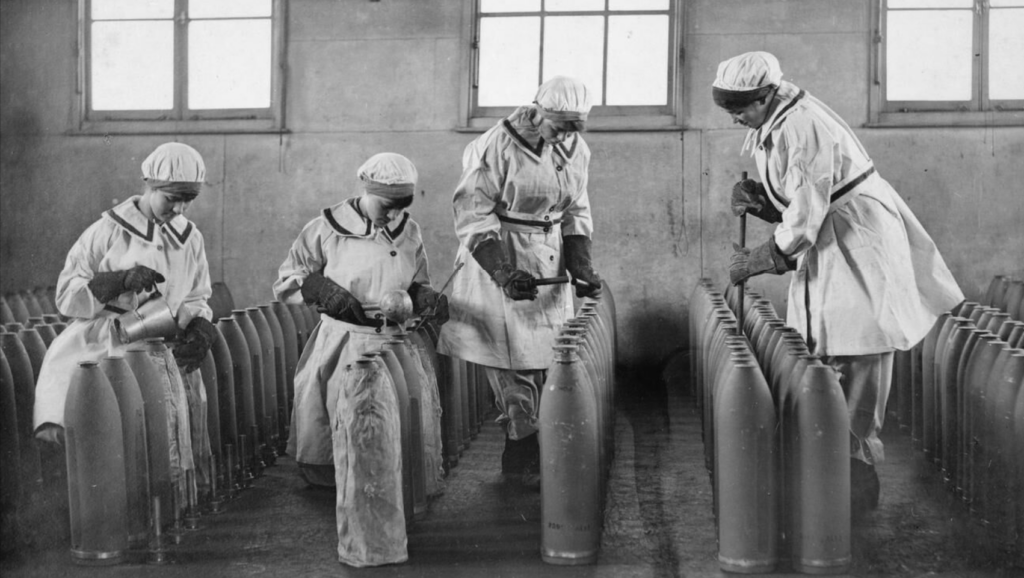
A photograph showing women wearing protective clothing while working in an ammunitions factory in Hereford, England during the First World War (1914-18).
Imperial War Museums
Does war make any economic sense? The unequivocal answer is: “no.” A war has no winners, only tiers of losers. The losses are literally incalculable—humanly, of course, but also from an economic viewpoint: mass casualties together with the annihilation of civilizational capital: cities, roadways, railroads, power plants, churches, libraries, homes, and farms.
Simply put, war has no price. It does not matter if we look at it from the viewpoint of the ‘aggressor’ or the ‘defender’—in a war, the devastation and destruction defy the logic of economics and finance.
Despite assured economic disaster, Europe is increasingly preparing for war. So far, the preparations are concentrated on building up core military functions, from conscription to the massive reinforcement of military hardware. However, with the belligerent war rhetoric coming out of many of Europe’s political leaders, this beefing-up of Europe’s military capabilities could easily turn into military aggression.
There is even talk about transitioning the peace-time economy into one that is geared for war. Laws are being passed, budgets are being drafted, and exercises are being held as military preparations for a large-scale war.
This is more than a little troubling. What first looked like an effort by European NATO countries to take more fiscal responsibility for their own spending is increasingly looking like the alliance is actually coordinating its resources for—yes—war. Rhetorically, there is no mistaking who the enemy is: Russia.
If Europe continues with what it has started, namely transforming a defense build-up into an increasingly aggressive war machine, then the next logical step would be to transform the European economy in the same fashion. War, namely, costs a lot of money. It consumes resources that would otherwise be available for the civilian population.
Given the enormous evolution of military technology since Europe last saw a continent-wide war more than 80 years ago, it is difficult to imagine what a modern war-time economy would look like. Based on the experience from those days, the most striking experience for the civilian population would be the militarization of resource distribution. The government, most likely in the form of a military agency, would impose a rationing system for all kinds of goods and services. Based on availability, it would apportion among the citizenry everything from food and clothes to fuel, health care, means of transportation, and, under more extreme conditions, even housing.
Digital rationing cards would replace debit and credit cards, online payment apps, and perhaps even cash.
Depending on what supply chains a government can muster, it will be more or less harsh in its rationing. If Europe does not produce enough beef, the government rationing cards will apportion the strictly rationed beef among the citizenry. People may be allowed to buy beef only on certain days of the week. Dairy, vegetables, and hygiene products may not be regularly available.
Civilian manufacturing and other production facilities will be adapted for the purpose of military production. Since foreign trade likely will be severely restricted or eliminated entirely, Europe would depend on its own ability to produce all the necessities that the armed forces require—and then provide what is left over to the civilian population.
This is what economic life would look like under a wartime scenario based on the experiences from two 20th-century world wars. Is it a realistic outlook on what awaits Europe if the continent goes to war again?
We can glean some of the answer from how Europe is currently preparing for war. Some of the preparations clearly indicate that the military leadership envisions a classic infantry-based army-vs-army war. Germany is a case in point, where the government is going to great lengths to prepare the population for the most critical of all elements in the build-up to a mass army war: conscription.
As a show of how seriously it takes these war preparations, the German government has introduced a mandate forcing all men aged 17-45 to get permission from the military, the Bundeswehr, to leave the country for more than three months. This comes on the heels of the new military service law with so-called voluntary conscription; the goal is a rapid expansion of recruitment to the ranks of the German military.
There is a similar wartime rhetoric echoing out of France, including the reintroduction of national military service—a limited one for now, but once it is in place, it can easily be expanded.
The French government also has other bellicose plans. According to Politico, they are planning a major expansion of military procurement, especially when it comes to missiles and drones. This is, they explain, part of a plan to transition France into a “war economy”—with Russia on the opposing side.
As if to reinforce that Europe is preparing for a traditional, conventional weapons war with Russia, back in October, NATO Secretary General Mark Rutte shared his version of war-time rhetoric. He, too, pointed fingers at Russia.
A February 23rd article at ForeignPolicy.com provided a wealth of details on how countries in eastern Europe are already reorganizing their military forces in compliance with the war-with-Russia scenario. On April 4th, Deutsche Welle built on the same narrative:
The threat from Russia has pushed Germany to carry out its biggest war drill of its kind in decades—testing its readiness for mass evacuations of wounded allied soldiers from NATO’s eastern border in Lithuania. Germany has carried out its largest medical exercise in decades as NATO prepares for the possibility of large-scale war.
On top of Europe’s war-oriented political paradigm, U.S. President Donald Trump recently presented his budget request for the 2027 fiscal year, which starts in October. At the top of Trump’s agenda is an expansion of U.S. military spending by $441 billion, or 44% over the 2026 fiscal year. This is by far the largest expansion of the American defense budget since the war in Korea more than 70 years ago. The year-to-year percentage increase in military appropriations is larger than the largest and the second-largest annual Vietnam War-era increases—combined.
The war rhetoric, war preparations, and war funding in the NATO countries are stronger, deeper, and more prevalent than they have been in the past several decades. We probably have to go back to the days of the 1961 Berlin and Cuba crises to find Europe and America in a similar stage of preparation for a large-scale war.
All this is frightening and probably foretelling of a war to come. Implicit in all these preparations for that major conflict is the premise that Europe would be engaging in a clash between armies, with battles and skirmishes over multiple battlefields, with tanks and infantry charging one another.
The reality of a 21st-century war will likely be very different. The entire idea of sustaining the civilian population with central resource distribution becomes moot if a conventional war escalates into a short but cataclysmic exchange of nuclear warheads. Within hours, the death toll counts in billions, and the destruction of civilizational capital will effectively transform human life into a Stone Age struggle for survival. The ensuing nuclear winter will engulf the entire planet and eliminate large swaths of those who survived.
Where no cities are left standing, where no church bells ring, no libraries dispense books; where no roadways work, no production, transportation, or distribution of resources can take place on any meaningful terms—that is where the modern war ends. There is no economy left, no civilization to uphold. All that remains is a cynical global monument to how political arrogance triumphed over human reason.