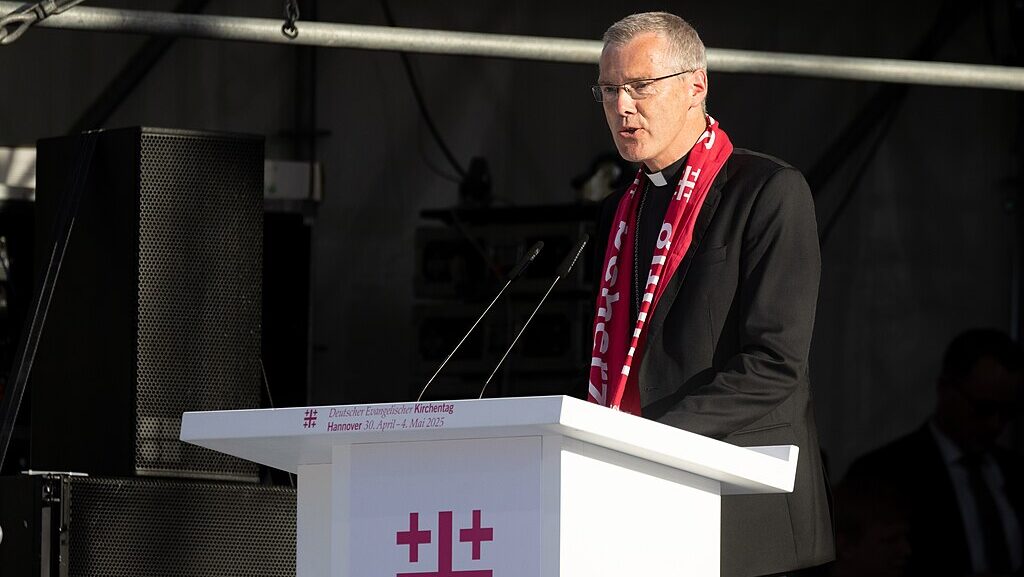
Bishop Heiner Wilmer at the inauguration of Kirchentag in Hannover, 2025.
Kadellar, CC BY-SA 4.0, via Wikimedia Commons
It is said that Georges Danton, one of the minds of the French Revolution, when he was tried in 1794 by those who had once been his allies in the war against the Ancien Régime, uttered before the judge the famous words, “The Revolution is like Saturn: it devours its children.”
A similar logic is unfolding in Germany, where the German Synodal Path seems truly to be taking a bad turn. For those unaware, the Catholic Church in Germany is at the forefront of theological and pastoral progressivism, to the point that Cardinal Marx—nomen omen—explicitly stated, during the Extraordinary Consistory of January 2026, that his goal is to make the Synodaler Weg “a model for the universal Church.” I have briefly reconstructed the history of this reality and explained its significance for Catholicism in a previous analysis.
The article concluded with an observation: we have entered a new phase of the “synodal process” with the announcement by Georg Bätzing that he does not intend to seek re-election to the leadership of the German episcopate, and with a question: for whom is space being made?
During the spring plenary assembly of the German Bishops’ Conference, held February 23-26 in Würzburg, the bishops addressed two central issues: the election of the new president and the establishment of the Synodal Conference (Synodalkonferenz), a permanent body of laity and bishops with decision-making powers not only pastoral but also doctrinal and governmental. Among the proposed reforms are the separation of powers in a democratic-parliamentary sense, the introduction of the female diaconate and priesthood, optional priestly celibacy, the stable admission of the divorced and remarried to the sacraments, and the official recognition of LGBT Catholics.
As for the election of the new president, the bishops chose Heiner Wilmer, a figure known in Rome for his strongly critical positions toward the traditional doctrinal framework. He is known as the “hawk of anti-doctrine” for his support of radically revolutionary reforms: from the abolition of priestly celibacy to the revision of Catholic sexual morality in a ‘modern’ sense, according to which simple consent would suffice to qualify any relationship as good.
Wilmer represents not only the continuity of progressivism after Marx and Bätzing but its consolidation.
It suffices to recall that, in December 2018, three months after his episcopal consecration, Wilmer publicly praised Eugen Drewermann, the psychoanalyst priest suspended in 1991 by the Diocese of Paderborn for his markedly progressive positions, describing him as “a prophet of our times.”
There was a time when Wilmer did not hesitate to underline that “structural evil exists in Church’s DNA” and therefore heterodox theologians such as Drewermann would be necessary, capable of “stepping on the bishops’ toes, however much it may hurt.”
In September 2022, after the fourth assembly of the Synodal Path, when the draft of the programmatic document for the systematic redefinition of the official Catholic position on affective relationships and sexual orientation was rejected, Wilmer protested against the resistance of conservative bishops and said, “The reform of Catholic sexual morality remains an essential issue.”
During this year’s spring assembly, the statutes of the future Synodal Conference were approved by a two-thirds majority, but with a very narrow margin, a sign of strong internal divisions within the German episcopate. The statutes will now be sent to Rome for possible final approval. If Rome approves, the first meeting of the conference is scheduled for next November.
The composition of the conference is indicative of its orientation. Alongside 27 bishops, there will be 27 lay members of the Central Committee of German Catholics (ZdK) and another 27 members elected internally, chosen among laity, religious, and clergy for particular competencies or “sensitivities.”
The tripartite structure, equal in numbers but substantially oriented toward a majority outside of the episcopal body, configures an assembly in which the hierarchical element is deliberately mutilated in its proper function, namely the governance of the Church. Nothing excludes that the conference may in the future include, among those eligible, even non-Catholic subjects, following the model of the “round table synods” already experimented with in Rome by Francis.
The decisive point is not so much the participation of the laity as such—provided for by right—but rather the claim to attribute to a mixed body decision-making powers over doctrine and governance, to the point of introducing a mechanism for monitoring the activity of diocesan bishops. In recent weeks, in fact, the lack of response from the Holy See to resolutions concerning blessings of homosexual couples, celibacy, and the female diaconate has been interpreted by the promoters of the Path not as an implicit denial, but as an operational space to be occupied.
It is in this context that the proposal emerges, far from marginal (indeed, it is the most important element), to make monitoring reports non-anonymous, exposing ‘dissenting’ bishops to the evaluation of public opinion and, consequently, to media pillorying. This is, in fact, a form of extrajuridical pressure: a disciplinary device founded not on law but on reputational mechanisms. A true controlled consensus. The objective is to create a climate in which the bishop who does not conform appears and perceives himself as isolated and backward, and therefore evil.
In past years, several distinguished German canonists—among them Thomas Schüller and Norbert Lüdecke—have already qualified the Synodal Path and the future Synodal Conference as null from a juridical standpoint. A diocesan bishop exercises in his own diocese ordinary, proper, and immediate power and answers for his governance only to the Roman pontiff, not to a synodal body and not even to the local episcopal conference.
What is occurring in Germany, therefore, is a true attempt at ecclesiological subversion. The separation of powers in a parliamentary sense, evoked among the reforms, implies a transfer of categories proper to the modern state into the constitution of the Church, which, according to Catholic doctrine, is not the fruit of a constituent pact but an institution of divine law and, for this very reason, irreformable.
It is striking, in parallel, the different register with which respect for canon law is invoked in regard to the Priestly Society of Saint Pius X, for which juridical irregularity has in the past been a reason for warnings and sanctions. Here, by contrast, the absence of a canonical basis does not prevent the construction of de facto structures, whose legitimation is even sought ex post through praxis.
The most important reaction in the opposite sense has come from Cardinal Rainer Maria Woelki, Archbishop of Cologne.
As announced, Woelki did not take part in the sixth synodal assembly that started January 29. His position is now clear: “For me the Synodal Path is over,” having participated in the five sessions initially foreseen. The premise is juridically relevant: the Synodaler Weg had initially been presented as a time-limited process. Its indefinite extension, with transformation into a stable body, in Woelki’s view alters the very nature of the initiative, changing it from an extraordinary consultative path into a permanent and parallel structure of governance.
Woelki also insisted on the need for an “urgent theological clarification.” The cardinal further noted that numerous bishops, even outside Germany, have expressed concern about the risk of a separation from the universal Church.
The Bishop of Passau, Stefan Oster, also officially communicated that he no longer wished to participate in the Path, citing “serious ecclesiological and anthropological problems.” The protest was joined by Rudolf Voderholzer, Bishop of Regensburg, and Alfred Rottler, apostolic administrator of Eichstätt.
The decisive scenario remains the judgment of the Holy See on the statutes of the future Synodal Conference. If Rome, as appears probable, were to reject them, a new phase with uncertain outcomes would open. The question will not be merely disciplinary, but doctrinal.
If the era of Bätzing could be interpreted as the attempt to carry forward the great and grave reforms while preserving apparent and formal unity with Rome, the era of Wilmer seems oriented toward a more conflictual dynamic. Wilmer, in fact, is a trench revolutionary, an attacking progressive, capable also of presenting himself as a ‘mystical’ man, with pious and devotional tones that can confer a certain sacral aura upon his reformist drives. Interesting times await us.