Shortly before Christmas, the U.S. State Department slapped visa sanctions on five individuals whom it described as being agents of a “global censorship-industrial complex” bent on restricting the freedom of speech of Americans. The headliner of the sanctions list was, of course, Thierry Breton, the former EU internal market commissioner, who spearheaded efforts to enforce the EU’s Digital Services Act (DSA) during the last years of his tenure in the Commission. But the directors of three organizations allegedly involved in censorship activities were also sanctioned: HateAid, the Global Disinformation Index, and the Center for Countering Digital Hate.
As discussed in my recent portrait of HateAid, the German organization is directly integrated into the DSA censorship system as a so-called trusted flagger of allegedly illegal or harmful online content. Under the DSA, online platforms and search engines are required to give priority treatment to the notifications of ‘trusted flaggers’ precisely because they have been certified as ‘trusted’ by EU member state governments—in this case, the German government.
But even though it does not have ‘trusted flagger’ status, another of the organizations targeted by the U.S. sanctions has likewise been a major player in the EU’s efforts to ‘regulate’ online speech, which in fact began many years before the passage of the DSA. Moreover, it, too, has important, if largely unclarified, ties to Germany. The organization in question is the Global Disinformation Index (GDI), whose executive director and best-known figure, Clare Melford, was placed on the sanctions list.
Although it had already come under scrutiny from right-leaning media and politicians in the U.S., GDI gained particularly wide public attention in April 2024 when the British website UnHerd revealed that it had been placed on a ‘dynamic exclusion list’ by the organization and was losing advertising revenue as a result. ‘Defunding disinformation’—or, more precisely, alleged purveyors of disinformation—by compiling this sort of advertising blacklist is the stated goal of GDI.
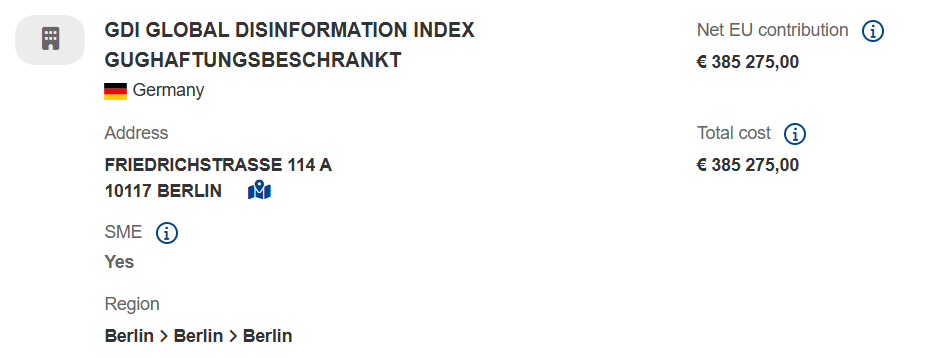
GDI is usually identified as a British organization in news reports, and it is that in the sense that it has a London office and Melford is British. But it is not only that, as the below entry from the European Commission’s CORDIS database makes clear. The GDI receives funding from the European Union as a German organization with its headquarters in Berlin.
Moreover, GDI also receives funding from the German government itself—or at least was receiving such funding when it last deigned to acknowledge its funding sources.
Thus, when UnHerd went public with its beef with GDI in 2024 and raised the issue of GDI’s funding by the British government’s Foreign, Commonwealth and Development Office (FCDO), it soon turned out that FCDO had already ceased funding the organization. The U.S. State Department had done likewise, following a similar controversy involving conservative media in the United States. As UnHerd noted in a follow-up report, FCDO and Disinfo Cloud, a now defunct platform that was funded by the U.S. State Department, quickly disappeared from the funders list on the GDI website. European Union and the German Foreign Office—Auswärtiges Amt—remained, as can be seen in the below screen cap from the site as it appeared on 19 April 2024.
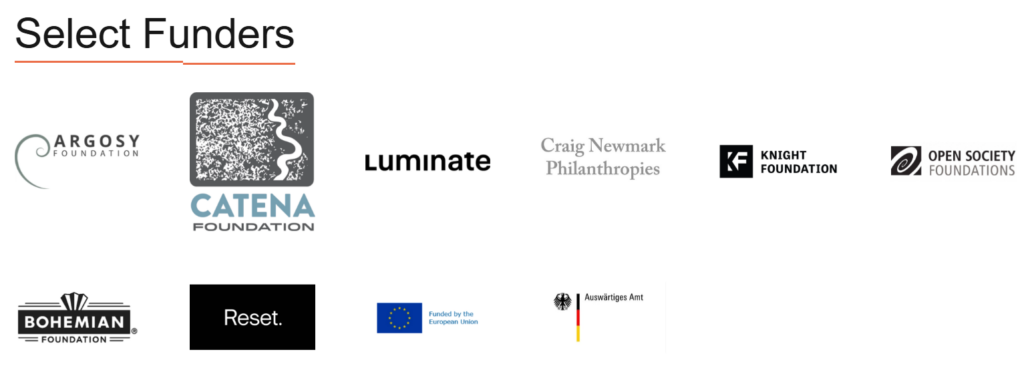
Meanwhile, the entire funders list has been purged from the GDI website. As it so happens, the German Foreign Office, located in Berlin’s central ‘Mitte’ district, is about a five-minute drive from GDI’s Friedrichstrasse 114 address, which is likewise in Berlin Mitte.
In 2018, the European Commission rolled out its first formalized effort to combat alleged online ‘disinformation’ in the form of the so-called Code of Practice on Disinformation, a supposedly ‘self-regulatory’ industry code into which the Commission recruited all the major online platforms and search engines. GDI was founded that very year.
In June 2022, shortly before the passage of the DSA, the Code of Practice was strengthened, and the EU-funded European Digital Media Observatory (EDMO) was given a seat on a Permanent Task Force on Disinformation that was created under it. Melford serves on the EDMO advisory board. Last year, the Code of Practice was elevated to the status of a Code of Conduct, meaning that platforms can use Code participation as a means of demonstrating compliance with the DSA.
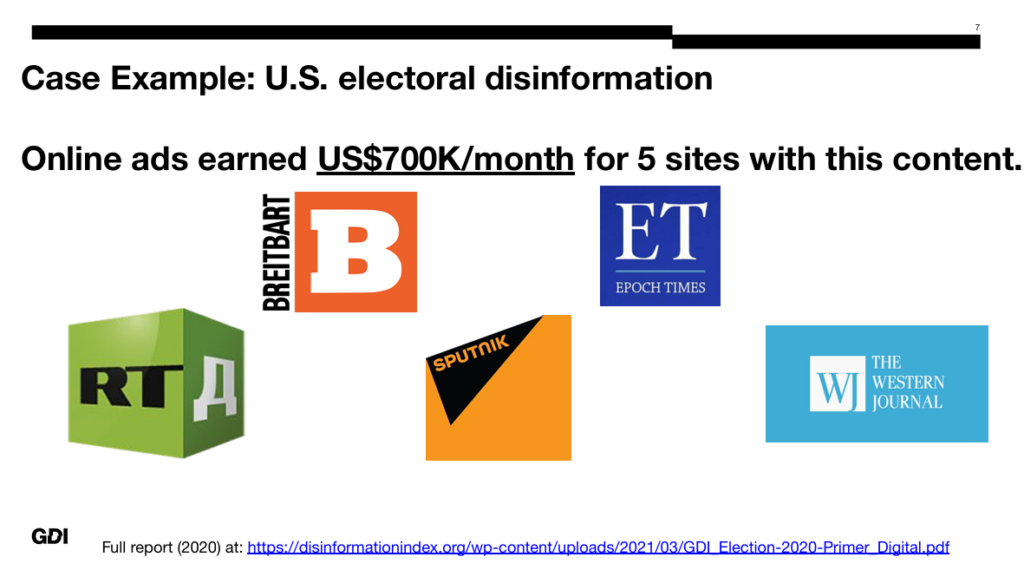
In a 2021 presentation to the European Parliament titled “Monetizing Disinformation in the EU,” Melford identified not only the Russian media RT and Sputnik as purveyors of ‘disinformation’ but also the American media Breitbart, The Epoch Times, and The Western Journal (see the below visual). The following year, Ursula von der Leyen would, of course, ban RT and Sputnik from operating in the EU—a ban that did not only cover their broadcasting but was also dutifully applied by online platforms.
In its early years, GDI was indeed generously funded by the British government. But GDI submissions to the EU lobby register already made its eagerness to be serviceable to the coalescing EU censorship regime unmistakably clear. Thus, GDI data circa May 2022 notes,
We are working globally but see a clear and unique opportunity at the EU level to advance the code of practice on disinformation to defund sites. We are keen to leverage our knowledge of this topic for meeting the EU’s commitment to this issue.
The submitted information also refers to “the weekly evidence we compile and share with EU contacts”—notably, on “ads funding disinformation (on COVID-19 conspiracies, for example).”
Lobbyfacts.eu, which assembled the above-cited data, was also able to document numerous meetings between GDI and European commissioners or their staff between 2020 and 2022. These included meetings with the offices of all the commissioners most actively involved in the Code of Practice and the preparation of the DSA: Thierry Breton (Internal Market), Margrethe Vestager (Europe Fit for Digital Age), and Věra Jourová (Values and Transparency).
Interestingly, the May 2022 data still lists a major grant of nearly €1.5 million from FCDO. Since, however, the British funding began to dry up (the last FCDO contribution was in 2023), GDI has taken to listing Disinformation Index Inc. as its main donor. See, for instance, the most recent register data here.
This is to say that GDI lists itself as its main donor! ‘Disinformation Index Inc.’ is the name used by an American branch of GDI. As we will see momentarily, this lack of transparency is typical for the organization—and indeed extends to the American branch as well, thus rendering GDI’s funding almost entirely opaque.
The current version of the register entry notes that “The Global Disinformation Index is tracking and supporting EU commitments to combat disinformation as outlined in the EU Code of Conduct on Disinformation and the Digital Services Act,” and Lobbyfacts.eu has been able to document five more meetings with European Commission officials—including one just last week! The most recent meeting was with the Commission’s current point person on the DSA, Executive Vice President Henna Virkkunen.
In 2022, following controversy over the GDI’s targeting of conservative U.S. media, the American branch of the organization released tax returns to the DC-based news outlet The Washington Examiner. The returns, however, not only omitted the identity of donors but even redacted those of its own officers.
“I don’t think I’ve ever seen a 990 that excludes the names of officers and directors,” a lawyer specializing in non-profit law told The Washington Examiner at the time, “And I’ve looked at hundreds.”
In any case, the German government’s response to a parliamentary question (p. 82) shows that already in 2023, precisely as the British funding was being wound down, the German foreign office had begun funding GDI via, namely, its American branch, as can be seen below. “AA” is the Auswärtiges Amt, and “Disinformation Index Foundation” is another name associated with the American branch of GDI. That year, the AA contributed a relatively modest sum of €48,000.

As touched upon above, GDI is devoted to defunding alleged online purveyors of ‘disinformation’ by depriving them of their advertising revenues. Not coincidentally, this demonetization agenda is part of both the 2022 strengthened Code of Practice on Disinformation and the DSA. But the irony of this is that advertising revenues are, of course, precisely what allow non-paywalled websites to remain independent. GDI calls itself “independent”—namely, from the media whose reliability it claims to assess—but if it depends on funding from governments and public institutions like the European Commission, what kind of independence is that? The would-be ‘watchdog’ could be nothing more than a guard dog.
And why has GDI become so cagey about its funding sources since the FCDO funding dried up? Who exactly is funding the defunders?