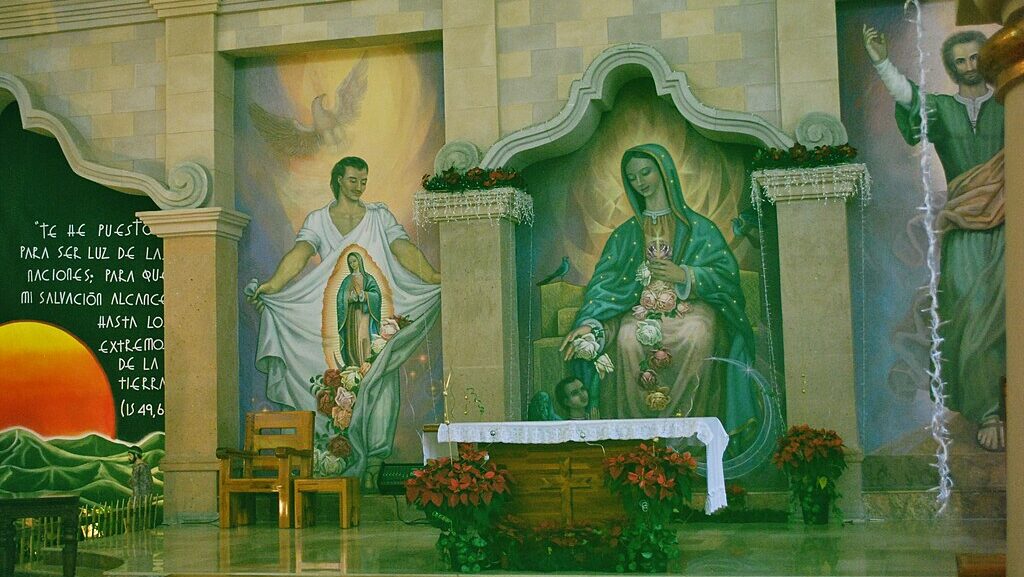
Images of Saint Juan Diego Cuauhtlatoatzin, an Indigenous man canonized by the Catholic Church and a central spiritual figure of Mexico, and the Virgin of Guadalupe at the San Francisco de Asís Church in Jalpa de Méndez, Tabasco.

Fr. Javier Olivera Ravasi, SE is an Argentine Roman Catholic priest, lawyer, and holder of two doctorates (one in Philosophy from the Pontifical Lateran University in Rome, 2007, and another in History from the National University of Cuyo, 2013, with a focus on the Cristero Wars in Mexico). He is widely known for his apologetics work, historical defenses of the Catholic faith, and his popular YouTube channel Que No Te La Cuenten (QNTLC), which has nearly half a million subscribers and focuses on historical apologetics and what he calls the “Catholic cultural counterrevolution.”
There is no doubt that the first great globalization, rightly understood, was that of the Iberian peoples, and principally that of Spain. That Spain which, since the time of the Catholic monarchs, did not hesitate to undertake that “great feat,” as Don José María Pemán put it, of conquering new worlds and evangelizing them for the glory of God.
We must remember that when Columbus reached what we now call America in 1492, writing, the wheel, and numerical notation did not yet exist there. Meanwhile, 2,200 years earlier in Greece, Hesiod, and Homer were already composing their great poems.
This ‘globalism’—in its healthy sense—so often invoked today is, in reality, Catholicism. It implies universality without loss of individuality: an Inca is as Catholic as an Aragonese or a Syrian, and none thereby lose their national or cultural identity. They fall under a moral order that transcends borders, and a political order that bestowed upon the newly discovered peoples the blessings of Christendom, which—as Leo XIII said—is when “the philosophy of the Gospel governs the State” (Immortale Dei).
The Valladolid Debate reveals something unique in the history of empires: the capacity to subject one’s own power to a public moral judgment. While other empires expanded their dominion without asking themselves whether they had the right to do so, the Spanish monarchy officially halted its conquests in order to ask theologians and jurists whether they were just.
This episode shows genuine, not fictitious, self-criticism: power was recognized as non-absolute, subordinate to natural law and to the law of God, and the indigenous peoples were acknowledged as subjects of rights because of their inherent human dignity.
This does not mean that every conquistador acted according to these principles, but it does demonstrate that the normative ideal of the empire was not brute force but an ethical conception of power. Valladolid is proof that, at least in doctrine, Spain sought to govern its expansion under principles of justice and conscience, not under the logic of sheer might.
Because the Black Legend has triumphed—even in certain Catholic circles—that is, the liberal, Protestant, and Masonic mythmaking with which we have been hammered in schools, universities, and even some parishes. The ‘evil conqueror–good native’ dialectic has conquered the collective unconscious of our society, and except for some who dare to think for themselves, it has become the obligatory mantra everywhere.
The reality is that all this legislation—beginning with Queen Isabella the Catholic’s codicil, in which she urged that no harm be done to the inhabitants of the New World—constituted the norm. A norm that, as said above, could of course be ignored by sinful men. But the standards were clear enough that, after his third voyage, Columbus himself returned in chains by order of the Catholic monarchs for having violated some of the rules designed to protect the most vulnerable.
The idea of a ‘racially oppressive empire’ is a modern ideological myth, not an honest description of historical reality. When one examines the facts, what one finds is not an apartheid system but a profoundly mestizo society open to integrating Indigenous elites.
I cite facts, not slogans.
In Peru, Garcilaso de la Vega “El Inca,” the son of a Spanish captain and an Inca princess, became one of the great intellectuals of the Golden Age. He was not marginalized; he was read, published, and respected. Militarily, the Tlaxcalans were not ‘subjugated peoples’ but armed allies of Cortés, with legal privileges granted by the Crown for generations.
In Mexico, the Colegio de Santa Cruz de Tlatelolco trained a genuine Indigenous elite: Antonio Valeriano, a Nahua, served as governor of Azcapotzalco and authored theological and Mariological texts. Fernando de Alva Ixtlilxóchitl, of Texcocan lineage, was an official historian of New Spain and a recognized civil servant.
In the ecclesiastical sphere, we must remember Saint Juan Diego Cuauhtlatoatzin, an Indigenous man canonized by the Church, a central spiritual figure of Mexico—not a ‘colonized subject’ but the protagonist of the continent’s greatest Marian devotion.
There were Indigenous lords with coats of arms granted by the king, such as the descendants of Don Felipe Túpac Amaru (before the 18th-century rebellion), integrated into the Christian nobility. Where, then, is this “racial domination regime”?
It does not exist as a rigid system. There was sin, abuse, injustice—because we are speaking of men, not angels—but there was also real social mobility, political alliances, cultural integration, and legal honor.
The contemporary racial narrative is not history; it is retrospective propaganda.
The first step is to stop treating Indigenous peoples as incapable, as if they were perpetual children of history. Contemporary indigenism is, paradoxically, profoundly colonial: it denies them freedom, intelligence, and decision-making capacity, reducing them to mere ‘structural victims.’
Real history shows something very different: Indigenous peoples not only resisted but also chose, evaluated, and appropriated elements of the Hispanic world with admirable creativity. They were not colonized automatons; they were active historical agents.
One need only look at the processes of healthy syncretism in art: Andean Christian architecture, mestizo altarpieces, the Quito school of imagery, Guaraní mission music. None of this is a servile copy of Europe; it is Indigenous reinterpretation of what was received. Indigenous languages themselves were preserved and elevated by missionaries and local elites: grammars of Quechua, Nahuatl, and Guaraní, bilingual catechisms, Indigenous Christian literature. This is agency, not passivity.
The Indigenous person was an actor, not a museum ornament. And as long as we deny him that condition, we continue practicing true colonialism—the colonialism of modern ideas.
Yes, we are clearly dealing with an ideologized and militant interpretation of history, not with serious analysis. The so-called woke discourse does not seek to understand the past, but to weaponize it politically in the present.
A modern category—biological race, class struggle, power structure—is artificially projected onto centuries that thought in entirely different terms: natural law, Christendom, the common good, moral hierarchy.
The Iberian world was, in many respects, radically innovative for its time:
it created laws to protect Indigenous peoples when other empires did not even recognize their humanity; it established universities in the Americas while much of Europe still had none; it legally recognized Indigenous peoples as free vassals of the Crown.
The woke narrative needs to erase this complexity because it lives off a simple scheme: oppressor–oppressed. If it admits nuance, it collapses. We are, ultimately, facing a mental colonization of history that destroys the true memory of peoples in order to impose a contemporary political morality. This is not an innocent academic error; it is a deliberate cultural operation.
They do not want history: they want inherited guilt.
They do not want truth: they want militancy.
The Iberian model was imperfect—as every human undertaking is—but it was far more humane than the narrative now repeated in universities and media.
Catholic universalism was not an ideological pretext; it was a genuine theological and juridical principle that forced power to set limits on itself. That is the fundamental difference with modern empires.
Evangelization was not mere cultural expansion but a metaphysical conviction: every human being has a soul, and therefore rights that the king may not trample with impunity. That principle does not arise from the Enlightenment but from the Gospel.
From this sprang reforms with no parallel in secular imperial projects: the Laws of Burgos (1512), the New Laws (1542), the legal prohibition of Indigenous slavery, the office of Protector of the Indians, the theological and juridical debates of Vitoria, Soto, and Las Casas—not debating whether the Indigenous were human (as other empires would later do) but how they ought to be justly governed.
This universalism required the conquistador to justify himself before Christian conscience and before the law. He could not simply impose himself by naked force without betraying himself as a Christian.
Later secular empires operated the other way around: they did not begin from the ontological equality of souls, but from racial, cultural, or economic superiority. There we indeed find scientific racism, planned extermination, and segregation assumed as state policy.
The Iberian project, with all its sins and contradictions, was internally restrained by a truth that transcended it: God was not the emperor’s property.
Whereas secular empire justified itself by interest, wealth, or race, the Catholic empire at least acknowledged that it had to ask forgiveness when it betrayed its own principles.
That difference is more revealing than any modern slogan.
The first step is to abandon therapeutic history—the kind that seeks not truth but feelings: guilt for some, victimhood for others. A healthy history is not built on slogans but on facts uncomfortable for everyone.
Simplification is always ideological. Real history is tragic, complex, contradictory; thus, when someone offers a past without grandeur or without sin, he is lying.
To build an honest history we must recover three things almost forbidden today:
First, love of truth, even when that truth serves no contemporary political banner. Second, a sense of proportion—that is, judging events according to their own context, not with the moral tribunals of the twenty-first century.,Third, courage, because today saying that the Hispanic world had real lights is an act of dissidence.
This is not about replacing a Black Legend with a Pink Legend.
It is about breaking the monopoly of the Black Legend with data, archives, context, and thought.
The problem is not complexity; the problem is the fear of losing control of the narrative.
To reject Hispanidad or Portugalidade from South America is not a simple ideological gesture: it is an act of spiritual and cultural self-mutilation.
Our nations did not exist before Spain or Portugal; they arose through them. Our language, our legal system, our political organization, our festivals, our conception of the person, of honor, of sin, of forgiveness, of suffering, and of death are a direct inheritance of Iberian Christendom. To deny that is to deny one’s own being.
Indigenism does not seek to reconcile identities; it seeks to create a new subject built upon the mutilation of memory. And any politics founded on hatred of one’s roots is destined to produce fractured, insecure, and easily manipulated peoples.
No one denies the existence of valuable pre-Hispanic roots. But America is not pure Indigenous continuity—it is a mestizo, Catholic, and juridically Hispanic reality. We are neither Indigenous nor European, but something new … and that “something new” was shaped around Hispanidad.
In truth, indigenism does not love the native peoples; it uses them as a political myth against the very civilization that gave form to our nations.
And a people taught to hate itself needs no external enemies—because it is already defeated.