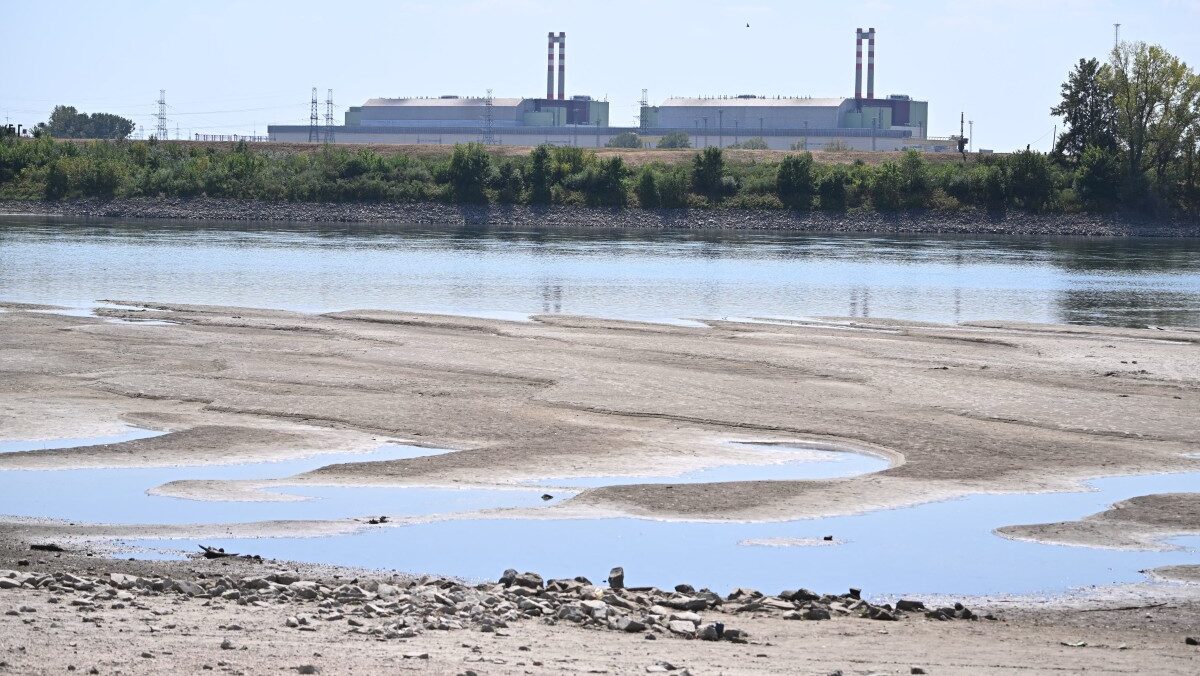
The dried-up Danube riverbed is pictured with the Paks power plant at the background, near Dunaszentbenedek, close to Paks town on July 31, 2026. Amid prolonged heatwave conditions and air temperatures exceeding 35°C, the Danube has fallen to record low levels, creating a critical operational challenge for the plant. The extraordinary low-water situation has raised the prospect of a complete shutdown to ensure the continued safe cooling of the reactor units.
ATTILA KISBENEDEK / AFP
The water level in the Danube has fallen to such a low level that Hungary’s Paks Nuclear Power Plant may be forced to shut down completely for the first time in its history.
“The hardest five days are coming now” Hungarian prime minister Péter Magyar said on Sunday evening. Water restrictions have been introduced in several municipalities, while the reduced output from Paks has increased Hungary’s reliance on imported electricity.
Magyar said the immediate priority is managing the crisis. Once it has passed, he argued, Hungary must draw the necessary lessons and accelerate the development of wind power. In an interview with RTL‘s evening program, Magyar said that the Paks Nuclear Power Plant could remain shut down for more than a month.
Since the drought began—the drastic heatwave and drought striking Europe not sparing Hungary—the government has urged the public to reduce electricity consumption, particularly during the peak period between 5 p.m. and 10 p.m. According to Minister of Economy and Energy István Kapitány, national demand reached 5,700 megawatts at 7 p.m. on Sunday—well below the projected 6,400.
Writing on Facebook, Kapitány noted that the reduction exceeded the output of an entire reactor unit at Paks, calling it a significant contribution by the Hungarian public.
The—for now—partial shutdown of the Paks Nuclear Power Plant also means a significant additional burden. Citing Hungarian politicians, Reuters reported that the energy crisis could cost Hungary 100-200 billion forints (€273–547 million) because imported electricity is much more expensive than what the Paks Nuclear Power Plant can produce.
In a video posted on Facebook on Monday, August 3, Magyar said the country’s most difficult days still lie ahead but announced that the plant’s final operating turbine remained online. He expressed hope that the 240-megawatt unit could continue operating through Monday and possibly Tuesday, allowing Hungary to avoid a complete shutdown of Paks—at least for the time being.
However, Magyar cautioned that further falls in the Danube’s water level could still force the remaining turbine offline. He said engineers were working to keep it operating safely for as long as possible.