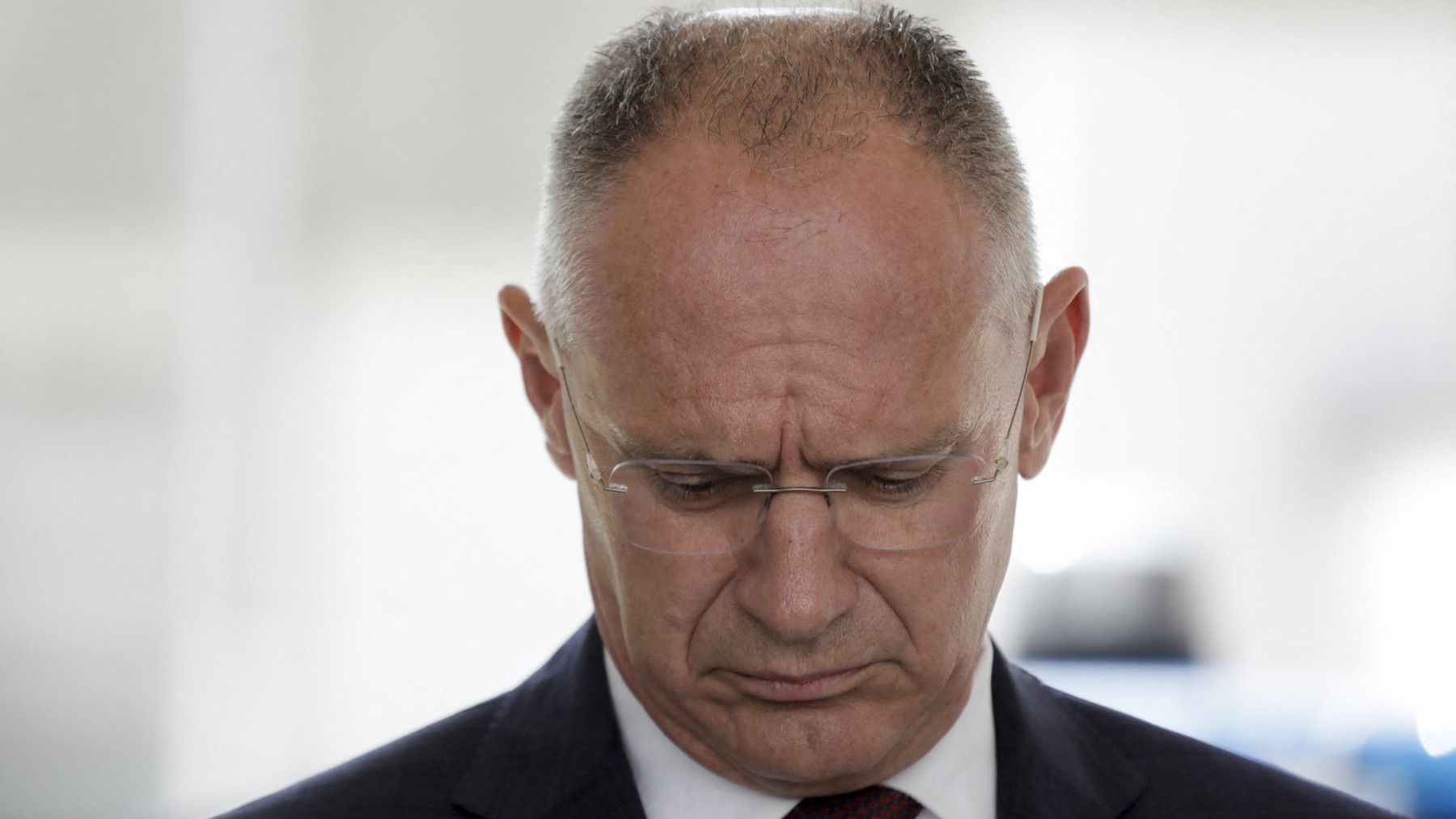
Austrian Interior minister Gerhard Karner attends a press conference near a school where several people died in a shooting, on June 10, 2025 in Graz, southeastern Austria.
ALEX HALADA / AFP
With the fall of the Assad regime and the end of the Syrian civil war in December 2024, Syrian refugees have lost their legal basis for asylum and, therefore, their formal right to stay in Europe. In practice, however, most European countries have still not begun deporting them, and many of them don’t even want to.
Among them is Austria, where Interior Minister Gerhard Karner (ÖVP/EPP) recently declared that large-scale remigration—a consistent demand of the national conservative FPÖ (PfE), Austria’s largest party—is unrealistic.
According to Karner, returning Austria’s 100,000-strong Syrian migrant community “is neither realistic nor reasonable, because I wonder how many hospitals would still be cleaned.”
Of course, this age-old argument about migrant labor is not only condescending to foreigners but can also be easily defeated by official statistics: only about 25% of Syrian refugees in Austria are employed, with full-time employment estimated to be as low as 15%.
Still, the minister believes it would be a mistake to let them go, arguing that employment can still be increased, despite most of them living in the country for a decade. “A large proportion are willing to integrate and work,” Kramer said. “They are a valuable part of society; this must not be denied.”
So instead of large-scale remigration—which voters have clearly demanded by backing FPÖ in the last election—the ÖVP-led government is only willing to deport convicted criminals as well as continue its underperforming voluntary return scheme.
Since the end of the civil war in 2024, only about 2,000 Syrians have left Austria—2% of the total Syrian refugee population. About 1,500 of them did so after accepting the government’s €1000 return incentive, costing the taxpayers €1.5 million so far.
Interest in voluntary return has also slowed down significantly since the beginning of the program. In the first quarter of 2026, only 270 people left the country—prompting renewed calls from citizens and the FPÖ for large-scale action, which the government continues to resist.
The national conservative FPÖ’s popularity keeps hitting new records, while all three parties of the ruling coalition have been losing support since the 2024 election. FPÖ currently stands at 37%, well ahead of the ÖVP (20%), the socialist SPÖ (17%), and their liberal coalition partner, NEOS (8%).