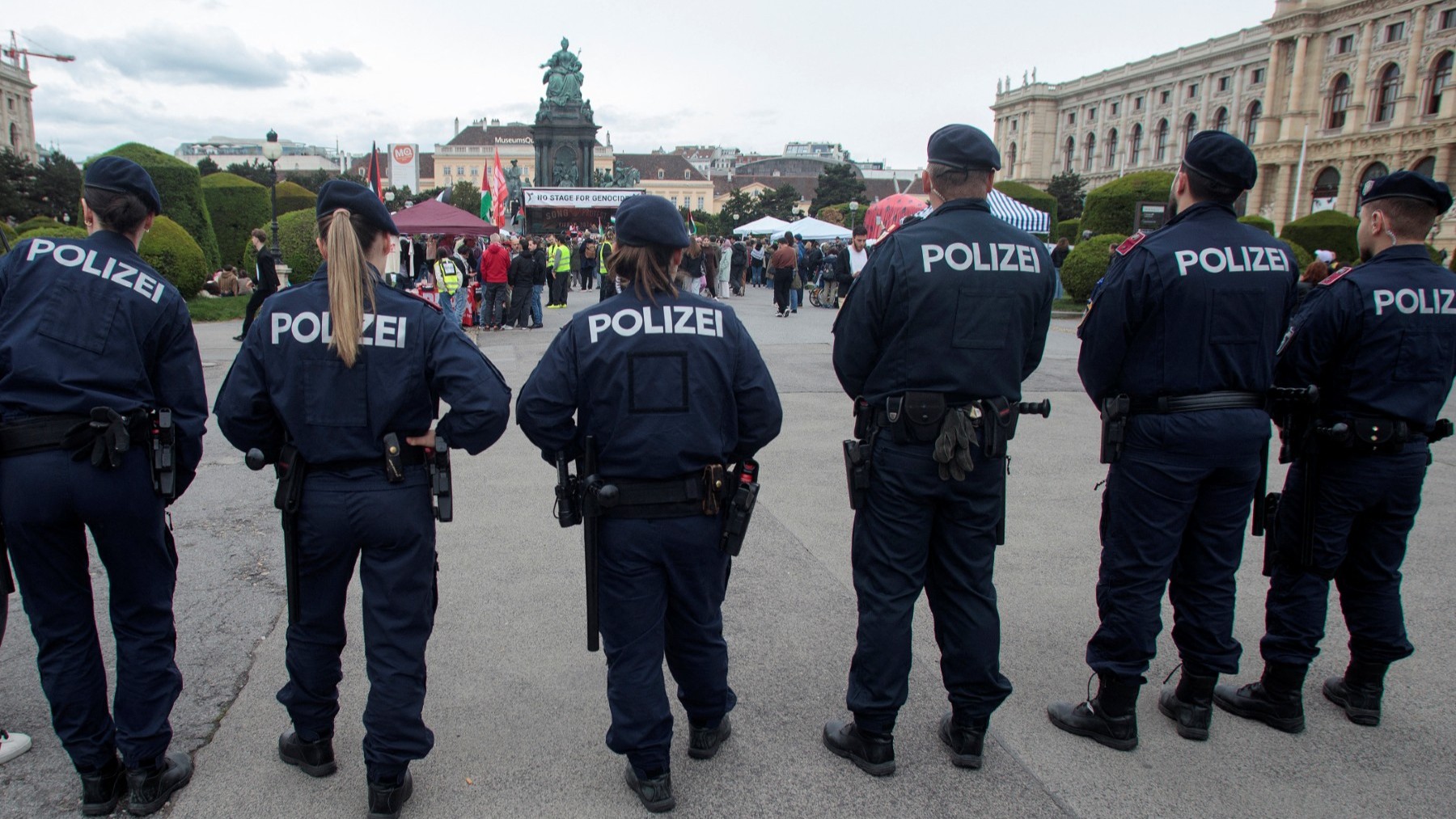
Police officers patrol on the sidelines of a pro-Palestinian demonstration under the motto ‘Song Protest Vienna 2026 – No Stage for Genocide’ against Israel’s participation in the Eurovision Song Contest (ESC), in Vienna, Austria, on May 15, 2026.
ALEX HALADA / AFP
Forty-eight police officers from Austria’s federal states are to be deployed to Vienna for up to three months from September, as authorities respond to growing concerns over migrant youth crime and violence in the capital.
The reinforcements will support Vienna’s police, particularly during night-time operations and in areas identified as crime hotspots. Six officers will come from Carinthia, while others will be drawn from Salzburg, Styria, Lower Austria, Upper Austria, and Burgenland.
The deployment follows daily temporary assignments of officers from outside Vienna, which have been taking place since August. The interior ministry said the measure was designed to strengthen police operations during the summer, when more people spend time in public spaces at night.
According to an operational order seen by Austrian media, particular attention will be given to parks in Vienna’s Favoriten district, where police have reported problems involving migrant youth groups, including rivalries, territorial disputes, and knife attacks. The document also refers to increased levels of violence, robbery, property crime, and drug-related offences.
Federal Police Director Michael Takács said the system allowed officers to be moved rapidly to areas experiencing temporary pressure.
The scale of the deployment has prompted criticism from the opposition right-wing Freedom Party (FPÖ). The party accused the city and federal government of failing to provide adequate security, and argued that taking officers from other states risked creating security gaps elsewhere.
According to FPÖ MP Reinhold Maier:
Our police officers are being used as stopgaps for the failed open-door policy of the establishment parties. Officers are now being made to pay the price for what the establishment parties have caused through open borders and a completely out-of-touch soft-touch justice system.
The concerns come amid a rise in juvenile suspects. Interior ministry crime statistics show that the number of suspected offenders aged between 10 and 14 increased from around 5,150 in 2015 to 12,049 in 2024. In Vienna, police recorded 5,983 suspects aged 10 to 14 in 2025.
As we recently reported, Vienna’s district leaders have voiced their concerns over repeated fights, robberies, vandalism, and assaults, with children under the age of 14 becoming involved in criminal activity more frequently.
FPÖ politicians have cited around twenty break-ins in recent weeks.
The party has renewed its call for Austria to lower the age of criminal responsibility, while Justice Minister Anna Sporrer of the Social Democrats has continued to favour educational measures.