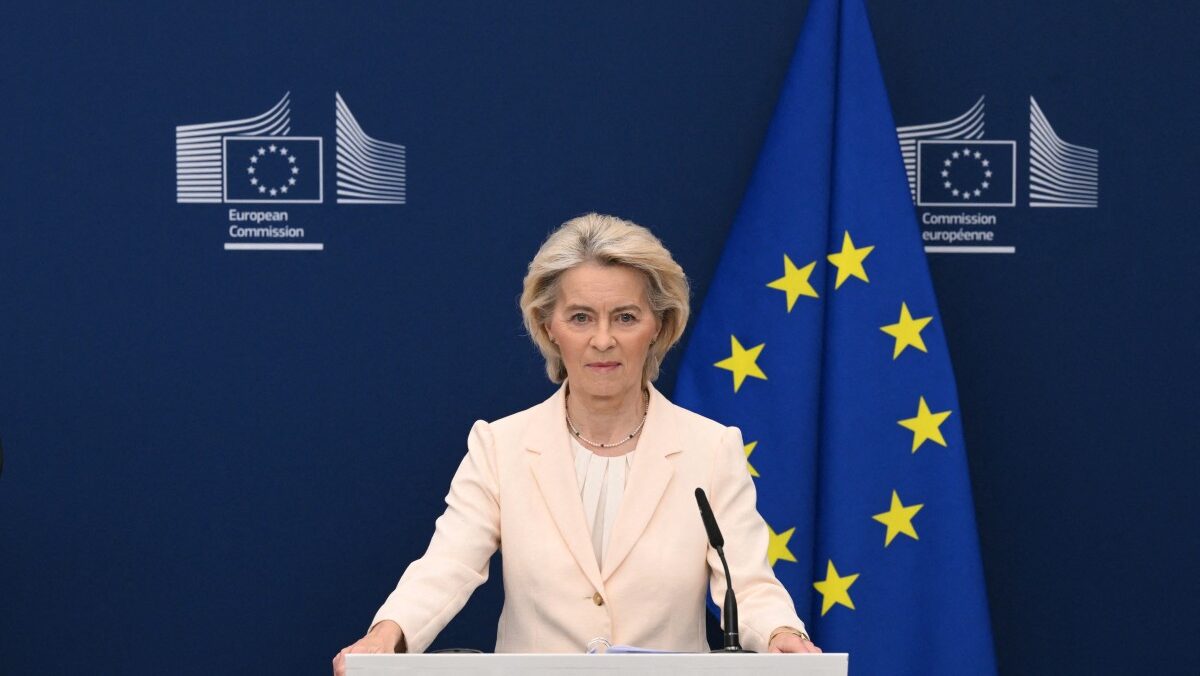
European Commission president Ursula von der Leyen
NICOLAS TUCAT / AFP
The European Commission presented its new strategy, “ProtectEU: Agenda to prevent and counter terrorism,” an ambitious document that seeks to update the Union’s response to an evolving threat environment.
On paper, the initiative aims to anticipate risks, prevent radicalisation, and strengthen police and judicial cooperation. In practice, however, it seeks to broaden the concept of “terrorism” and “violent extremism” to such an extent that it ultimately encompasses increasingly diffuse political and cultural categories (and is convenient for those in power).
The result is a framework in which the boundary between criminal violence and ideological dissent becomes dangerously blurred.
The document itself acknowledges that, although jihadist terrorism remains “the most prominent and lethal threat,” terrorist actors are driven by a “growing range of motivations,” including the “rejection of European democratic values,” antisemitism, anti-Muslim hatred and, among others, “anti-LGBTQ+ hatred,” misogyny, racism, “anti-system ideologies,” or even “nihilism.”
The additional problem is no longer only what they call combating crimes “motivated by hatred or violence”—something already codified in most national legal systems, albeit in an imprecise manner—but integrating this open-ended catalogue of motivations into the strategic umbrella of counterterrorism policy.
In other words, terrorism ceases to be defined primarily by the use of violence for political purposes and instead becomes a flexible category that can include cultural attitudes, moral positions, or criticism of the European institutional order.
Who defines those values, and what happens when a legitimate political force questions certain policies coming from Brussels?
The proposal insists that actions will be carried out with respect for fundamental rights. However, the institutional design it proposes—strengthening Europol, expanding data sharing, increasing digital surveillance, and cooperating with online platforms to detect “radicalising” content—creates an ecosystem in which the administrative interpretation of what constitutes “extremism” gains decisive weight.
The text explicitly mentions cooperation to improve AI-assisted detection of “extremist and radicalisation” content, as well as a possible revision of the Regulation on Terrorist Content Online. It also envisages “harmonising” definitions of “hate crimes” in the digital sphere.
In that context, the category of “anti-system ideologies” or “nihilism” is far from trivial. In an increasingly heated political climate, Eurosceptic movements, sovereigntist parties, or voices critical of the dominant progressive cultural and political agenda could find themselves subject to enhanced scrutiny simply for their frontal opposition to certain EU policies. It closely resembles what Alternative für Deutschland (AfD) is currently experiencing in Germany.
It is worth noting that, while the document recognises that jihadist terrorism remains the most lethal threat in Europe, it avoids any structural reflection on the ideological and cultural factors that fuel this phenomenon on European soil.
There is talk of “anti-Muslim hatred,” of protecting religious communities, and of combating Islamophobia—legitimate objectives in a plural society—but there is no equivalent debate on political Islamism, the influence of transnational networks, or the integration challenges that have been highlighted after attacks in cities such as Paris, Brussels, or Vienna over the past decade.
Instead, the conceptual expansion toward categories such as “misogyny” or “rejection of European values” implies that everything can be radicalisation—except questioning the ideological dynamics that have been behind the bloodiest attacks on European territory.
The risk is twofold: on the one hand, trivialising the term “terrorism” to the point of emptying it of operational meaning; on the other, making an honest analysis of the most serious threats more difficult.
If everything is terrorism, nothing is.