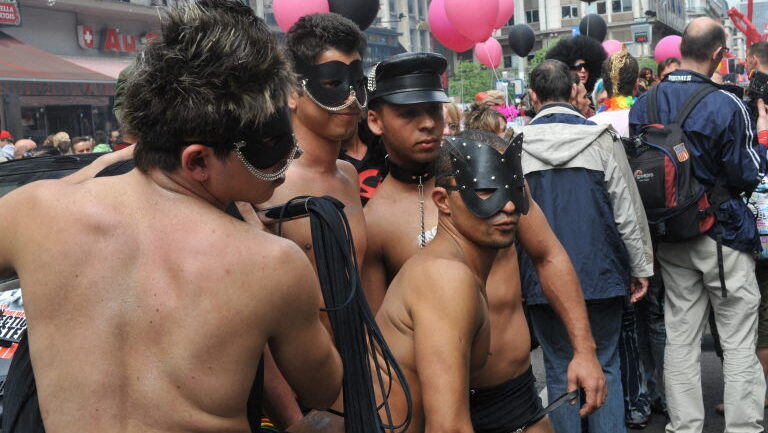
People march during the gay pride parade on May 17, 2008 in the centre of Brussels.
DOMINIQUE FAGET / AFP
The European Union’s top court has ruled that Hungary’s 2021 child protection law violates EU law in a decision that appears driven more by ideology than by legal reasoning.
On Tuesday, April 21st, just days after Hungary’s national elections, the European Court of Justice (ECJ) delivered its judgment in a case brought by the European Commission, supported by 16 member states and the European Parliament.
The court found that Hungary’s legislation—originally introduced to strengthen penalties against paedophilia but later amended to restrict the promotion of homosexuality and gender ideology to minors—violates EU rules on multiple fronts, including fundamental rights and internal market provisions.
The ECJ declared that the law infringes Article 2 of the Treaty on European Union, which enshrines the bloc’s core values such as human dignity, equality, and respect for minority rights. The court argued that Hungary’s measures were “contrary to the very identity of the Union” and rejected Budapest’s attempt to justify them on grounds of national identity.
The ruling represents a significant overreach by EU institutions into the domestic affairs of a sovereign member state. Hungarian officials and conservative commentators have long maintained that the law is about protecting children and preserving parental rights in education rather than discriminating against adults based on sexual orientation.
“The issue is not about adults in relation to gender, but about children, about who is given authority in sex education: schools or parents,” Prime Minister Viktor Orbán explained back in 2022.
The timing of the judgment can also be called into question. Had the decision been announced before, and not after the April 12 Hungarian elections, it could have boosted support for outgoing Prime Minister Viktor Orbán and his Fidesz party, which lost to the pro-Brussels Tisza Party.
Hungary remains a socially conservative country, where scepticism towards gender ideology extends well beyond the government’s traditional voter base.
Balázs Orbán, the prime minister’s political director, reacted sharply, describing the decision as evidence that “Brussels has shifted toward a woke ideological framework.” He argued that the ruling undermines parents’ rights to determine their children’s upbringing and raises serious questions about the EU’s role in sensitive cultural matters.
BRUSSELS RULES AGAINST LIMITS ON GENDER PROPAGANDA‼️
— Balázs Orbán (@BalazsOrban_HU) April 21, 2026
One and a half weeks after the elections, the Court of the European Union has struck down Hungary’s child protection law.
According to the Brussels court, the spread of gender-related content in media and advertising cannot… https://t.co/m7zrBpKLdG pic.twitter.com/m7fDdak1fg
Rodrigo Ballester, head of the Center for European Studies at the Mathias Corvinus Collegium in Budapest, commented: “Today, the EU officially became a liberal autocracy.”
The case has long been seen as a test of the balance of power between Brussels and member states. The ruling sets a precedent for ideological interference, potentially limiting the ability of national governments to legislate on education, family policy, and child protection.
The European courts are playing a decisive role in driving the EU’s progressive agenda. Issues such as gender identity and same-sex marriage are increasingly being decided by judges in Luxembourg rather than by elected national parliaments.Hungary’s newly elected parliament, led by incoming centrist-liberal Prime Minister Péter Magyar, will now face pressure to amend or repeal the contested provisions. While Magyar has signalled a more pro-Brussels and pro-LGBT stance than his predecessor, his exact position on the law remains unclear.