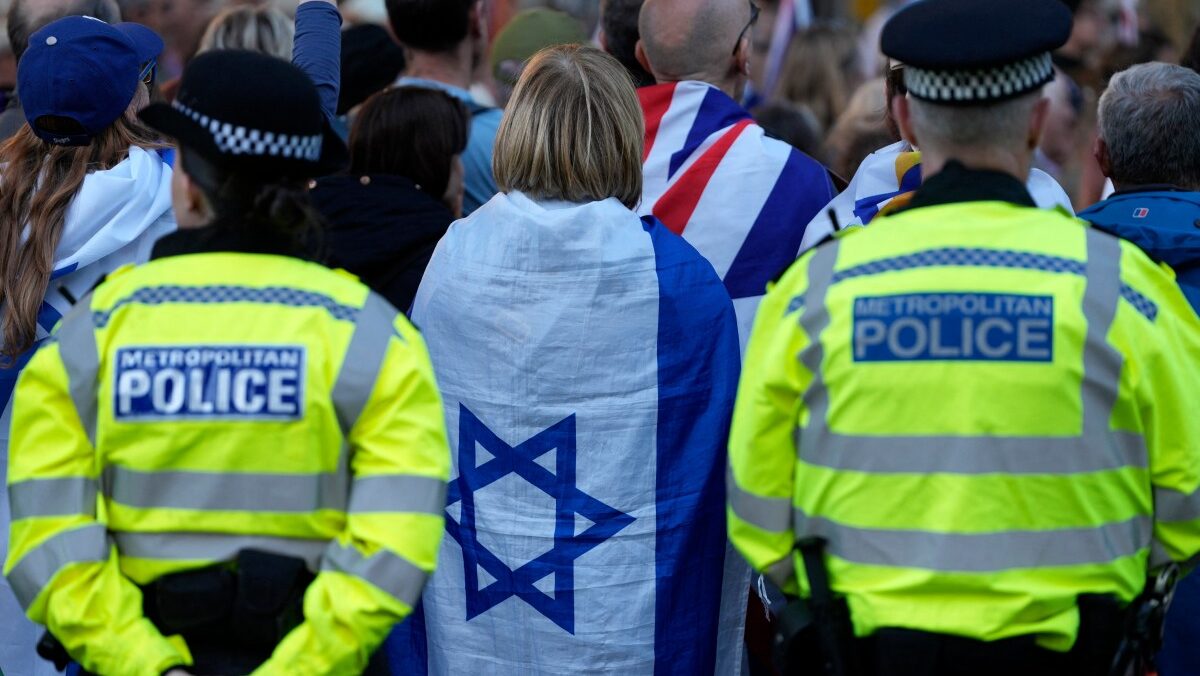
Metropolitan Police officers stand on duty as people attend a rally organised by the Campaign Against Antisemitism, opposite Downing Street in central London on April 30, 2026, following the stabbing of two Jewish men the day before in the Golders Green neighbourhood of north London.
CARLOS JASSO / AFP
European intelligence agencies are investigating a growing wave of attacks on Jewish and Israeli-linked sites believed to be connected to a shadowy organisation known as Harakat Ashab al-Yamin al-Islamiya (HAYI), which security officials suspect may operate as a proxy for Iran’s Islamic Revolutionary Guard Corps (IRGC).
The group, which emerged shortly after the start of the Iran war in late February, has claimed responsibility for a series of low-level attacks across at least seven European countries, including Britain, Belgium, Germany, France, and the Netherlands.
The incidents have largely involved arson, vandalism, and small improvised explosive devices targeting synagogues, Jewish charities, and Iranian opposition organisations.
Counter-terrorism police in London on Sunday, May 10th, arrested a 45-year-old man and a 52-year-old woman on suspicion of conspiracy to commit arson after a fire at a former synagogue in Whitechapel, east London.
The blaze caused minor damage to gates and a lock at the building, which has not functioned as a synagogue for several years. Officers believe the fire was started deliberately.
The attack is the latest in a series of incidents that have heightened fears among European security services.
British police say they are conducting their largest-ever community protection operation following multiple arson attacks in north London and the stabbing of two Jewish men in Golders Green in April.
HAYI claimed responsibility for the Golders Green attack, although investigators have cautioned that no conclusive evidence has yet linked the suspect directly to the organisation.
The arrested man, Somali-born British citizen Essa Suleiman, reportedly has a history of violent offences and mental health issues. “This fits the profile of a lone or opportunistic actor far better than HAYI’s pattern of low-effort harassment and arson,” according to The Washington Institute for Near East Policy.
Analysts believe HAYI represents a new form of ‘gig economy’ terrorism—rather than relying on trained operatives, the network is said to recruit young local offenders with petty criminal backgrounds through encrypted messaging platforms such as Telegram and Snapchat, offering modest sums of money to carry out simple acts of intimidation and violence.
German and Dutch intelligence services have traced the group’s propaganda distribution to channels associated with pro-Iranian militias and Tehran’s “axis of resistance.”
Experts say the network’s visual branding and messaging closely resemble those of Hezbollah and Iraqi Shia militias backed by Tehran.
Authorities across Europe have made at least 44 arrests linked to HAYI-related incidents, many involving teenagers and young adults.
Security officials warn that while most attacks so far have caused limited physical damage, the campaign appears designed to spread fear, inflame communal tensions, and stretch counter-terrorism resources across multiple countries.