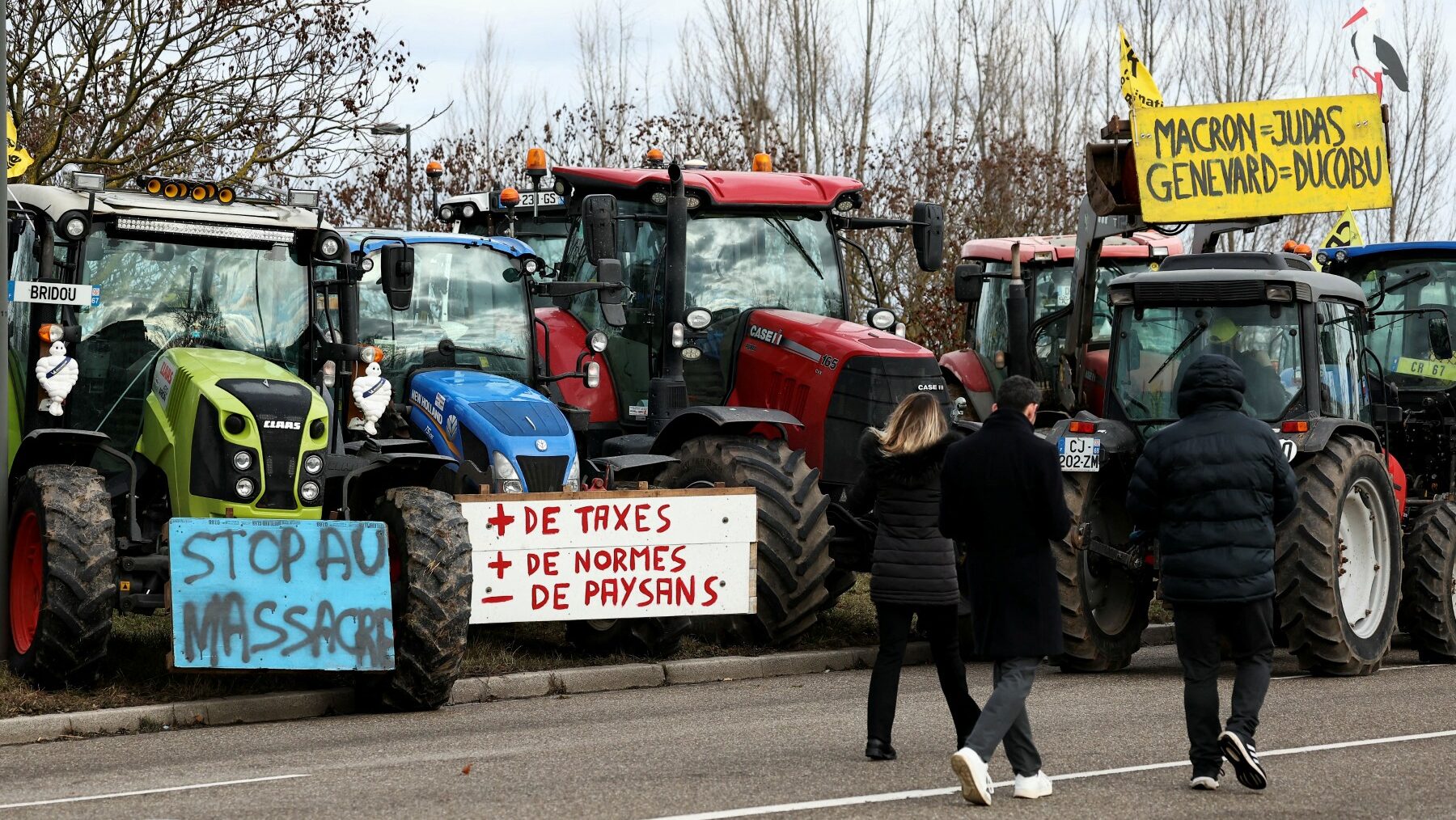
Farmers of the Coordination Rurale (CR) farmers union take part in a demonstration to push French government to block the Mercosur trade deal at the Pont de l’Europe (Europe bridge) in Strasbourg, eastern France on January 9, 2026.
FREDERICK FLORIN / AFP
The negotiation of the next European budget has already opened one of the most sensitive fractures within the European Union: who pays, who wins, and who absorbs the costs of the Community economic model.
The clash became visible again this week during talks on the 2028-2034 Multiannual Financial Framework (MFF), where Germany, the Netherlands, Austria, and several Nordic countries called for cuts to two of the EU’s historically most important policies: the Common Agricultural Policy (CAP) and Cohesion funds.
The position of the so-called frugal bloc is not new. In their eyes, the European budget is already too high, common debt must not be increased, and resources should be directed towards new priorities such as defence, innovation, competitiveness, or security. Berlin considers the budgetary increase proposed by the Commission to be “disproportionate,” while the Netherlands insists that “significant” cuts are necessary.
Beyond the arguments, the debate is more complex than a simple accounting discussion.
Many of the countries that now question the CAP and Cohesion are also among the main structural beneficiaries of the trade model that Brussels has been building for years. The extensive network of European trade agreements with Canada, South Korea, Japan, Chile, Mexico, and the recently unblocked agreement with Mercosur has particularly strengthened industrial and export sectors where Germany, the Netherlands, Sweden, Denmark, and Austria hold clear comparative advantages.
The German automotive industry, industrial machinery, chemicals, Dutch logistics, and the manufacturing chains of northern Europe have found in trade openness a market multiplier. The same does not apply to much of southern and eastern Europe, where the weight of agriculture, agro-industry, or less industrialised regional economies remains far greater.
And it is in that difference that the conflict arises.
While trade agreements expand markets and opportunities for industrial and export-oriented Europe, the sectors most exposed to external competition tend to be concentrated precisely in those countries that depend to a greater extent on the CAP and Cohesion as compensatory mechanisms.
Spain, Italy, Portugal, Poland, and other countries grouped under the ‘Friends of Cohesion’ platform have reacted on the basis of that fact. The group calls for strengthening agricultural and regional budget lines and opposes the adjustments proposed by Brussels.
They argue that if the overall budget increases, it is difficult to justify that the policies aimed at balancing territorial differences are the only ones to lose weight. Several governments also maintain that cohesion and competitiveness are not competing priorities, but complementary elements.
The European Parliament also does not appear to be aligned with the cuts. The European chamber has already expressed reservations about the planned reductions to the CAP and Cohesion and also questions the growing budgetary centralisation being driven by the Commission.
The underlying discussion is not only about agricultural budget lines. What is really being negotiated is the European economic model for the next decade. For years, Brussels defended a relatively stable balance: trade openness, the single market, and territorial redistribution through the CAP and Cohesion.
The problem is that new priorities—defence, reindustrialisation, energy transition or security—are beginning to compete for the same resources.