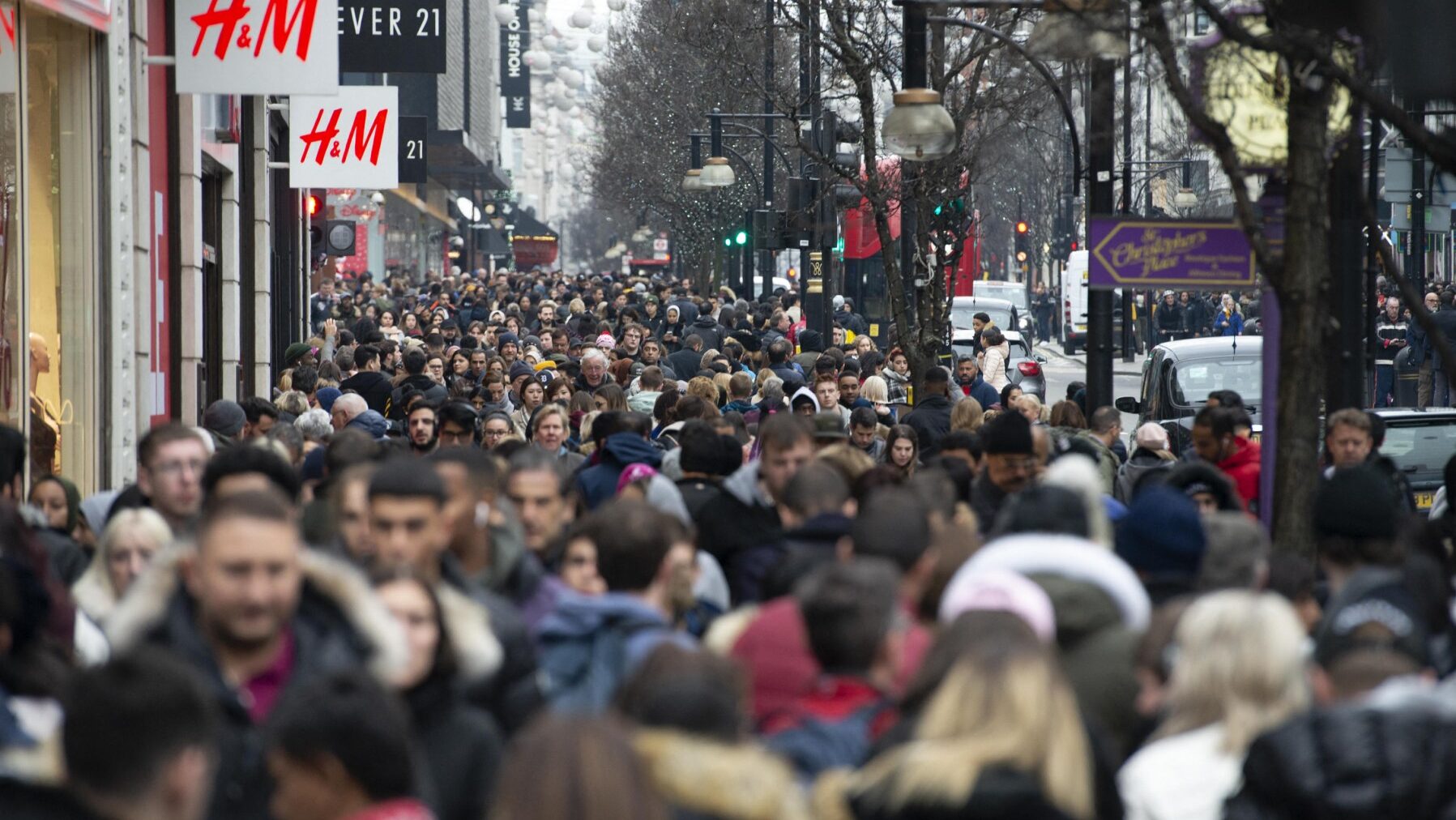
A crowded London street
Niklas HALLE’N / AFP
Migration accounted for 211,700 of the 224,900 people added to the population of England and Wales in the year to mid-2025—almost 95% of the total increase.
Bombshell figures from the Office for National Statistics (ONS) show that the combined population hit a record 62 million, rising by 224,900 in just one year.
Net international migration added 211,700 people, while the excess of births over deaths accounted for just 19,600.
A total of 816,500 people arrived from abroad during the year, compared with 604,800 who left. Although net migration fell sharply from 612,500 the previous year, it still dwarfed every other source of population growth.
Political analyst Matt Goodwin said the figures showed that Britain had entered an “entirely new demographic era,” with rapid change now remaking towns and smaller cities as well as London.
Migration has been the leading driver of population growth since 1999. Before then, the population largely expanded because more people were born than died, according to the ONS.
Goodwin’s analysis found that more than 130 council areas gained at least 1,000 residents in the year to mid-2025. Fifteen grew by more than 3,000.
In nearly a quarter of those areas, migration accounted for at least half of the increase.
And in 11 areas, it accounted for more than 100%—meaning arrivals more than replaced residents lost through deaths or people moving elsewhere.
In Wolverhampton, net migration was equivalent to a staggering 429% of the city’s overall population growth. The figure reached 322% in Bristol, 281% in Slough, 225% in Derby, 208% in Reading and 177% in Bolton.
The same dramatic pattern can be seen over the longer term.
Between 2020 and 2025, the populations of 110 council areas surged by at least 10,000. Migration accounted for at least half of the growth in 53 of them.
Milton Keynes gained more than 25,000 people in five years, with migration responsible for 60% of the increase.
Coventry grew by more than 20,000, while migration was equivalent to 280% of its total population growth.
Across roughly 100 areas—including Cardiff, Guildford, Oldham, Walsall, Swansea, Barnet and Stevenage—migration accounted for more than 100% of the increase.
The figures suggest that Britain’s demographic upheaval is no longer confined to London and a handful of major cities. It is now reaching communities across England and Wales, putting growing pressure on housing, schools, transport, and public services.
The overall population rise has slowed, however. Growth fell to 0.4% in the latest year—the lowest rate since 2020—following three years of unusually rapid expansion.
Wales suffered its first population decline in a decade, while London’s population also fell as people leaving for other parts of Britain outnumbered gains from immigration and births.
The ONS cautioned that its estimates are subject to uncertainty, particularly at council level, and could be revised as its migration data and methods improve.