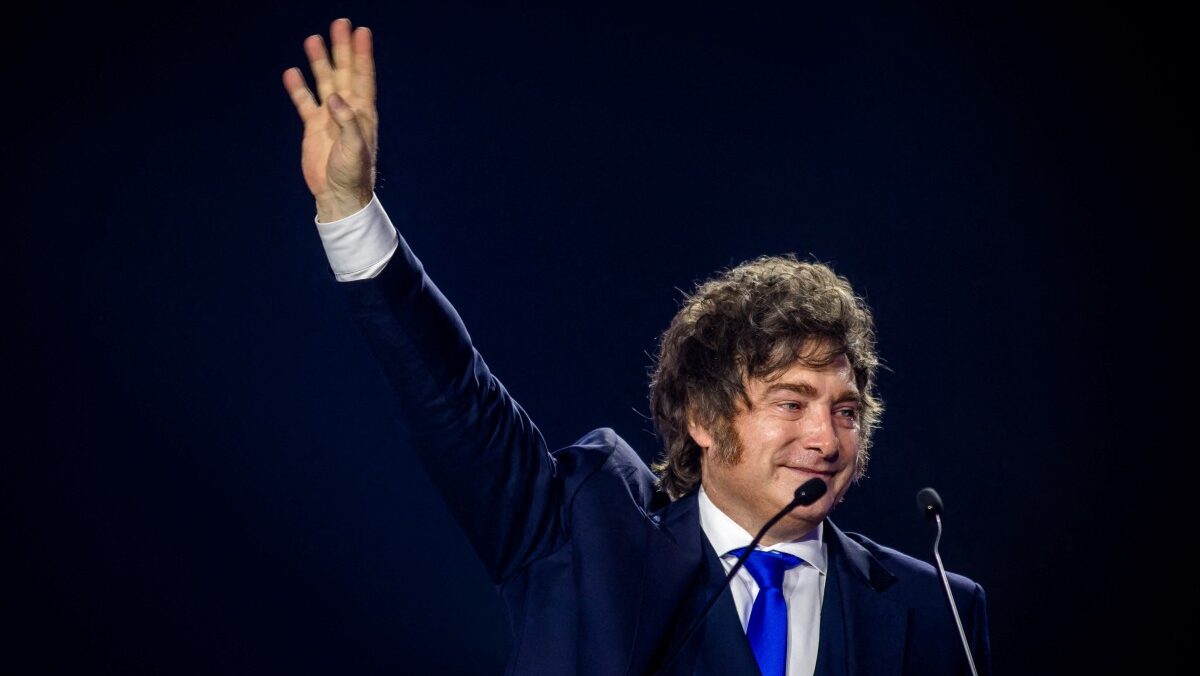
Javier Milei speaks at CPAC Hungary
Gergely BESENYEI / AFP
The afternoon session of CPAC Hungary made one thing clear: the Budapest gathering is no longer just a meeting of like-minded conservatives, but an emerging coordination hub for parties preparing to challenge Brussels in an increasingly tense European political climate.
Speaker after speaker delivered the same blunt message: power in the European Union is shifting away from nation-states and into central institutions, with growing consequences for sovereignty, energy policy, and democratic control.
Immigration, censorship, energy, and the war in Ukraine were framed not as separate issues, but as fronts in a single political struggle shaping Europe’s future. Hungary was repeatedly presented as proof that resisting that trajectory remains possible.
“In Hungary, much more than Hungary’s sovereignty is at stake,” warned Santiago Abascal, who described the country as “the most important bastion in defense of European identity and Western civilization.”
The VOX leader argued that the Budapest meeting showed an international alliance already taking shape—one uniting European parties, American figures, and governments around a shared political vision. He said European politics can no longer be understood at the national level alone, criticising the Spanish government for placing the country “on the opposite side of the Western world.”
“We believe we must redouble our efforts with our patriotic allies,” Abascal said, presenting gatherings like CPAC as evidence that an organised alternative is emerging.
That shift beyond traditional Left-Right divisions was echoed across the session. Vlaams Belang president Tom Van Grieken framed the central question as who decides a nation’s future: its citizens or European institutions.
Dutch leader Geert Wilders struck a similar tone, warning that Europe faces “mass immigration, woke ideology and Euro-federalism,” and arguing that his generation must defend “our nations, our families and our civilization” against policies imposed without public backing.
Several speakers also criticised new EU rules on online content, warning that measures such as the Digital Services Act risk restricting political debate. They linked free speech directly to sovereignty, arguing that decisions made in Brussels are increasingly shaping domestic political life.
Hungary remained central to that argument. Balázs Orbán, adviser to the prime minister, said the Hungarian model shows it is possible to defend national interests within the EU without accepting deeper integration. The real problem, he argued, is not Europe itself, but a system in which central authorities override national decision-making.
Alice Weidel also focused on the nation-state as the foundation of political freedom. She accused European elites of using immigration, climate policy, and economic regulation to expand their power, and said rising support for patriotic parties reflects growing public resistance to the EU’s direction.
One of the most anticipated interventions came from Argentine president Javier Milei, who framed current politics as part of a broader ideological struggle. He argued that the conflict is not only economic but cultural, and that the rise of conservative movements reflects a backlash against decades of collectivist policies.
Events such as CPAC, Milei said, help sustain an international network built around the “ideas of freedom,” extending from domestic policy to foreign affairs.
Despite national differences, the message across the session was strikingly consistent: Western politics is entering a phase of realignment, and conservative parties must coordinate if they want to shape decisions in Brussels, national capitals, and the European Parliament.
What emerged in Budapest was not a formal alliance, but something close—a loose but increasingly self-aware bloc of sovereignist forces, now moving beyond shared rhetoric toward coordinated political action.