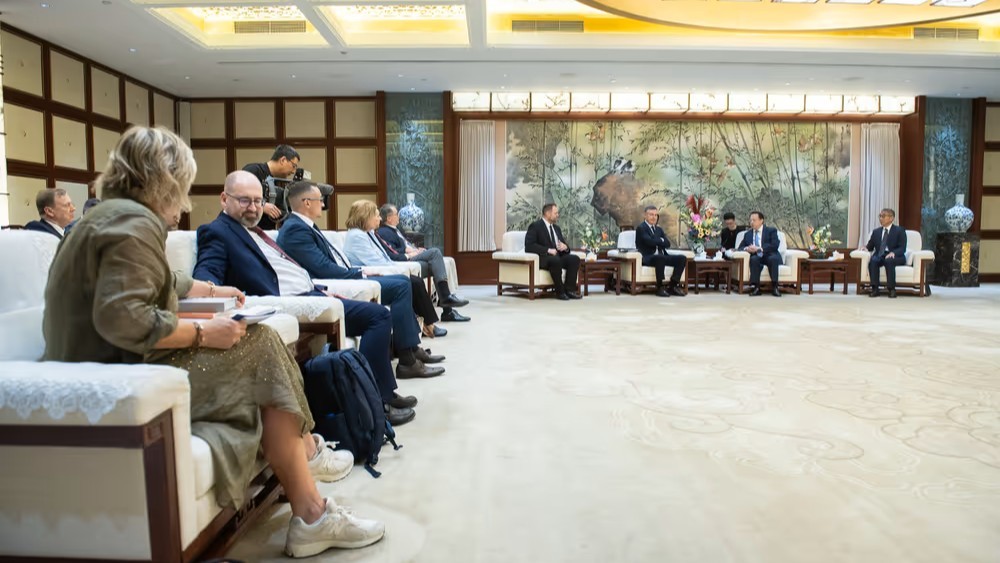
AFET Committee visit to Beijing and Shanghai, China
© European Union 2026 – Source : EP
A European Parliament delegation has told China that relations with the European Union cannot fully return to normal unless Beijing uses its influence to compel Moscow to move towards ending the war in Ukraine.
The message was delivered during a visit to Beijing and Shanghai between July 21st and 23rd by eight members of the Parliament’s Foreign Affairs Committee. The official agenda included the trade imbalance, human rights, Indo-Pacific security, and the war, but the latter ultimately became a political condition for any bilateral thaw.
Nicolás Pascual de la Parte, from the European People’s Party, said Chinese pressure on Vladimir Putin was a “precondition for normalizing relations.” Javi López, from the Socialist group, likewise called on Beijing to assume the responsibilities expected of a power holding a permanent seat on the United Nations Security Council.
The formula is not blackmail in the strict legal sense, but its political logic comes close: Brussels is offering diplomatic and economic relaxation in exchange for China forcing a change in Russia’s strategic calculations. Should Beijing maintain its position of equidistance, Pascual de la Parte warned, the EU will regard it as a hostile stance towards Europe.
As expected, Beijing has rejected that framework. Foreign Minister Wang Yi reminded the MEPs that China and Europe should treat each other as partners and urged them not to allow specific disputes to undermine the relationship as a whole. China continues to present itself as an actor outside the conflict and as a supporter of a negotiated settlement.
European pressure also exposes a less frequently acknowledged weakness. After more than four years of war, Brussels needs an external power to persuade Moscow to make concessions that Ukraine and its allies have failed to impose on the battlefield.
The search for Chinese leverage does not, in itself, prove a Ukrainian defeat, but it does contradict the narrative that time is working unequivocally against Russia. Talks remain deadlocked, while the EU itself is debating how to recover a diplomatic role amid the stalemate.
China continues to maintain a strategic partnership with Moscow and has no clear incentive to rescue Europe’s position. Expecting Beijing to surrender those advantages in exchange for a vague diplomatic “normalization” looks more like an expression of necessity than a strategy of power.
Brussels wants to turn political and commercial access to Europe into leverage over Ukraine. Whether it still retains enough influence to make Beijing pay the price remains to be seen. It is difficult to bet on Brussels prevailing in this contest.