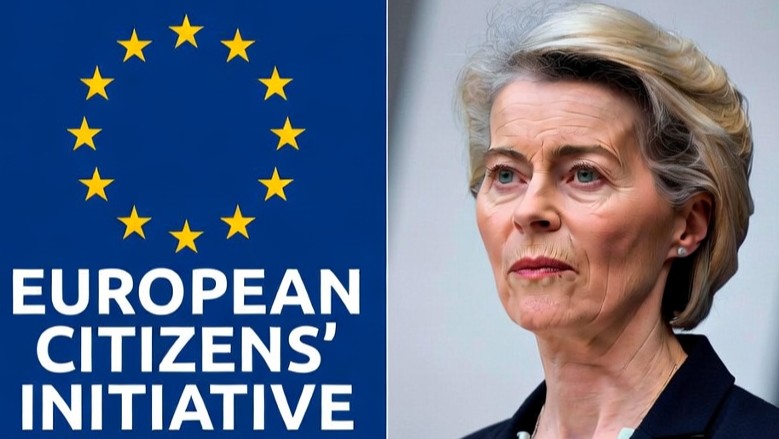
Grok / europeanconservative.com
The European Commission has recently celebrated the 15th anniversary of the European Citizens’ Initiative (ECI), presented in 2012 as the “great instrument of participatory democracy” of the Union. Over these fifteen years, 127 initiatives have been registered, a figure Brussels showcases as proof of civic vitality and citizen engagement.
127 initiatives. 15 years. One powerful EU tool.
— EU Justice (@EU_Justice) February 16, 2026
Since the European Citizens’ Initiative was established, citizens have had a formal way to put issues directly on the EU agenda.
Will you take the initiative?
🔗https://t.co/h1VYBxfFV3#EUTakeTheInitiative pic.twitter.com/S7cvCGfcAz
Officially, the ECI is the only mechanism that allows citizens to formally request that the Commission propose legislation in areas within its competence. The problem is that it is designed in such a way as to make it hard to use and to hardly ever yield tangible results.
The key requirement is to reach at least one million valid signatures from EU citizens. But it is not enough to accumulate total support. The initiative must also surpass a minimum threshold in at least seven member states (one quarter of the current 27), in accordance with Regulation (EU) 2019/788.
The system thus introduces a double filter: total volume and geographical dispersion.
The national threshold is calculated according to the number of members of the European Parliament (MEPs) elected in each member state. Since 2020, the links the required minimum to the number of national seats multiplied by the total number of MEPs in the current legislature. In the present term, with 720 MEPs, the national minimum numbers have been adjusted upwards as of July 2024.
Even after meeting all formal requirements, the Commission is not legally obliged to propose legislation. It is merely “invited” to do so. The final decision remains political. Anyone surprised?
Since 2012, only a small fraction of registered initiatives have surpassed one million signatures and the national thresholds. The real rate of initiatives that culminate in a meaningful formal response stands at approximately 10%.
Even among those that reach the million mark, the outcome is often limited to a policy communication, a public hearing in the European Parliament, or a partial revision of existing legislation. Direct conversion into law is exceptional.
Brussels insists that the ECI serves to “set the agenda.” But fifteen years later, the question is whether it sets a citizens’ agenda or merely reinforces dynamics already present within the institutional environment.
One of the least debated aspects in official celebrations is the ecosystem surrounding many successful initiatives: a network of NGOs and associations that are favored by the European Commission. These groups, active in fields such as climate policy, gender ideology, social policies, or environmental activism, are regularly financed, through various programs, by the Commission.
Formally, they are independent organizations. But in practice, many depend heavily on European funds. These entities develop campaigns, reports, and awareness activities that shape public debate. Subsequently, they may promote an ECI aligned with that discursive framework or support proposals that the Commission itself already considers a priority.
The result is a circular process: mobilization is financed, a favorable climate is generated, an initiative is presented reflecting that ‘demand’, and it ultimately translates into regulatory proposals consistent with the Commission’s strategic agenda.
Everything unfolds before our eyes as if it were natural. Or at least that is what we are led to believe, as researcher Norman Lewis explained to this publication.
From a strictly legal standpoint, there is no irregularity. From a democratic perspective, however, the question is more delicate: is it a tool of citizen participation or a mechanism of political legitimization?
The most illustrative example of the real limits of the ECI is probably the pro-life initiative One of Us.
It gathered nearly 1.7 million verified signatures, becoming the initiative with the greatest support among those that surpassed the threshold. It achieved the national minimum numbers in numerous member states and strictly fulfilled all formal requirements.
Its objective was to strengthen the protection of the human embryo within the framework of European funding.
The Commission decided not to propose any legislation.
The decision left no room for doubt: even with nearly two million signatures and full compliance with the Regulation, the ultimate decision depends on the political criteria of the Community executive. Unlike other initiatives aligned with already existing strategic priorities such as certain campaigns on environmental or animal welfare matters—One of Us did not fit the dominant political direction.
Fifteen years later, the ECI with the greatest effective citizen backing remains also the most cited example of its limits. Citizen participation? Only when it suits Brussels.