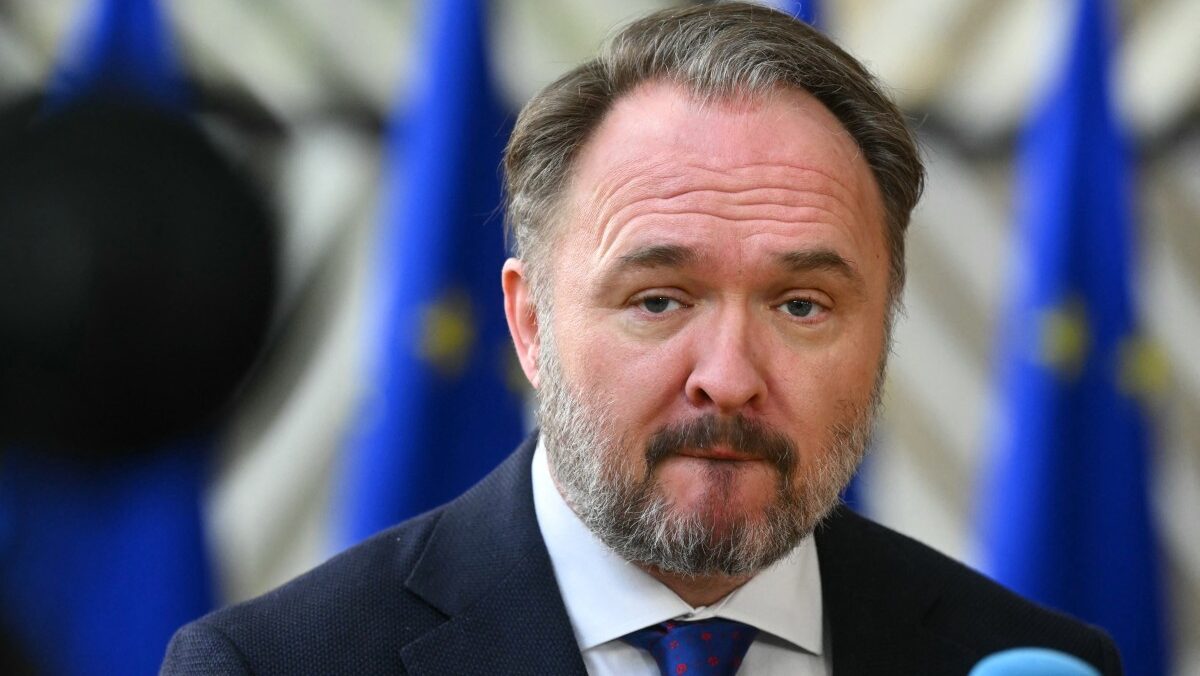
EU Commissioner for Energy and Housing Dan Jørgensen arrives for a Transport, Telecommunications and Energy Council in Brussels on March 16, 2026.Ω
NICOLAS TUCAT / AFP
Europe’s foreign ministers agree that keeping the Strait of Hormuz open is essential for the global economy, but remain unwilling to do what is necessary to secure it, exposing once again the gap between the EU’s ambitions and its capabilities.
A significant share of Europe’s oil and gas passes through the strait, so any prolonged disruption would quickly push up prices and hit industry.
Yet when ministers moved from recognising the problem to discussing solutions, divisions quickly resurfaced.
Several governments rejected the idea of expanding the EU’s naval mission or sending more ships to the region, even though the existing Aspides operation could be strengthened to improve maritime security.
Countries such as Spain, Germany, and Austria insisted on diplomacy over military action, warning of escalation at a time when the United States and Israel are already carrying out operations and Iran is responding by putting pressure on shipping.
In private, EU diplomats acknowledge that the bloc lacks both the means and the political will to take on a larger role without U.S. backing.
As a result, Europe once again finds itself in an uncomfortable position: it depends on American protection, but does not want to be involved in the decisions that come with it.
This contradiction became even clearer after direct pressure from U.S. President Donald Trump, who warned that NATO faces “a very bad future” if allies do not help secure the Strait of Hormuz.
Those who benefit from the flow of oil through the Gulf, he said, must be willing to help defend it.
Trump also revealed that he spoke personally with French President Emmanuel Macron to discuss the issue.
“I spoke with him. On a scale from zero to ten, I would say he was at eight. Not perfect, but it’s France. We don’t expect perfection,” he said at a press conference, making clear that he expects a greater commitment from the Europeans.
The U.S. president himself explained that the request also had a political component.
“I didn’t ask because we need them, but because I want to see how they react. I have been reading for years that if we ever needed them, they wouldn’t be there,” he said, recalling that he had made a similar request to the United Kingdom weeks earlier.
His remarks reflect growing distrust in Washington toward European allies. But they also highlight a deeper problem: the EU speaks more and more about “strategic autonomy,” while still not being ready to act when it matters.
That same tension was visible in the energy debate held the same day. While several governments acknowledge that the new international scenario could trigger another supply crisis, European Energy Commissioner Dan Jørgensen firmly ruled out any possibility of resuming imports of Russian hydrocarbons.
“In the European Union we have decided that we do not want to import Russian energy,” he said, assuring that the bloc will not buy “a single molecule of gas” from Russia in the future. In his view, returning to dependence on Moscow would mean repeating the mistake that allowed the Kremlin to use energy as a tool of pressure.
The problem is that this political position clashes with economic reality.
Leaders in countries such as Belgium, Slovakia, and Hungary have already suggested that, at least in the medium term, some decisions taken after the war in Ukraine may need to be reconsidered.
The European Commission, however, is sticking to its line, even though the global situation has changed significantly in recent years.
Persisting in that position, despite mounting risks, increasingly looks less like prudence than paralysis.