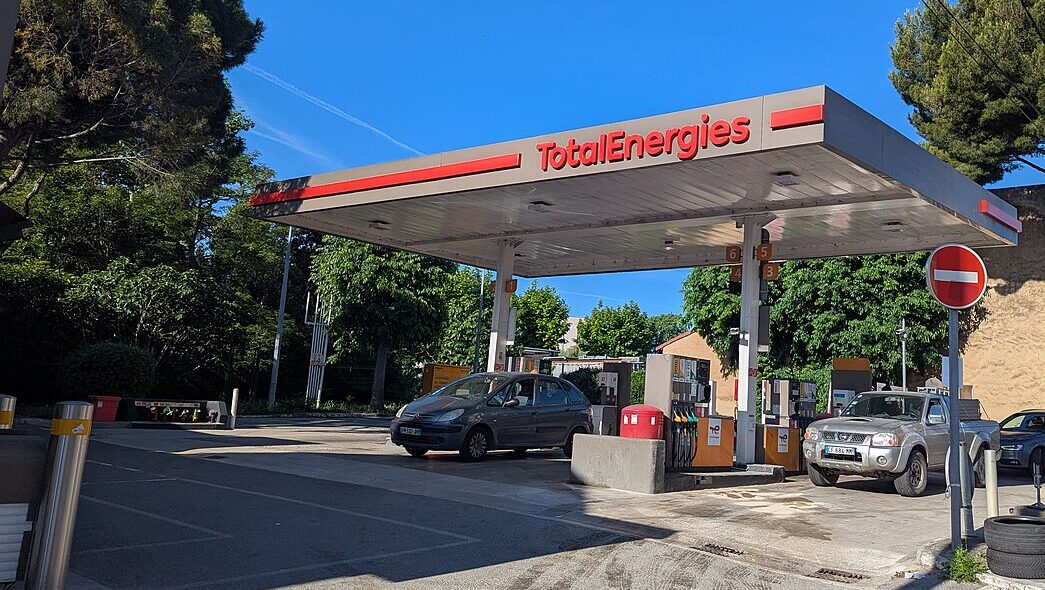
TotalEnergies petrol station in Saint-Antoine, France, May 2025
Андрей Романенко, CC BY-SA 4.0, via Wikimedia Commons
12% of French petrol stations have run out of at least one type of fuel. The French government insists there is no nationwide shortage and no supply crisis. Officials describe the problem as a series of “local and temporary logistical tensions,” concentrated mainly in the network of TotalEnergies’ service stations.
But the figure matters because of what it reveals. Europe’s new energy crisis, triggered by the war with Iran and rising tensions around the Strait of Hormuz, is no longer an abstract geopolitical risk. It is beginning to affect ordinary life.
The shortages are concentrated above all in the stations operated by TotalEnergies, France’s largest energy company. Under political pressure to help consumers, the company imposed a temporary price cap of €1.99 per litre for petrol and €2.09 for diesel until April 7.
Those prices are significantly below the French average. As a result, drivers rushed to TotalEnergies stations in unusually large numbers. Hundreds of stations began running out of fuel. According to French authorities, around 700 of the 900 affected petrol stations belong to TotalEnergies.
The French government is trying to avoid the word ‘shortage’ because it understands the political consequences. France still remembers the Yellow Vest protests of 2018, which began after an increase in fuel taxes. A rise in fuel prices has always carried a particular political risk in a country where many people depend on their cars and where living costs are already under pressure.
Paris has therefore announced targeted support measures for farmers, fishermen, and low-income households. The cost is estimated at €130 million. But the government has also made clear that there will be no large rescue package like the one introduced after Russia’s invasion of Ukraine in 2022.
That is the real difference between this crisis and the last one. Three years ago, European governments still had the fiscal room to subsidise households, cut taxes and spend heavily to soften the shock. Today most European countries enter this new crisis with higher debt, weaker public finances and inflation beginning to rise again.
France is therefore becoming the first visible sign of a wider European problem.
At the same time, five European countries—Spain, Germany, Italy, Portugal, and Austria—have asked the European Commission to create a new windfall tax on energy companies. In a letter sent to European Climate Commissioner Wopke Hoekstra, the five governments argue that the companies benefiting from higher oil and gas prices should help pay for emergency support measures.
The proposal would revive the mechanism already used in 2022 after the start of the war in Ukraine. At that time, the European Union introduced a temporary ‘solidarity contribution’ on the extraordinary profits of oil, gas and coal companies.
The political logic is simple. If the Middle East conflict pushes up prices for European consumers, governments do not want energy companies to appear as the only winners.
But the proposal has already alarmed the energy sector.
Spain’s wind energy association warned this week that a new European tax could create legal uncertainty and discourage investment at exactly the moment when Europe needs more domestic energy production. The organisation argues that Europe should be accelerating investment in renewable energy rather than changing the rules in the middle of a crisis.
Spain offers an example of that argument. Renewable energy now produces around 65% of the country’s electricity, and wind power alone accounts for more than one fifth. Because of that, Spain has been less exposed than much of Europe to the surge in gas prices.
In March, the average price of electricity in Spain was around €42 per megawatt-hour, below the price of natural gas itself. Without the contribution of renewable energy, Spanish officials estimate that electricity prices would have been more than twice as high.
This exposes a contradiction at the heart of Europe’s energy policy. Brussels says it wants more investment, more energy independence, and less reliance on imported fossil fuels. But several governments are now considering a new tax that parts of the industry believe could discourage exactly that investment.
The deeper problem is that Europe remains vulnerable to an external energy shock.
Three years after reducing its dependence on Russian gas, Europe is still heavily dependent on imported oil and on strategic routes such as the Strait of Hormuz. The supplier may have changed. The dependence has not.
If the conflict in the Middle East continues and energy prices keep rising, the debate in Brussels will quickly move beyond taxes on energy companies. The central question will become much larger: how much economic pain are Europeans willing to accept, and who will ultimately pay the price?