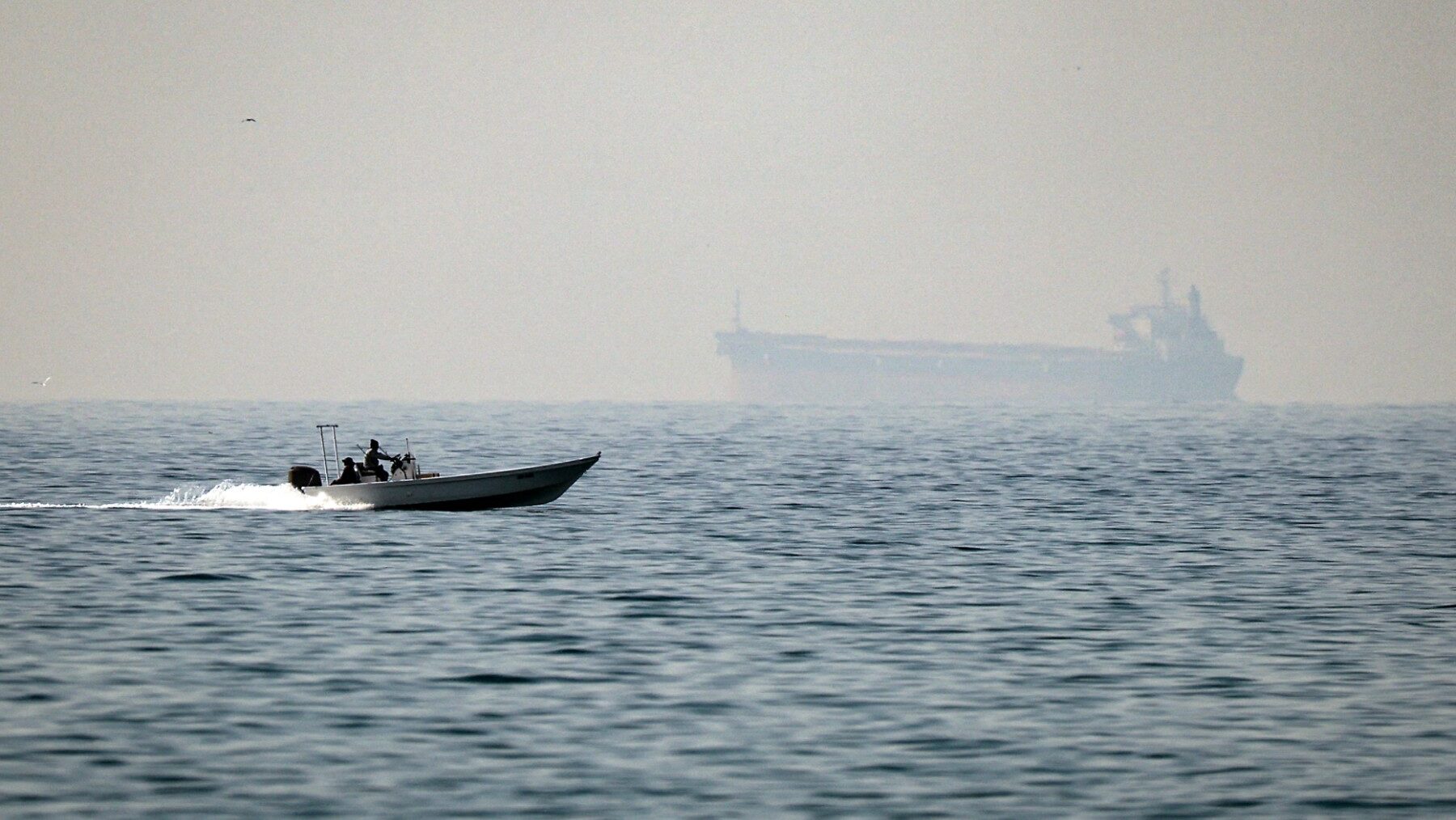
The Strait viewed from the UAE in February 2026
FADEL SENNA / AFP
Iran’s decision to fire on a tanker in the Strait of Hormuz on Saturday has jolted the Middle East back to the brink—while exposing just how fragile the supposed ceasefire between Washington and Tehran really is.
The incident itself was a blunt show of force. According to the UK Maritime Trade Operations centre, a tanker sailing about 20 nautical miles northeast of Oman was approached by two fast boats from Iran’s Islamic Revolutionary Guard Corps (IRGC). There was no radio warning. Instead, the vessels opened fire. The tanker escaped unharmed, but the signal was unmistakable: Iran is once again willing to enforce its control over the world’s most critical oil corridor at gunpoint.
That matters far beyond the region. The Strait of Hormuz is not just strategically important—it is indispensable. Roughly a fifth of the world’s oil supply normally passes through this narrow channel. When traffic there is disrupted, energy markets react, shipping costs spike, and the economic ripple effects are felt across Europe and beyond. This is one of the few places where a single flashpoint can quickly become a global problem.
What makes the latest escalation particularly striking is how quickly it followed a brief moment of apparent de-escalation. On Friday, Iran had indicated that the strait would remain open during the ceasefire. For a few hours, it looked as though tensions might ease. Then came the reversal.
The turning point was Washington. President Donald Trump made clear that the U.S. naval blockade targeting Iranian ports would remain in place until a broader agreement is secured. Tehran responded in kind: if Iranian shipping is restricted, then so too will be passage through Hormuz. In effect, both sides are now applying pressure in different ways—Washington through a blockade, Tehran through geographic leverage.
The result is a standoff with immediate consequences. Vessel-tracking data shows ships turning back rather than risk confrontation. U.S. Central Command says 23 vessels have already reversed course since the blockade began. Iranian media reports that two Indian-linked ships were forced away, including a supertanker said to be carrying two million barrels of Iraqi oil.
All of this is happening while diplomacy is still, at least on paper, alive. Talks between the United States and Iran are expected to resume on Monday. But the political messaging tells a different story. Trump has warned that if no long-term deal is reached by Wednesday, the ceasefire could collapse and airstrikes may resume.
That leaves the region in a precarious in-between state—neither full war nor genuine peace. Instead, it is a tense holding pattern in which both sides are testing limits, probing weaknesses, and raising the stakes without crossing into outright conflict.
Saturday’s gunfire in Hormuz is a reminder of how easily that balance could tip. One misstep, one miscalculation, or one incident that spirals out of control—and the world’s most important shipping lane could become the trigger for a much wider crisis.