JUSTIN TALLIS / AFP
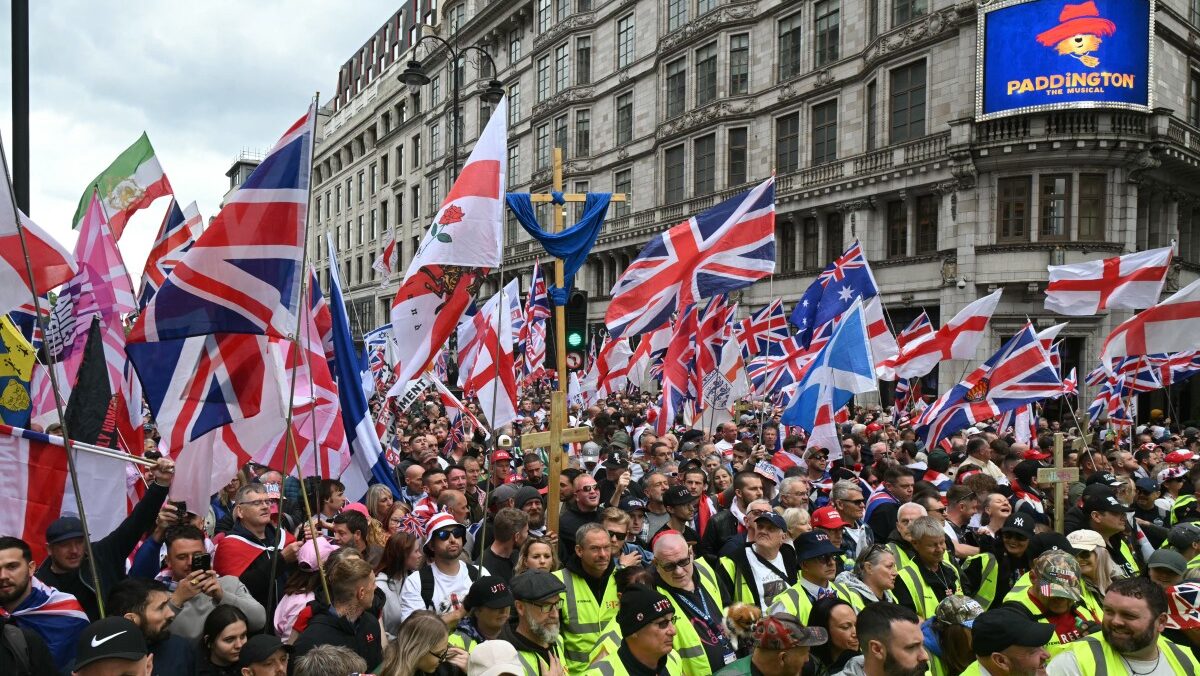
Tens of thousands of people gathered peacefully in central London on Saturday for Tommy Robinson’s ‘Unite the Kingdom’ rally, with police confirming there had been no major incidents despite one of the largest security operations mounted in the British capital in recent years.
London’s Metropolitan Police deployed 4,000 officers—alongside horses, dogs, drones, and helicopters—to oversee the demonstration, which coincided with both a rival pro-Palestinian counter-protest, as well as the FA Cup Final.
In a late afternoon update, the force said the day’s events had “proceeded largely without significant incident,” adding that 31 arrests had been made by that stage.
The ‘Unite the Kingdom’ march began in Holborn before crowds moved toward Parliament Square for speeches by Robinson and other speakers. Aerial footage showed tens of thousands attending the rally, many waving Union Jack and St. George’s flags.
The demonstration centred heavily on concerns over illegal migration, border security, free speech, and national identity.
“Immigration’s the main concern,” Christine Turner, 66, from northeast England, told AFP.
“We’re an island. We’ve got a clear border that they’re not protecting. Something needs to be done. It’s gone on too long,” Turner said.
Many attendees wore ‘MEGA’ (‘Make England Great Again’) clothing, carried crosses, and chanted “Christ is king.”
“The main aspect that I’m behind is to protect women and children,” British-Polish teenager Amelia Stearn told AFP after travelling from Poland.
“Illegal immigration is really taking a toll on the country,” Stearn added.
Robinson—whose real name is Stephen Yaxley-Lennon—is a former football hooligan turned right-wing activist who has built a large online following through campaigns focused on immigration, Islamism, and free speech.
Last September, Robinson drew an estimated 150,000 people to central London for a similarly themed rally promoting ‘national unity, free speech, and Christian values’—one of the largest nationalist demonstrations seen in Britain in recent decades.
Saturday’s event passed without the large-scale clashes that many in the British media and political establishment had feared. Robinson had urged supporters beforehand not to wear masks, avoid excessive drinking, and remain “peaceful and courteous.”
Addressing supporters in Parliament Square, Robinson described the movement as a “cultural revolution” and urged attendees to become politically active ahead of the next UK general election, expected in 2029, although he did not tell them which party to join.
A smaller rival demonstration, combining a pro-Palestinian rally marking Nakba Day with a march organised by the far-left Stand Up to Racism group, was held elsewhere in central London under strict police conditions designed to keep the groups apart.
Ahead of the demonstrations, Prime Minister Keir Starmer warned that “anyone who sets out to wreak havoc on our streets, to intimidate or threaten anyone … can expect to face the full force of the law.”
The government also barred 11 foreign activists from entering Britain ahead of the rally, including U.S.-based activist Valentina Gomez.
Saturday’s demonstrations took place amid heightened security concerns in Britain, with the country currently operating at its second-highest terrorism alert level of “severe.”