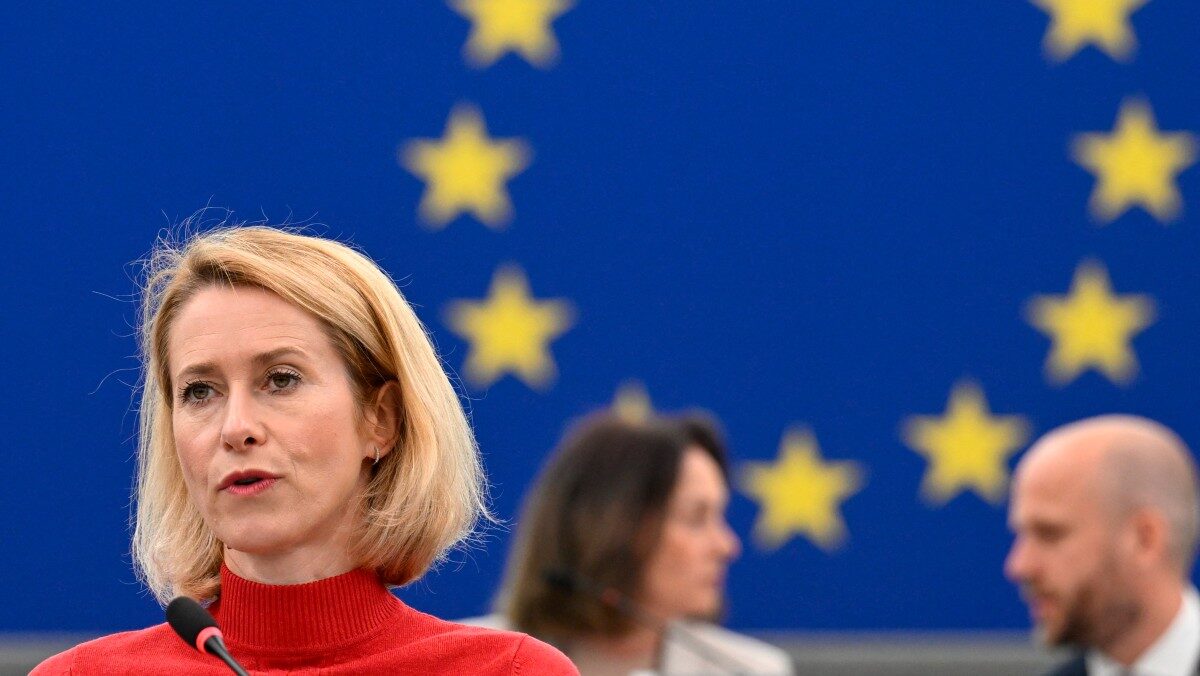
Kaja Kallas
Jean-Christophe VERHAEGEN / AFP
Israel’s decision to freeze contacts with EU foreign policy chief Kaja Kallas has exposed a growing power struggle in Brussels, where the European Commission is increasingly conducting its own foreign policy alongside the EU’s official diplomatic service.
While the Israeli government continues to freeze contacts with Kallas following her recent criticism of Israel’s actions in Gaza, the European Commission has decided to send the Commissioner for the Mediterranean, Dubravka Šuica, to Tel Aviv in a move seen as a message to both Israel and the EU’s top diplomat.
The visit surprised even several European capitals. Although Brussels insists that the trip had been planned for months, it was barely communicated publicly and did not initially appear on the commissioner’s official agenda.
The timing is particularly striking. Just days earlier, Israeli Foreign Minister Gideon Sa’ar decided to suspend all contacts with Kallas after several media outlets reported that the Estonian politician had compared Israel’s situation to apartheid-era South Africa.
Although subsequent clarifications were made regarding the exact content of her remarks, the political damage had already been done.
During a joint appearance with Šuica in Jerusalem, Sa’ar also took the opportunity to deliver an implicit criticism of Kallas. The absence of any public defence of Kallas from the European Commission caused frustration among several EU diplomats, who viewed the episode as yet another sign of the EU speaking with different voices and damaging its own position.
The issue goes far beyond a personal disagreement. Diplomatic sources argue that the visit forms part of the European Commission’s own agenda. The objective is to strengthen Brussels’ geopolitical role at the expense of the European External Action Service, which is headed by Kallas.
The friction predates Kallas’s appointment. Tensions between Josep Borrell and Ursula von der Leyen were also a recurring feature of the previous Commission. However, Borrell’s political weight and deep knowledge of the institutions made it far more difficult for the Commission president to act publicly against him.
Since the beginning of von der Leyen’s second term, the Commission has steadily expanded its role in foreign affairs. The creation of a commissioner responsible for Mediterranean affairs and the establishment of new departments focused on the Middle East have strengthened the impression that the Commission is seeking to conduct diplomacy through its own channels rather than through the EU’s diplomatic service.
Israel has become one of the clearest examples of this rivalry. While Kallas and numerous member states have pushed for possible trade restrictions on Israeli settlements in the occupied territories, the Commission has maintained a far more cautious position and has been reluctant to impose sanctions.
The result is a European foreign policy that increasingly speaks with two voices. Rival institutions inside the EU risk making the bloc appear divided to allies and opponents alike—a problem that is becoming increasingly visible in its relationship with Israel.