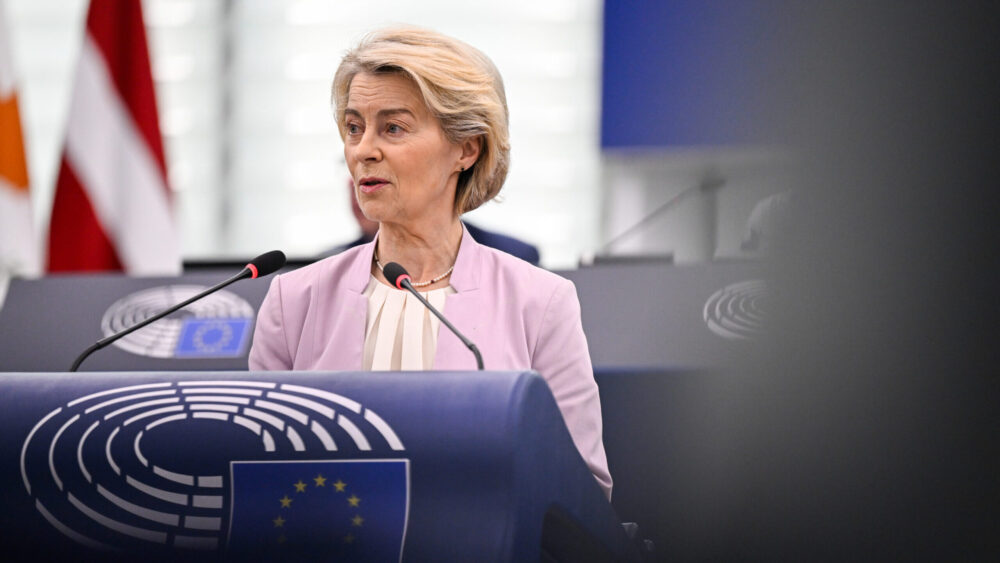
Ursula von der Leyen
Laurie DIEFFEMBACQ, © European Union 2025 – Source: EP
Donald Trump says the EU-U.S. trade deal will “bring us closer together.” But it has already had the opposite effect on countries within the European bloc that will have to suffer its consequences.
Leaders said the agreement could only be supported “without any enthusiasm” (Spain’s Pedro Sánchez) and that it would “substantially damage” national finances (German chancellor Friedrich Merz).
Others went straight for the jugular, attacking Commission president Ursula von der Leyen for—as Hungary’s Viktor Orbán put it—allowing herself to be eaten for breakfast by Trump.
French Prime Minister François Bayrou said, “It is a dark day when an alliance of free peoples, united to affirm their values and defend their interests, resolves to submission.”
András László, Hungarian MEP for Fidesz, went even further, saying the deal so far “reads as a surrender by Ursula von der Leyen to the United States.”
Weak leadership, no vision by the Commission. Yet again.
From the initial reports about this US-EU trade deal, it's quite stunning to see how little Ursula von der Leyen was able to gain for the European Union. In fact, the promise of 600 bn euros investment is something the EU cannot deliver on, merely hope that the private sector…
— András LÁSZLÓ MEP 🇭🇺 (@laszloan) July 28, 2025
In response to a barrage of criticism, the Commission—through trade chief Maroš Šefčovič—insisted that “this is clearly the best deal we could get under very difficult circumstances” (emphasis added).
Reports also suggested that VDL had presented a rosier—that is, not wholly accurate—image of the deal to member states after the White House published a fact-sheet containing claims “that directly contradict the European Commission’s version of events.”
As if to add to the confusion, the EU admitted after von der Leyen’s (often embarrassing) meeting with Trump that it doesn’t have the power to deliver on one of its key promises in the deal—to invest $600 billion (€518bn) on American soil, primarily in defense-related sectors. Officials said this was because the money would come from private sector investment, over which Brussels has no authority.