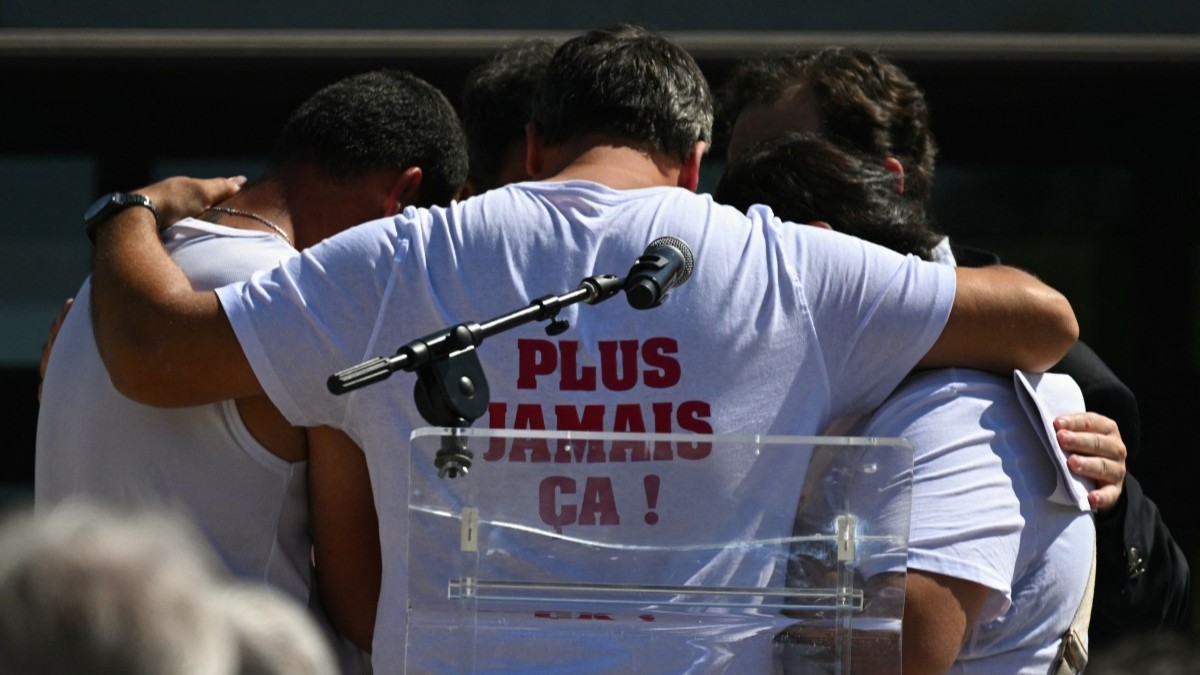
Relatives of the late Lyhanna comfort each other during a silent march in tribute to the 11-year-old girl found dead on June 4, in Fleurance, France on June 7, 2026.
LIONEL BONAVENTURE / AFP
Anger is mounting over the death of 11-year-old Lyhanna in the Gers, who fell into the clutches of a predator who could have been stopped by the authorities had they acted in time. As we previously reported, a rape complaint had already been filed against the man but was not investigated in time by police and courts. The public sentiment is deeply shaken, and, unexpectedly, voices are being raised not only on the Right, but also on the Left to condemn the judicial system’s negligence in the case.
Beyond the individual incident, the issue of institutional failings has emerged as central. How could reports have been so inadequately addressed? How was an individual already known to the justice system able to continue to operate, with preventive mechanisms failing to step in?
The uniqueness of the sequence of events triggered by the tragedy of Lyhanna’s death lies in the fact that political, media, and cultural circles, which until now have always refrained from interfering in judicial and security matters, have this time deemed it appropriate to speak out.
Mathilde Panot’s reaction was one of the first signs of this shift. The leader of the La France Insoumise (LFI) group in the National Assembly directly implicated Justice Minister Gérald Darmanin, going so far as to call for his resignation. At first glance, this might seem like business as usual: since his time at the ministry of the interior, Darmanin has remained one of the most contested figures on the Left. Any major crisis affecting his new ministry automatically presents a political opportunity for his opponents.
The attack from LFI is nonetheless of great interest. Issues relating to the failings of the justice system, a lack of public safety, or the state’s inability to protect citizens are usually raised primarily by the Right, with the Left preferring to shift the debate towards crime prevention, using the insufficient budgetary resources allocated to the state and social inequalities as explanatory factors. In the Lyhanna case, the discourse is different. It does not seek to downplay the failings but to denounce them head-on. It is no longer a question of explaining why the institutions have failed but of acknowledging that they have failed.
With less than a year to go before the presidential election, this is a politically significant shift, reflecting the growing prominence of a concern that has become difficult to ignore: the practical protection of victims, and more specifically that of children, at a time when Jordan Bardella, leader of the Rassemblement National (RN), is leading all the opinion polls. By seizing this ground, the Left implicitly acknowledges that these concerns can no longer be left to its opponents.
Darmanin firmly dismissed these accusations and ruled out any possibility of resigning, citing “a failure that was not due to instructions given by the ministry.”
The political Left is not the only one to have taken up the cause. Media personalities—actresses, television presenters—have also spoken out to denounce the public scandal of the judicial failings that led to Lyhanna’s death.
The actress Juliette Binoche, for example, is not a figure typically associated with debates on security or legal affairs. When she speaks out publicly, it is usually on cultural, humanitarian, or environmental issues, taking a strong left-wing stance. This time, she felt that the injustice warranted a public statement. “Girls have rights, including the right not to be prey! Enough is enough!” she posted on Instagram, alongside other celebrities, such as popular TV host Flavie Flament, in a message accompanied by a photo of them as children or in their early teens, following an appeal by the media outlet Mesdames and its co-founder, Maïtena Biraben.
“Enough is enough”—is Lyhanna’s death the last straw? Following the highly publicised deaths of Maëlys de Araujo in 2018 and Lola Daviet in 2022, the Lyhanna case is set to leave a lasting mark on French public opinion. In each of these tragedies, the collective emotion ultimately centres not solely on the crime itself but crystallises around a broader question: could it have been prevented? Since 2018, nothing seems to have changed.
In this context, the reaction of the mother of little Maëlys, who was abducted in 2018 during a wedding and then raped and killed by a man with a particularly dangerous profile, carries particular significance. She appeared in the media to pay tribute to Lyhanna, whilst also remembering Lola and all the children who have fallen victim to similar crimes, in a message that goes far beyond mere compassion. The French press regularly gives a voice to the parents of these children who have died too young. These families now occupy a special place in the French public sphere, embodying a voice that is not sufficiently represented within traditional political circles.
The convergence of reactions surrounding the Lyhanna case may well be the true political development of this episode. That a leader of LFI should make judicial failure a priority issue, that public figures such as Juliette Binoche should speak out publicly on the state’s failings in protecting children, that the families of victims should become moral authorities in the national debate: these are all developments that would have been far less likely just a few months ago.
Issues of authority, public safety, and victim protection are no longer the preserve of the Right. The deterioration of the social climate in France means that these issues now demand attention from everyone, even within political, media, and cultural circles that previously preferred to keep their distance. Unfortunately, in the coming months marked by major elections, political opportunism might have the final say at the expense of far-reaching reform.