

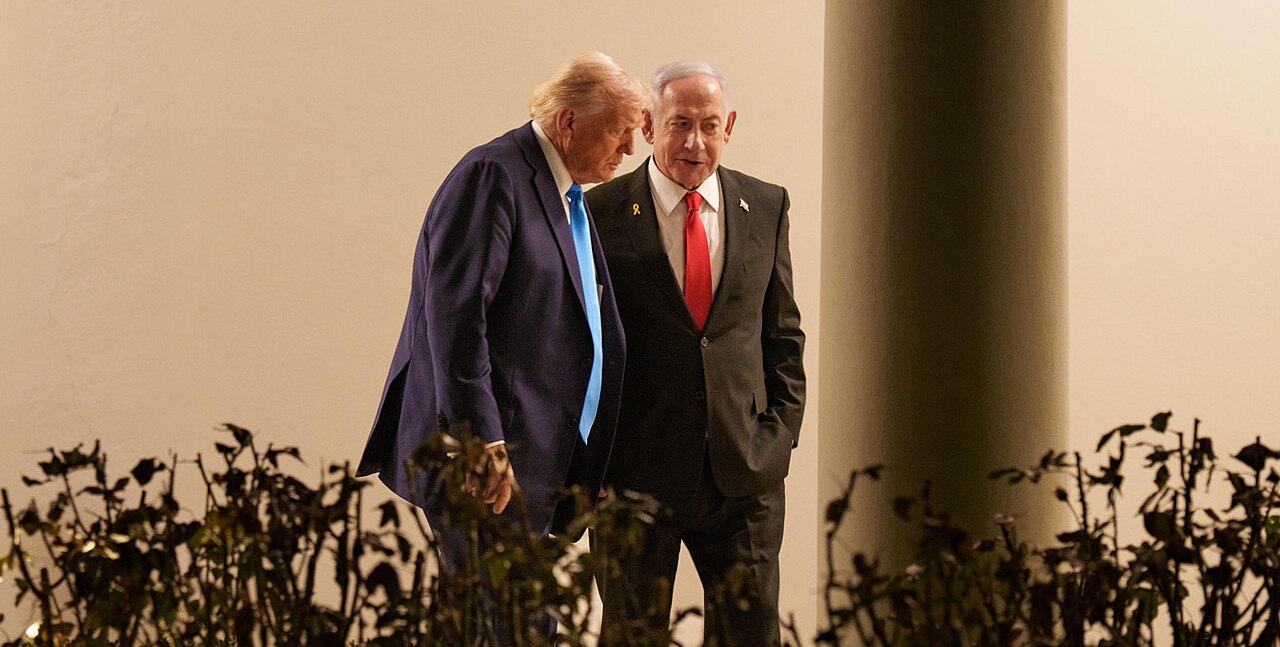
President Donald Trump welcomes Israeli Prime Minister Benjamin Netanyahu at the White House (2025).
Airstrikes, missile attacks, and diplomatic threats continue to shake the Middle East, with Israel, Iran, and several Gulf Arab countries drawn into a rapidly expanding conflict.
The Israeli military carried out fresh strikes on Tehran early Sunday, March 22nd after Iranian missiles hit several cities in southern Israel. More than 100 people were injured in attacks on the Arad and Dimona areas, while Iranian state media said the action was in response to an earlier Israeli attack on the Natanz nuclear facility.
The conflict has also widened regionally, with rocket and drone attacks targeting U.S.-linked facilities in Baghdad. Iranian sources reported a strike on a military base near the airport, while a rocket attack from Lebanon killed an Israeli civilian—the first fatality since clashes between Hezbollah and Israel resumed in early March.
Tensions have extended to the Persian Gulf, where Iran-linked attacks targeted Saudi Arabia and the United Arab Emirates, and incidents were also reported in Qatari airspace. Although the crash of a Qatari military helicopter was officially attributed to a technical malfunction, authorities remain on high alert amid the escalating situation.
The geopolitical crisis deepened further after U.S. president Donald Trump issued a 48-hour ultimatum to Iran to reopen the Strait of Hormuz, warning of potential strikes on Iranian energy infrastructure if it failed to comply. In response, Tehran’s military leadership threatened to target U.S. and allied assets across the region.
The ongoing missile exchanges, airstrikes and escalating ultimatums suggest the conflict is increasingly evolving into a broader regional war, directly involving multiple key actors across the Middle East.




.jpg)