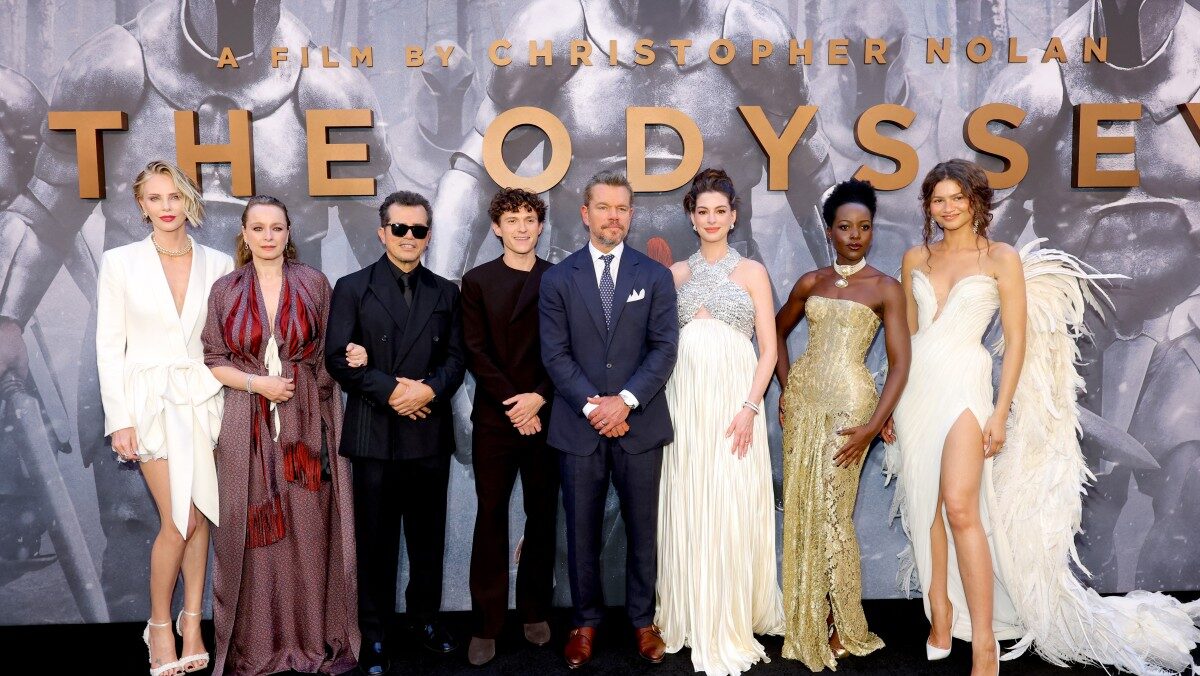
Mike Coppola / GETTY IMAGES NORTH AMERICA / Getty Images via AFP
Christopher Nolan’s newly released adaptation of The Odyssey has become the latest Hollywood blockbuster to generate a backlash over casting, with critics accusing the director of updating Homer’s epic to meet the identity-conscious tastes of the modern film industry.
The film, which follows the Greek hero Odysseus on his ten-year journey home after the Trojan War, earned more than $264 million worldwide during its opening weekend. Yet much of the debate in Greece has centred not on the monsters, gods or impressive box-office numbers, but on who Nolan chose to bring the country’s foundational epic to the screen.
The most controversial decision was the casting of Kenyan-Mexican actress Lupita Nyong’o as Helen of Troy. The absence of any Greek actors from a film based on one of Greece’s greatest cultural treasures has also left many wondering whether Hollywood’s enthusiasm for diversity stretches quite as far as the people whose story it is telling.
Helen has traditionally been regarded as the most beautiful woman in the world—the face whose abduction launched the Trojan War. Homer offers few details about her physical appearance, but repeatedly describes her as “white-armed”, making Nolan’s choice rather difficult to present as an attempt at textual fidelity.
Artistic freedom provides the obvious defence. Ancient myths have been retold and reimagined for thousands of years, and filmmakers are not required to treat Homer as a casting manual. Even so, critics suspect that the decision owes rather more to Hollywood’s contemporary ideological preferences—and its awards-season incentives—than to anything found in the original poem.
The casting of transgender actor Elliot Page as Sinon has added to that impression. Sinon does not actually appear in The Odyssey and is best known from Virgil’s Aeneid, but Nolan imported the character into his version and considerably expanded the role. Apparently, adapting Homer was not enough; the epic first required some supplementary material from Rome.
Taken together, the choices have encouraged claims that the production was assembled partly with Hollywood’s diversity expectations in mind. There is no evidence that Nolan cast the film specifically to qualify for an Oscar, but that has not stopped critics from noticing how conveniently his artistic decisions reflect the industry’s prevailing tastes.
Tesla and SpaceX CEO Elon Musk delivered the least diplomatic verdict. “Chris Nolan desecrated Homer and groveled on his knees just to meet the woke rules required to win an Oscar,” Musk wrote on X. “What a worm,” he added.
The controversy has also entered Greek politics. The small ultra-Orthodox opposition party Niki criticised both the casting and the government’s decision to provide the production with approximately €6.5 million in subsidies, arguing that Greek taxpayers were being made to finance the imposition of “woke-type ideology” on their own history and cultural identity.
Endy Zemenides, executive director of the Hellenic American Leadership Council, likewise described the absence of Greek actors as a missed opportunity. He said it was disappointing to hear suggestions that casting decisions may have been based on identity characteristics in order to improve the film’s Oscar prospects.
Nolan’s €250 million production is nevertheless an international box-office success, proving that audiences remain hungry for Homer—even after Hollywood has finished making the ancient Greek poet more suitable for modern sensibilities.