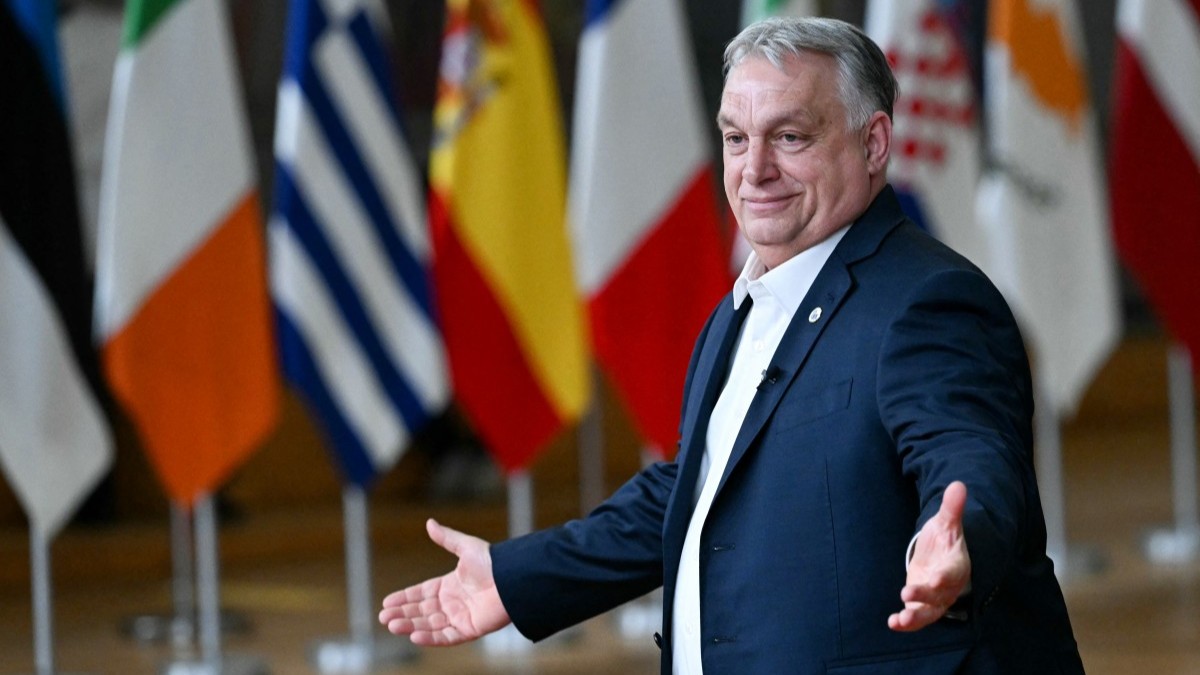
Hungary’s Prime Minister Viktor Orbán speaks at a press conference during the EU Summit at the EU headquarters in Brussels, on March 19, 2026.
NICOLAS TUCAT / AFP
Officials attending the EU summit on Thursday appeared genuinely shocked that the leader of a member state was acting in his own country’s interest. Perhaps it hurt their egos that regardless of their repeated blows, Hungary’s Viktor Orbán maintained his position—that Budapest’s veto on a €90 billion EU loan for Ukraine will not be lifted until oil flows from Russia to Hungary and Slovakia resumes via the Druzhba pipeline.
“It was a tough debate,” said the prime minister after a more-than 90 minute discussion, “but we stood our ground.”
📍 Brussels. Situation report.
— Orbán Viktor (@PM_ViktorOrban) March 19, 2026
It was a tough debate, but we stood our ground. We have the right to say no to the Ukrainian war loan. As long as @ZelenskyyUa does not lift the oil blockade, they will not receive any money from Brussels.
No oil = no money. pic.twitter.com/2tCWJms5kx
One diplomat went further in their comments published in Welt, saying: “Almost everyone in the room was very critical of Orbán. There’s never been so much discontent.”
Some leaders continued their condemnation outside of the private halls, too. Germany’s Friedrich Merz, for example, bashed the Hungarian PM over his “gross breach of the loyalty between member states,” which he said “damages the EU’s reputation”—or, rather, what’s left of it.
This claim—that Budapest was being disloyal to Brussels, rather than the other way around—frustrated AfD MP Maximilian Krah, responding:
Ukraine is personally threatening Orbán and destroying the oil pipeline vital for Hungary. Who deserves loyalty? The EU member Hungary or the mafia state Ukraine?
Kyiv claims the pipeline was damaged in a Russian drone strike, and would be dangerous to repair. Both Hungary and Slovakia have openly dismissed this version of events, accusing Volodymyr Zelensky’s administration of turning off the taps for political reasons. The EU has offered to help restore the line—if, indeed, repairs really are needed.
Some leaders appear uninterested in Budapest’s presentation of what it describes as proof that “there is no technical obstacle to restarting” the pipeline. Indeed, despite this, Polish Prime Minister Donald Tusk said on Friday morning: “Europe has a growing problem with Orbán.”
German MEP Terry Reintke even went as far as to suggest that “we have a situation in which Vladimir Putin is sitting directly at the table here.”
Reports say, however, that Italy’s Giorgia Meloni told her counterparts that she at least understands Orbán’s Ukraine position, although the source of this information is unclear.
The situation was not helped when Russian energy company Gazprom said Thursday that sites linked to TurkStream—which Budapest describes as “essential for Hungary’s natural gas supply”—were struck by Ukrainian drones. Hungarian Foreign Minister Péter Szijjártó responded: “Stop these attacks that endanger Hungary’s energy security!”