The defeat of Viktor Orbán has left an obvious political vacuum in Europe. For more than a decade, Hungary was the main institutional obstacle to much of Brussels’ agenda: from migration policy and the expansion of EU powers, including the Green Deal, to mandatory quotas and Agenda 2030 itself.
But the event held yesterday in the European Parliament by the European Conservatives and Reformists Group (ECR) together with Fundación NEOS made clear that, for a growing part of the European right, the problem was never Orbán. The problem was—and still is—the conceptual framework on which Brussels has built its political project.
For Europe’s pro-sovereignty and conservative sectors, opposition to the 2030 Agenda stems not so much from its stated objectives as from the way in which it has become a binding political framework. The criticism is not directed at the fight against poverty or economic development, but rather at the fact that under broad and seemingly indisputable concepts such as sustainability, inclusion, equality or governance, specific policies on energy, immigration, education, the family or digital regulation are being introduced without a genuine democratic debate.
According to this view, the 2030 Agenda has allowed decisions to be shifted from national parliaments to supranational bodies, large corporations and international bureaucracies, reducing the scope of state sovereignty and presenting ideological choices as if they were mere technical or moral imperatives.
At the April 15 event, the loss of Hungary as the main sovereign stronghold was presented not as the end of one phase, but as the beginning of another. A phase less dependent on the veto of a national government and more focused on contesting the language, priorities and concepts through which European politics is defined.
That is, precisely, one of Orbán’s main legacies. Long before other European governments began to question Agenda 2030, the Hungarian government had managed to establish a simple but politically powerful idea: that behind apparently neutral concepts—“sustainability”, “inclusion”, “resilience”, “governance”—there is a concrete political project, with direct consequences for national sovereignty, the family, immigration and energy.
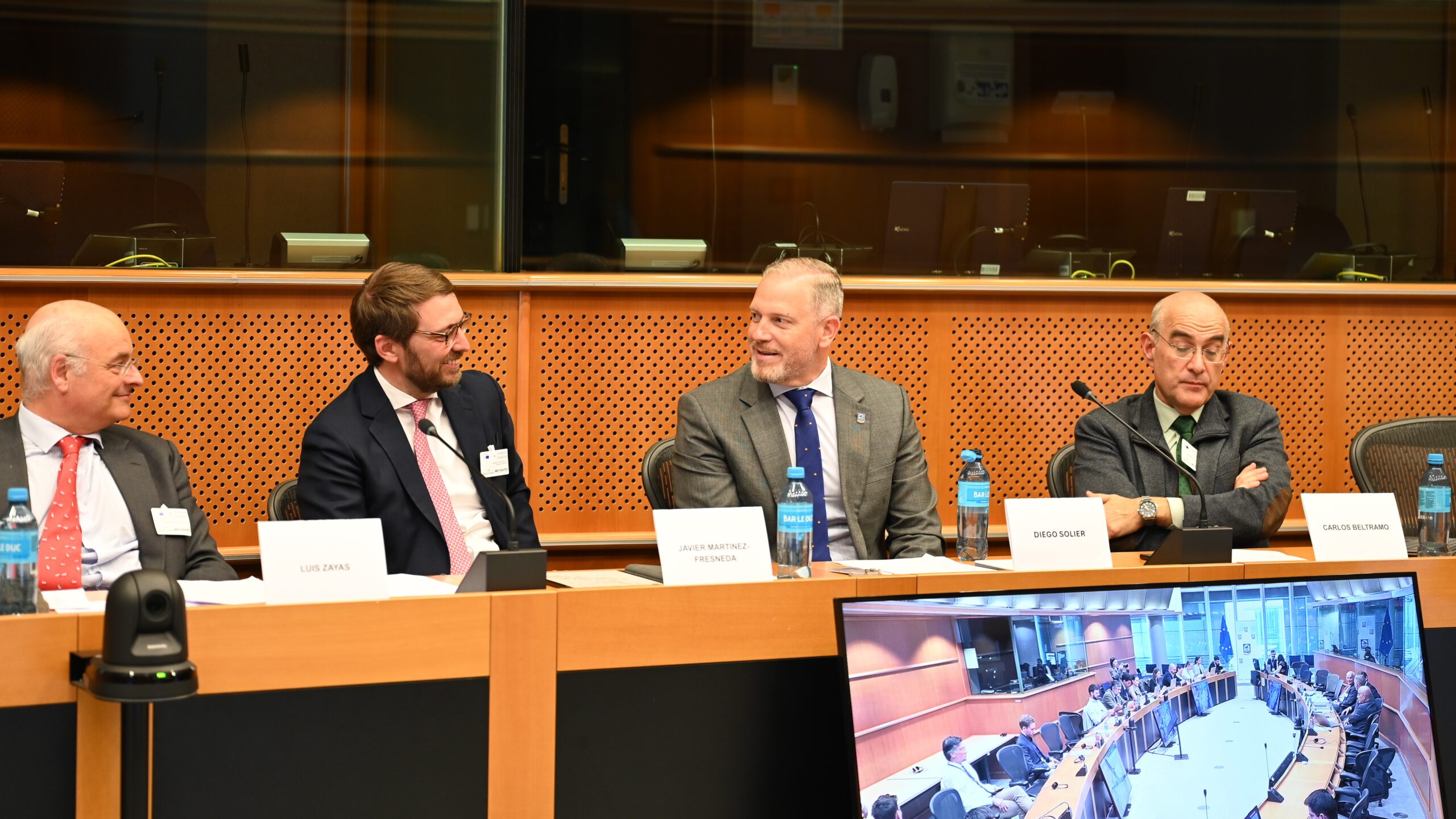
During the presentation of the report, NEOS Director General Javier Martínez-Fresneda argued that “Agenda 2030 has become a total ideological framework” and that the debate no longer revolves only around specific policies, but around who defines which positions are legitimate and which are pushed outside the public sphere.
Carlos Beltramo, an expert from the team, insisted on the same idea. “What matters is not so much 2030. What matters is the word agenda,” he said. According to him, Agenda 2030 has served to organise political priorities and establish a common language that is then translated into legislation, education, media and corporate decisions.
Luis Zayas, an expert from the same group, even spoke of a “cultural hegemony” that has made it possible to present deeply political decisions as if they were merely technical or moral requirements. In his view, that consensus has, for years, spread through conservative and progressive governments, companies, universities, and European institutions.
For that reason, the question hanging over the event was not who could replace Orbán, but how to continue the battle without him.
The figure of Giorgia Meloni repeatedly emerged in conversations after the event. Within ECR, it is assumed that the Italian prime minister will, at least during this parliamentary term, be the main counterweight in the European Council against a Commission seeking to accelerate political and regulatory centralisation.
But there is also an awareness that Meloni does not occupy the same position as Orbán. Italy depends far more on the Union’s internal balances, on its relationship with Berlin and Paris, and on the need to remain within the Atlantic consensus. That limits her room for confrontation.
Precisely for that reason, the event’s main message was that the European right can no longer continue to depend on a single national government to stop certain policies. It needs to build a political, cultural and media network capable of sustaining that battle even when governments change.
It was no coincidence that the conference brought together issues as different as the digital euro, European digital identity, censorship on social media, immigration, climate policy and education. The speakers presented them as parts of the same trend: the gradual transfer of power from national states to supranational and technocratic institutions.
MEP Diego Solier closed the event with a phrase that summed up the logic of the day: “We cannot limit ourselves to resisting the agenda of others; we have to build our own.”
And that is what right-wing Europe is forever in Orbán’s debt. He did not simply block European decisions from Budapest. He has succeeded in bringing words such as sovereignty, nation, border and family back to the centre of the European debate.