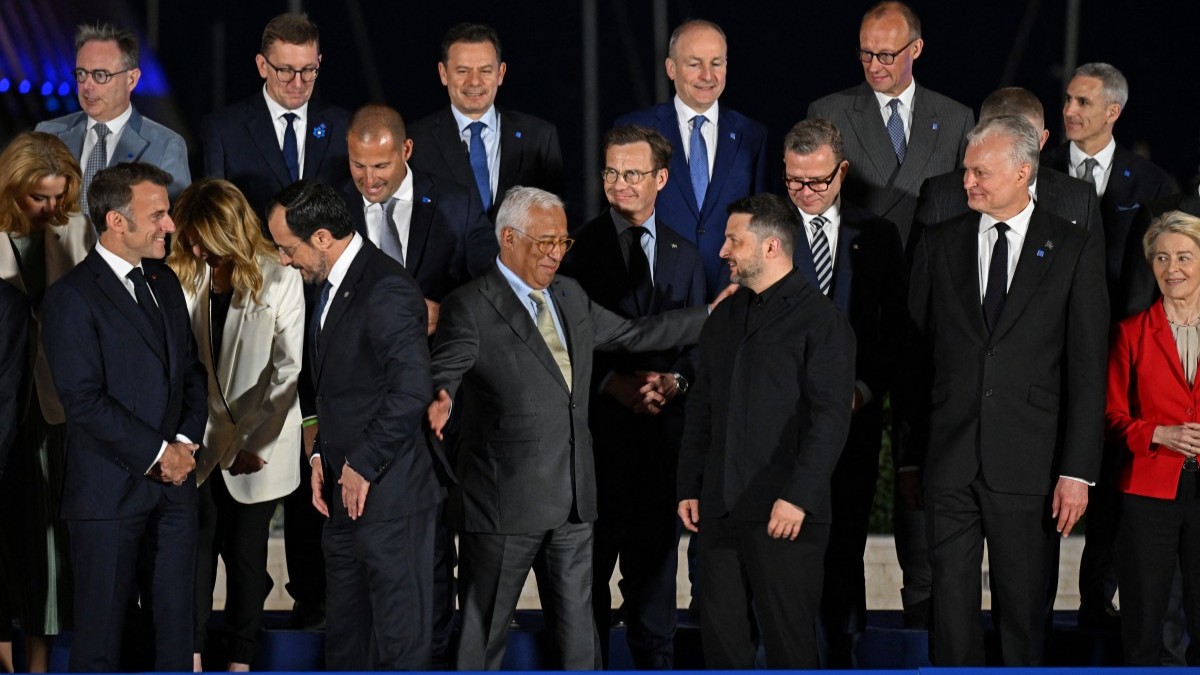
European Council President António Costa (C) gestures to Ukraine’s President Volodymyr Zelensky before a group photograph ahead of an informal meeting of the European Council, in Ayia Napa on April 23, 2026.
JEWEL SAMAD / AFP
The European Union has spent years insisting that enlargement is a strategic priority. Yet the closer new accessions appear, the more apparent a contradiction becomes that Brussels has been trying to resolve for some time: how to bring new countries into the Union without multiplying political blockages within the European institutions.
France, Germany, Belgium, the Netherlands and Luxembourg have put forward a proposal that reflects precisely that concern. According to information that has emerged, new member states could join the Union without initially enjoying full voting rights in particularly sensitive areas such as foreign policy, security and the EU budget.
Officially, the measure would be temporary and designed to ensure that enlargement does not reduce the EU’s capacity to act. In practice, it would amount to creating a form of limited membership or gradual accession for future members. A European second division league.
The proposal could potentially affect countries such as Montenegro and Albania, but also candidates of enormous geopolitical significance such as Ukraine and Moldova.
The debate comes at a particularly delicate moment. Brussels is trying to maintain political momentum in favour of Ukrainian accession while numerous European governments continue to express reservations about the institutional, financial and agricultural consequences of admitting a country of more than thirty million inhabitants that, at least for now, still shows no clear prospect of bringing its war with Russia to an end.
For that reason, temporarily limiting voting rights could become a way of bringing Ukraine closer to the Union without immediately confronting all the political implications of full membership.
The idea fits with other proposals that have circulated within European institutions in recent years, ranging from gradual integration formulas to mechanisms for partial participation in specific EU policies.
Alongside the temporary suspension of voting rights, the document also proposes strengthening post-accession control mechanisms. Brussels would be able to intervene more easily if a new member state were to backslide on issues related to the rule of law, democracy or press freedom.
The initiative also reopens a debate that has divided the Union for years: the future of the veto.
Just this Wednesday, Dutch MEP Marieke Ehlers (Party for Freedom/Patriots for Europe) warned at an MCC Brussels event that national differences do not disappear simply by replacing unanimity with qualified majority voting. “Portugal will never see Ukraine the same way Poland does,” she argued, maintaining that the different geopolitical interests of member states will continue to exist regardless of institutional reforms.
Her remarks reflect a concern that is becoming increasingly present in some European circles. If Brussels succeeds in establishing a system in which new members enter without veto powers in certain areas, pressure could later grow to extend the same principle to the rest of the member states.
The abolition of unanimity in key policy areas has for years been part of the reform agenda promoted by numerous European leaders, who argue that an enlarged Union will become virtually ungovernable if the current blocking mechanisms remain in place.
This also serves to advance the idea of the “mandatory” centralization to which the EU must increasingly submit itself. The more members there are, the more power Brussels will supposedly need to exercise. It is a vicious circle that is highly useful for the European governing class.