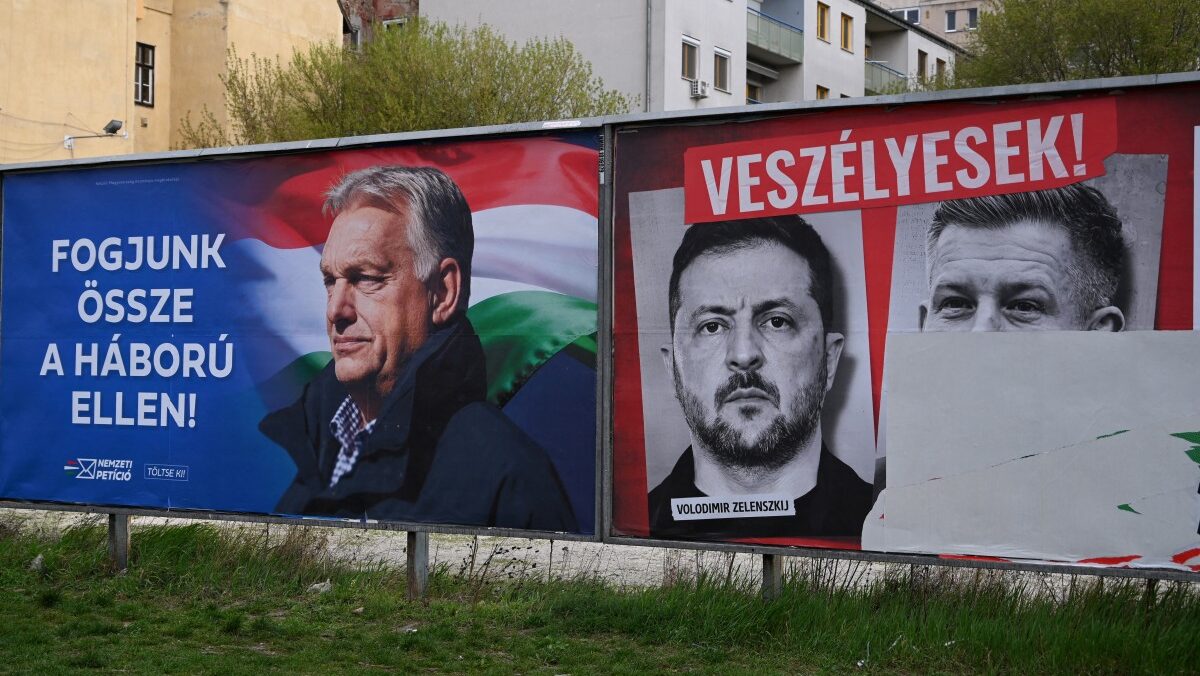
Election billboards in Budapest
ATTILA KISBENEDEK / AFP
Hungary’s election this Sunday is not just about who runs the country—it is about how much control Brussels will be allowed to exert over it.
That is why the vote matters far beyond Budapest. At its core, this is a straight choice between two rival visions of Europe, embodied by Viktor Orbán and Péter Magyar.
Orbán offers a sovereign Hungary, prepared to keep clashing with Brussels to resist deeper centralisation. Magyar offers the reverse: a return to the EU’s political mainstream, closer alignment with Ursula von der Leyen, and a Hungary more willing to follow the direction set by the European institutions.
Behind the domestic contest sits a much bigger fight over power inside the EU itself.
In recent years, Hungary has become Brussels’ most persistent internal obstacle. Orbán’s government has delayed aid to Ukraine, blocked sanctions, challenged migration policy, and used the veto as leverage.
For his supporters, that has made Hungary one of the few countries still willing to push back against what they see as an increasingly centralised and unaccountable system. Orbán argues that Brussels has drifted far from a union of cooperating nations, and is instead behaving more like a political authority seeking influence over migration, energy, justice, and foreign policy.
That argument is gaining ground beyond Hungary. From Rome to Bratislava—and among parts of the political class in Berlin and Vienna—Orbán is seen as proof that Brussels can still be resisted from within.
At the heart of the clash is the veto. As long as Hungary retains it, it can slow—or block—decisions on sanctions, enlargement, and institutional reform. That has intensified efforts by larger member states to scrap unanimity altogether and replace it with majority voting.
Germany, France, and the Commission argue this is necessary for a larger Union to function. For critics, it is a clear attempt to sideline smaller states and remove one of the last meaningful checks on Brussels’ power.
Péter Magyar offers a clear break with that approach.
A former insider of the Fidesz system, he has built his campaign on restoring ties with Brussels. That would mean unlocking frozen EU funds, ending routine vetoes, backing support for Ukraine, and working within the Commission’s framework rather than against it.
For EU leaders, the appeal is obvious. Hungary would shift from being the bloc’s main internal dissenter to a far more compliant partner.
The stakes on Sunday are therefore hard to ignore.
If Orbán wins, Hungary will remain one of the few governments willing to challenge Brussels—and pressure to strip back national veto powers will likely intensify.
If Magyar wins, Hungary moves back into line with the EU’s central direction.
This is not just a vote on who governs Hungary. It is a test of whether national resistance inside the EU still has real force—or whether it is being steadily pushed aside.