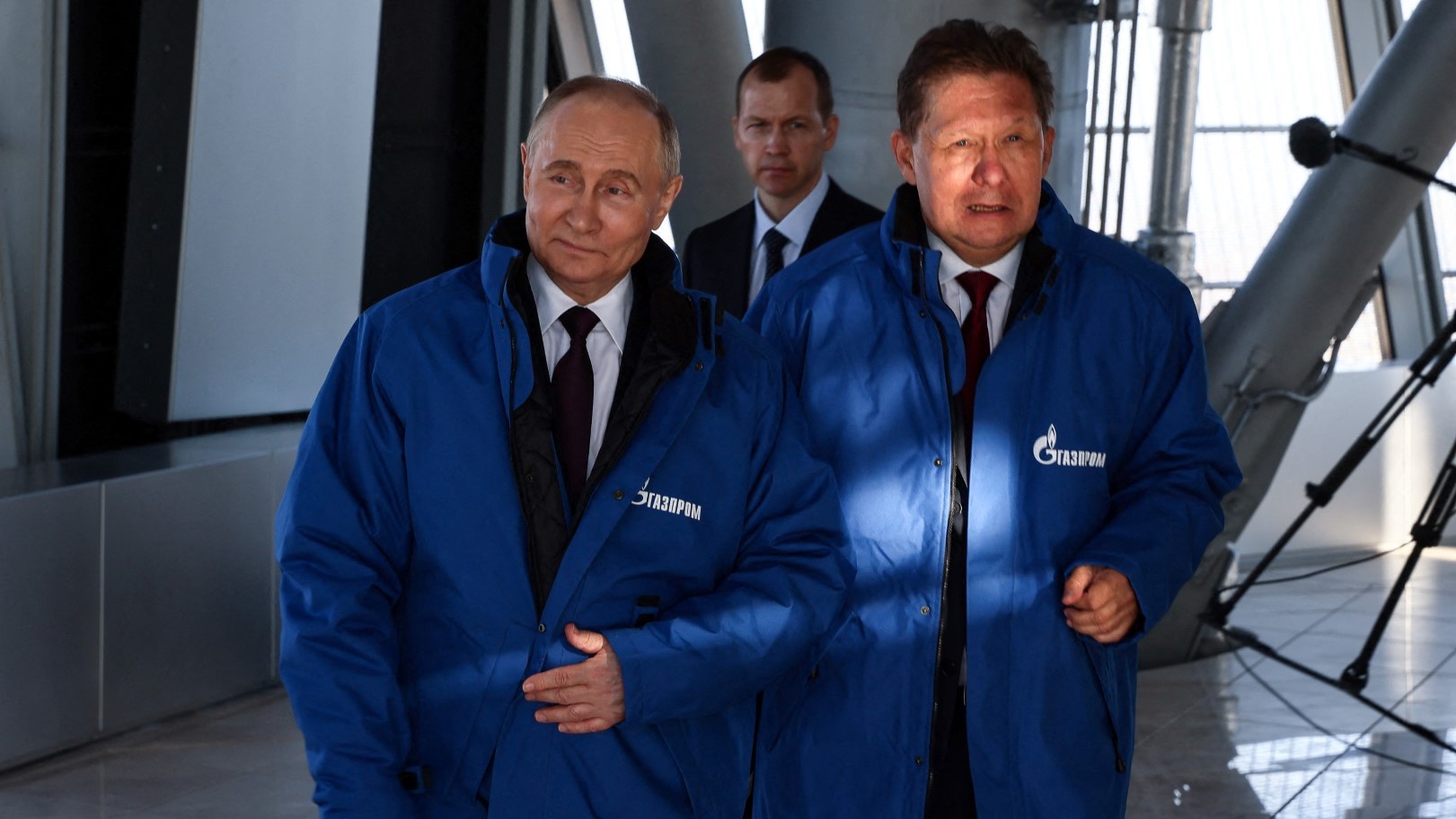
Russia’s President Vladimir Putin (L) speaks with Russia’s energy giant Gazprom CEO Alexei Miller as they visit the Lakhta Centre skyscraper, the headquarters of Russian gas monopoly Gazprom in Saint Petersburg on June 5, 2024.
KIRILL MOROZOV / SPUTNIK / POOL / AFP
On the fourth anniversary of the war in Ukraine, an increasingly obvious question is circulating in Brussels: have the energy sanctions imposed on Russia truly been effective? The latest data point to a reality that differs from the official narrative. Moscow is exporting more crude today than before the invasion, although it earns slightly less per barrel sold.
According to the latest report by the Centre for Research on Energy and Clean Air (CREA), the volume of Russian crude exports remains around 6% above pre-2022 levels, despite Western restrictions.
Revenues have indeed declined—the Kremlin has been forced to apply substantial discounts to place its oil in Asia—but the drop has not led to the economic collapse many anticipated. Russia sells more; earns somewhat less; but it keeps selling.
Redirection has been the key. China, India, and Turkey now absorb the vast majority of Russian crude. The European Union, once one of its main destinations, has virtually disappeared as a direct customer.
However, the global energy market does not operate in sealed compartments. Part of the Russian oil refined in third countries ultimately returns indirectly to Europe in the form of processed products. It is difficult to assume that this is unknown in Brussels.
Sanctions have reduced Russia’s energy revenues, but they have not succeeded in suffocating its export capacity. The Kremlin has offset the per-barrel discount with higher volumes and alternative logistics—including the so-called “shadow fleet”—which has enabled it to circumvent part of the restrictions.
In strictly economic terms, Russia’s total profit today is slightly lower than before the invasion, but it is far from having evaporated. This is not a decisive strategic victory; at best, it is a partial erosion.
If the impact in Moscow has been contained, in Europe the consequences have been far deeper. The continent has endured an energy crisis that sent gas and electricity prices soaring, eroded industrial competitiveness, and accelerated the relocation of energy-intensive companies.
Germany—the EU’s industrial engine—has seen its model based on affordable Russian energy dismantled within months. Sectors such as chemicals, metallurgy, and automotive have suffered notable contractions.
Energy-driven inflation has spread across the broader economy, reducing households’ purchasing power and generating social tensions.
Brussels argues that energy diversification has strengthened strategic autonomy. However, this diversification has entailed higher structural costs: more expensive liquefied natural gas, long-term contracts with distant suppliers such as the United States, and growing dependence on volatile markets.
Another structural element must be added to this scenario: the insistence on accelerating the energy transition in the midst of a supply crisis. The push for ambitious green policies—without yet having sufficient technological and storage capacity to sustain them at a continental scale—has added further pressure to an already strained energy system.
Renewables are a necessary part of the future energy mix, but the reality is that, today, they cannot guarantee full stability or competitive pricing without conventional backup.
The combination of energy sanctions and accelerated climate targets has created a complex equation that not only hampers Europe’s industrial recovery but, in many cases, makes it unattainable.
From a technical standpoint, yes: they have reduced Russian energy revenues and forced Moscow to restructure its foreign trade. But they have not significantly reduced export volumes nor paralyzed their economy.
From a broader strategic perspective, the question we must ask is whether Europe has emerged stronger. The answer is no. The economic damage within the Union is undeniable, and reversing it will require years of reform, investment, and a redefinition of the energy model.
Four years on, Russia sells more cheaply but continues to sell; Europe has reduced its direct dependence on Russia, but at a high cost including increased dependence on other actors.