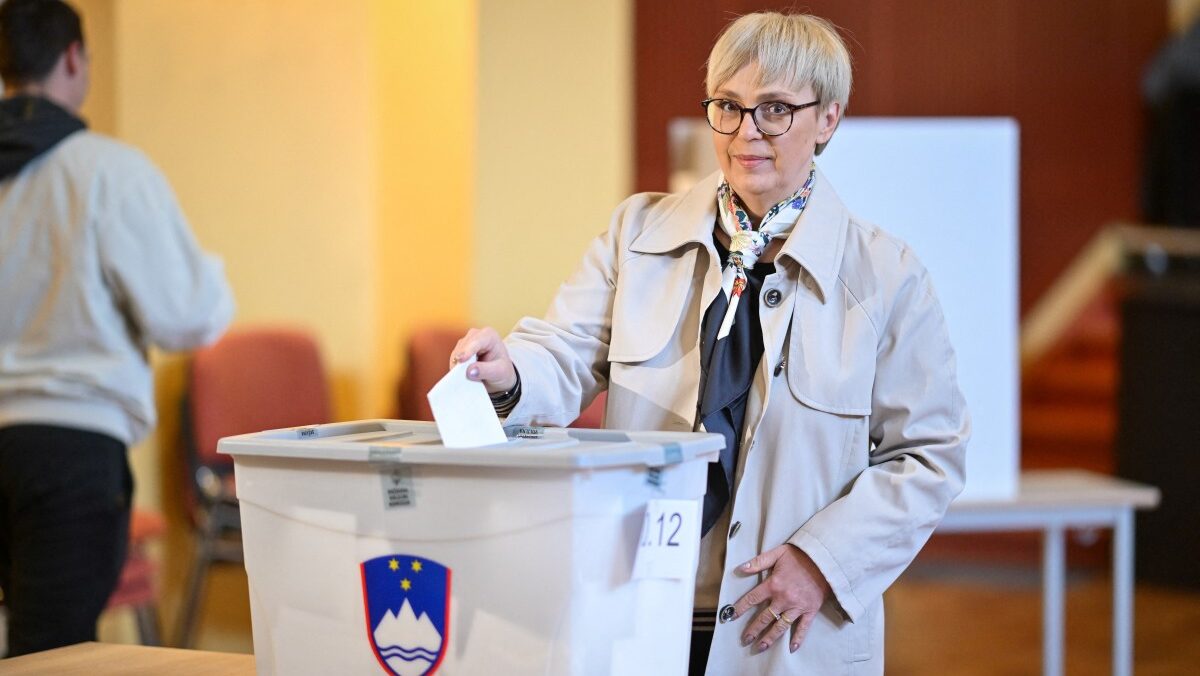
Slovenia’s President Nataša Pirc Musar votes in Radomlje, March 22, 2026.
Jure Makovec / AFP
Slovenian president Nataša Pirc Musar said on Saturday she is unable—for now—to nominate a prime minister, prolonging the political deadlock that has gripped the country since March’s tightly contested election.
After weeks of consultations, no viable majority coalition has emerged in the 90-seat parliament.
“No absolute majority coalition is in sight. I do not wish to designate the head of a minority government,” Pirc Musar said, just two weeks before the constitutional deadline to propose a candidate.
The impasse follows a razor-thin electoral victory for incumbent prime minister Robert Golob’s Freedom Movement (GS), which secured 29 seats—just ahead of Janez Janša’s Slovenian Democratic Party (SDS) on 28. The fragmented result left neither bloc able to govern alone, with smaller parties holding the balance of power.
Golob, whose current coalition controls only 40 seats, admitted after initial talks that he could not assemble a majority. His earlier proposal for a broad “national unity” government has failed to gain traction, with even potential partners expressing doubts about its stability.
The stalemate has reopened a potential path to power for Janša, a three-time prime minister. A centre-right coalition involving SDS, the Christian democratic New Slovenia (NSi), and Anže Logar’s Democrats could theoretically emerge—but would still fall short of a majority and require support from the anti-establishment Resnica party.
Political tensions remain high following the election, which Janša and his allies have repeatedly challenged. Allegations of irregularities—including claims of mishandled ballots and procedural violations—have further complicated coalition-building and deepened mistrust between the Left and the Right.
Under Slovenia’s constitutional timeline, the president has 30 days from the parliament’s inauguration to nominate a prime minister. If that fails, a second round allows lawmakers themselves to put forward candidates. Only in a final stage could a minority government be approved.