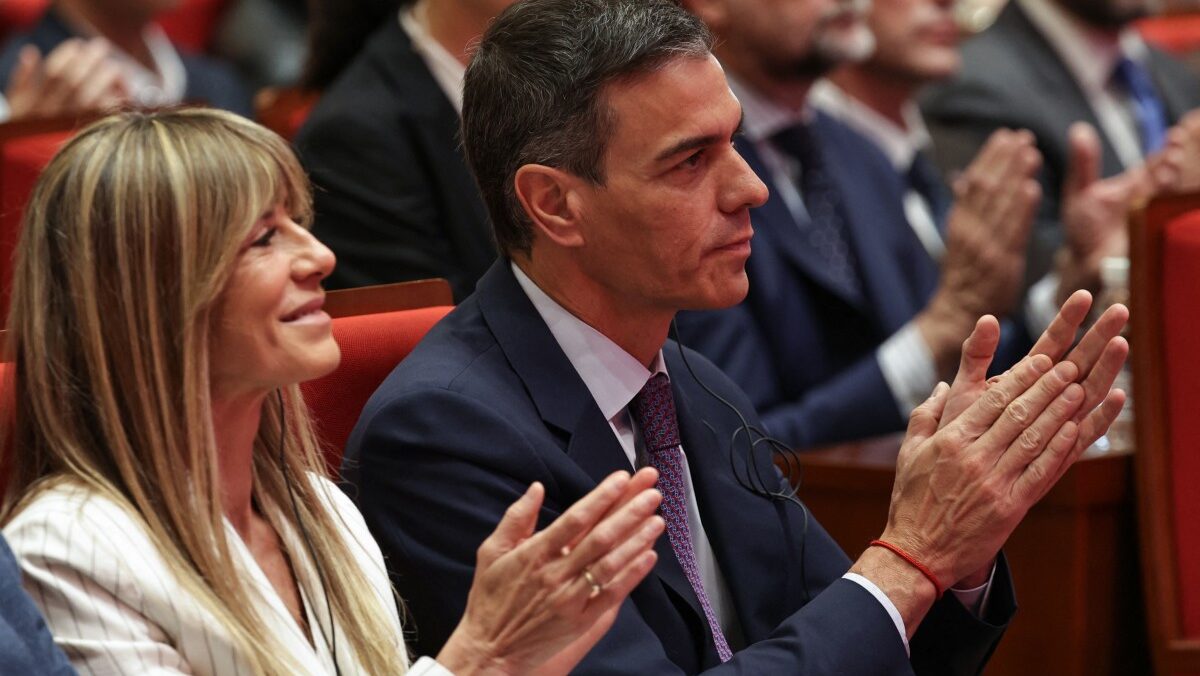
Begoña Gómez, the wife of Spanish prime minister Pedro Sánchez, surrendered her passport on Wednesday at a Madrid court after the investigating judge ordered several precautionary measures, citing the risk that she might try to evade justice.
The decision marks a new escalation in an investigation that, over the past year, has gone from being a political problem for the government to becoming a judicial case with direct consequences for the president’s immediate family.
Judge Juan Carlos Peinado has ordered Gómez to stand trial on alleged offences of influence peddling, business corruption, misappropriation, and embezzlement of public funds. The prime minister’s wife denies any wrongdoing, and her defence has appealed the measures imposed against her.
As part of those precautionary measures, Gómez will not be allowed to leave Spain, must appear before the court every two weeks, and has been required to surrender her passport.
The measure was requested by the private prosecutors, led by conservative advocacy group Hazte Oír, during the preliminary hearing held last week.
The significance of the case extends beyond the offences under investigation. It concerns the wife of a sitting prime minister, already subject to judicial restrictions on her movements in a case that directly affects the government’s public image.
The episode also has an unprecedented institutional dimension. In Spain’s recent democratic history, no comparable case had placed the spouse of a head of government in a procedural situation of this magnitude.
Peinado’s ruling has triggered a strong political and legal reaction. In his order, the judge argued that there was a possibility that Gómez could try to “remove herself from the action of justice.” He also suggested that officers assigned to her security detail could facilitate a potential escape, a claim that has caused outrage within the government, the interior ministry, and several police unions close to the Socialists.
Gómez’ defence, led by former Socialist minister Antonio Camacho, argues precisely the opposite: that the risk of flight is non-existent because the prime minister’s wife is subject to a permanent police protection detail that monitors all her movements, both in Spain and abroad.
That will be one of the points to be examined by the Madrid Provincial Court, before which the defence has appealed the withdrawal of her passport, the ban on leaving the country, and the obligation to periodically appear before the court.
What is beyond doubt is the political impact on a PSOE that appears close to being knocked to the ground by its own corruption.
Pedro Sánchez has governed Spain since 2018 and has built much of his political discourse around democratic regeneration and institutional cleanliness against the corruption that for years damaged his political opponents. That narrative is now turning against him.
The PSOE is facing an accumulation of cases and investigations affecting people linked to the party, the government, and the president’s closest circle. The case against Begoña Gómez is the most delicate because of its symbolic weight: it does not affect a mid-level official or a regional leader, but the wife of the head of government.
Even so, Sánchez’ survival does not currently depend directly on the courts but on parliament. The prime minister remains in office thanks to the support of a complex majority made up of left-wing, regionalist, and separatist parties.
As long as those partners continue to back him, there will be no immediate political change in Spain.