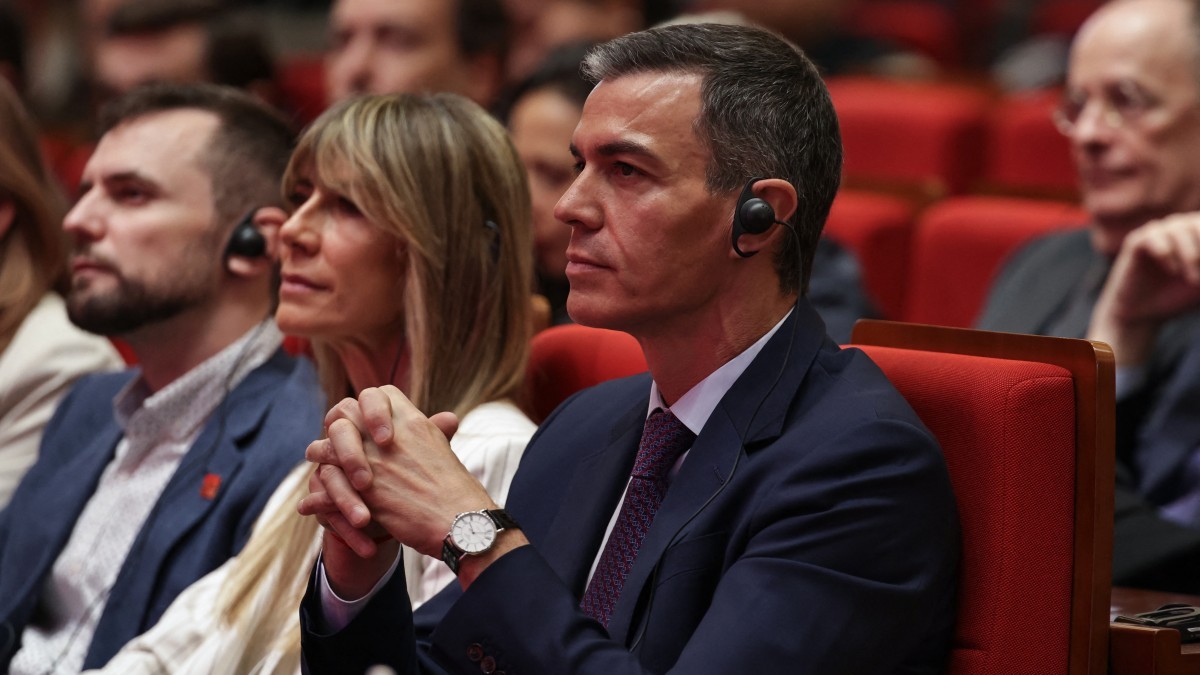
Spain’s Prime Minister Pedro Sánchez (R) and his wife Begoña Gomez listen to a speech as they visit Tsinghua University in Beijing on April 13, 2026.
ANDRES MARTINEZ CASARES / POOL / AFP
The Spanish Socialist Workers’ Party (PSOE) is going through one of the most delicate moments of Pedro Sánchez’s time in office, as several judicial investigations continue to advance and increasingly affect figures linked to the party and the prime minister’s immediate circle.
The most significant development has been the appearance of Sánchez’s wife, Begoña Gómez, before a Madrid court in a preliminary hearing that many observers view as a decisive step towards a possible criminal trial.
After more than three hours of proceedings, no immediate decision was made regarding the request by the private prosecutors to impose precautionary measures, including the temporary withdrawal of Gómez’s passport. The decision now rests with the investigating judge, who has several days to determine whether sufficient grounds exist to adopt such measures.
The hearing took place after the magistrate proposed sending Gómez to trial for alleged offences of influence peddling, business corruption, embezzlement of public funds, and misappropriation linked to academic projects developed within the framework of the Complutense University of Madrid. Gómez denies any wrongdoing.
One of the most significant developments of the day was the position adopted by the Complutense University itself. The institution, acting as a private prosecutor in its capacity as an alleged injured party, requested that the case proceed to trial, while the Public Prosecutor’s Office once again argued for dismissing the case.
The proceedings have become one of the most politically consequential judicial cases in Spain, as they directly affect the wife of a sitting prime minister and raise questions about the relationship between political influence, public institutions, and private interests.
The investigation into Begoña Gómez is only one of several fronts currently affecting the PSOE.
In recent weeks, the opposition has intensified its efforts to portray various judicial proceedings as part of a broader corruption problem within the governing party. People’s Party leader Alberto Núñez Feijóo and the party leadership have launched several initiatives aimed at bringing together under a single narrative the main cases affecting current and former Socialist figures.
Judicial pressure is also extending to other historic figures of Spanish socialism. Former Prime Minister José Luis Rodríguez Zapatero is due to appear before the courts in connection with the investigation into the Plus Ultra bailout, a development that adds a new political dimension to an already difficult situation for the PSOE.
So far, none of these investigations have resulted in final convictions, and the PSOE continues to reject accusations of systemic corruption. The Socialist leadership insists that it is cooperating with the courts and argues that part of the political offensive seeks to use ongoing judicial proceedings as a tool to weaken the government.
Nevertheless, the accumulation of cases is generating an increasing political cost for Pedro Sánchez.
The erosion is now no longer coming solely from the opposition. Some of the government’s parliamentary allies are also beginning to distance themselves. Junts‘ attempt to force a vote calling for early elections—ultimately blocked by the Congress Bureau this Tuesday—highlighted the growing unease within the majority that enabled Sánchez’s re-election.
Although there are currently no clear signs of an early election, the accumulation of corruption cases and the progress of multiple investigations are increasing political pressure on a government that is becoming ever more dependent on a fragile and heterogeneous parliamentary coalition.