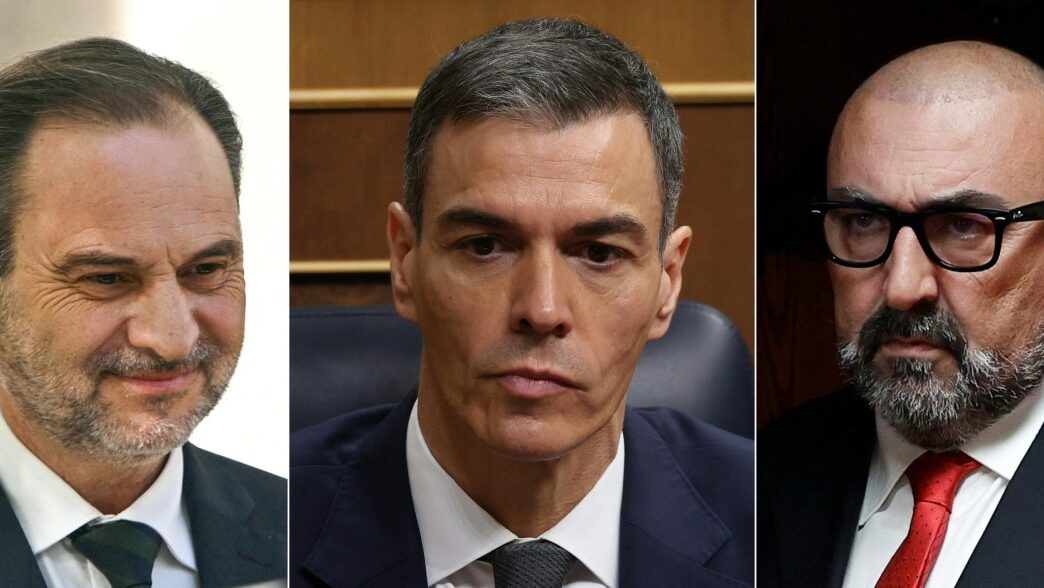
This combination of file pictures created on April 6, 2026 shows (from L) former Spanish Minister of Transport José Luis Ábalos (Madrid, October 15, 2025), Spain’s Prime minister Pedro Sánchez (Madrid, February 11, 2026) and former adviser of Spanish transport minister Koldo García (Madrid, April 22, 2024).
JAVIER SORIANO / AFP
Former Spanish transport minister José Luis Ábalos appeared before Spain’s Supreme Court on Tuesday, accused of bribery, influence peddling, embezzlement, misuse of confidential information, and belonging to a criminal organisation. Prosecutors are seeking a 24-year prison sentence.
Ábalos and his former aide Koldo García are accused of receiving kickbacks in exchange for public contracts awarded during the COVID pandemic, especially for masks and sanitary equipment. García faces 19 years in prison. Businessman Víctor de Aldama, who has cooperated with investigators, faces seven.
The case matters because Ábalos was not a minor figure inside Spain’s Socialist government. He was Pedro Sánchez’s closest political ally for years: the man who helped him return to the leadership of the PSOE in 2017, negotiated the parliamentary alliances that brought him to power in 2018, and later became one of the most powerful ministers in government. The guy who works behind the scenes for every president.
Sánchez came to office after removing the People’s Party government of Mariano Rajoy in a no-confidence vote triggered by corruption scandals. Ábalos himself played a central role in that campaign, accusing the previous government of having destroyed the moral credibility of Spanish politics.
Now the same politician is sitting in the dock accused of having profited from emergency public contracts.
The trial comes at a difficult moment for Sánchez. International crises had pushed Spain’s domestic scandals out of the headlines, but the start of proceedings has brought corruption back to the centre of political debate.
The problem for the prime minister is that the Ábalos case no longer appears isolated.
Santos Cerdán, who replaced Ábalos as the PSOE’s organisation secretary, was also forced to resign after being linked to another investigation over public works contracts. Spanish police later searched PSOE headquarters in Madrid, while judges opened a separate inquiry into possible illegal cash payments inside the party.
At the same time, Sánchez’s wife, Begoña Gómez, remains under investigation for alleged influence peddling and business corruption linked to companies that received public funding. His brother, David Sánchez, is also due to stand trial over his hiring by a regional authority.
The opposition argues that these cases reveal a broader pattern of corruption around the Socialist government. Sánchez denies any wrongdoing and insists that Ábalos acted alone.
But that defence may become harder to sustain if Ábalos is convicted.
He was not a distant colleague. He was one of the architects of Sánchez’s rise to power and remained at the centre of government for almost a decade.
This, combined with his control of the party on behalf of the president, makes it almost impossible to imagine that he acted on his own initiative. In a way, Sánchez is trying to cut himself loose from all his past ties in order to prevent his ship from sinking.
The trial may therefore become more than a criminal case. It could mark the moment when a series of separate investigations starts to be seen, inside Spain and abroad, as a wider crisis surrounding Pedro Sánchez and his government.