Jean-Luc Mélenchon is gaining ground as France’s 2027 presidential race takes shape, exploiting a divided Left and sluggish centrist campaigns. Still deeply unpopular, the chameleon-like Insoumis leader may yet prove far more dangerous than his current ceiling suggests.
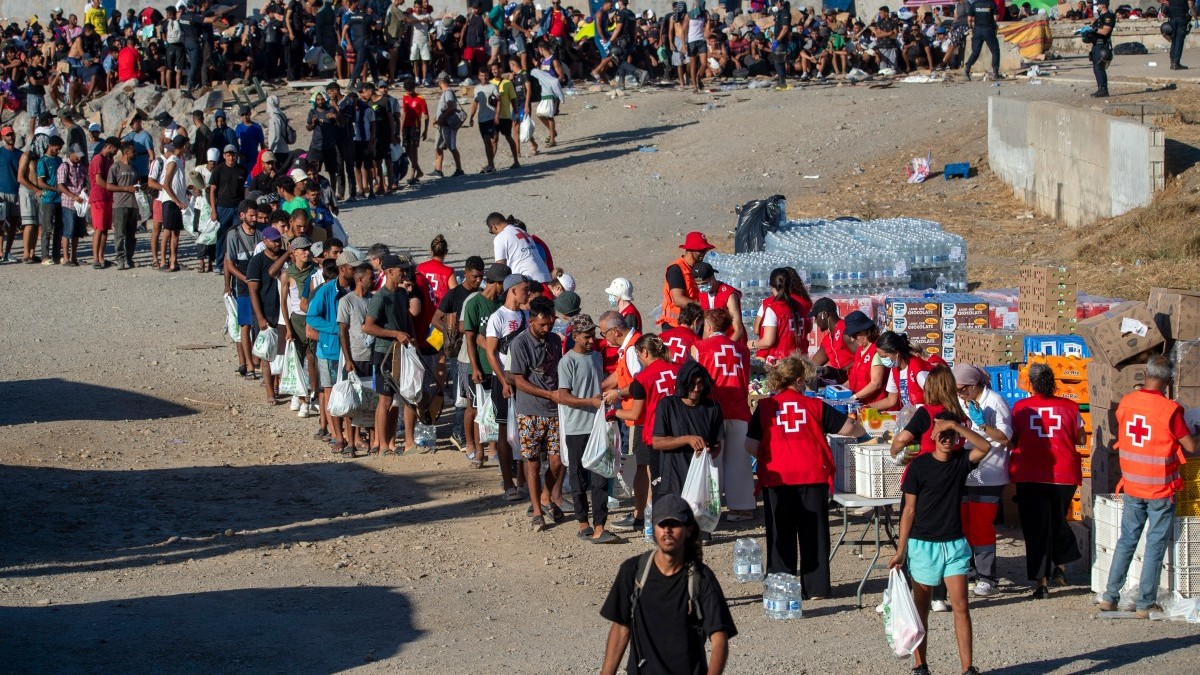
Red Cross volunteers distribute food to migrants living on the streets, at Trampolín beach in Ceuta, on August 22, 2026.
ANTONIO SEMPERE / AFP
A leak involving tens of thousands of members of Morocco’s security apparatus has opened a new chapter in the Ceuta crisis.
The hacker group Jabaroot claims to have published personal and professional information on around 70,000 agents and police officers linked mainly to the domestic intelligence service —DGST— and the General Directorate for National Security —DGSN— and has presented the operation as a “gift to Spain” following the mass entry on July 30.
The documents reportedly also include police officers and employees of the security apparatus. El Confidencial reports that former members of the Moroccan intelligence services have assessed at least part of the material examined as authentic.
Jabaroot goes beyond the leak and points directly at the Moroccan regime. The group accuses Abdellatif Hammouchi, head of both the DGST and DGSN, and royal adviser Fouad Ali El Himma of having planned the migratory pressure on Ceuta. It also claims to have information on agents deployed to Castillejos before and during the events.
For Spain, the use of the border as a political tool is not a new hypothesis.
The 2026 Strategic Outlook, published by the Ministry of Defence months before the crisis, explicitly recalled that in May 2021 Morocco used the entry into Ceuta of around 9,000 Moroccan citizens, including 1,500 minors, as an “instrument of pressure” to secure Spanish backing for its position on Western Sahara. The diagnosis, therefore, was already on paper before tens of thousands of people once again crossed the border this summer.
Police unions had also been warning for some time about the mounting pressure. On July 30th itself, Jupol denounced that Morocco had effectively lifted exit controls and argued that immigration was being used as an instrument of pressure against Spain. The government eventually created a unified command structure and convened the National Security Council almost a month after the crisis began, prompting widespread criticism.
Fernando Cocho has now added his warning to the list. The intelligence analyst claims since 2022 that he has had access to reports contemplating a future “co-sovereignty” arrangement for Ceuta and Melilla. This week, he clarified that he was not referring to a proven agreement between Pedro Sánchez and Mohammed VI, but rather to Moroccan documents allegedly setting out Rabat’s objectives for around 2030.
According to Cocho, the objective would be to progressively overwhelm the border, public services and the welfare system, until living conditions deteriorate enough to push part of the resident population to leave. With the city increasingly dependent on civil servants and state structures, he argues, Rabat could later seek to promote a special status or some form of shared sovereignty. “They are seeking a social explosion,” he summarised. Given Brussels’ inaction, they may not be far off the mark.
Meanwhile, the immediate problem continues on the ground. The government transferred around 1,700 migrants from El Trampolín beach to temporary facilities with an initial capacity for 1,800 people, providing food, water, accommodation and assistance. Hours later, around 500 returned to the beach. Some cited fears of possible repatriation and distrust of the reception centres.
Ceuta has therefore returned to the same political reality Spain has known since 2021: the border is not merely a migration issue. It is also a lever of power. And Rabat has already shown that it knows how to use it. Several figures within the Moroccan government continue to lay claim to Ceuta and Melilla. One of the most prominent advocates of that has been Justice Minister Abdellatif Ouahbi.