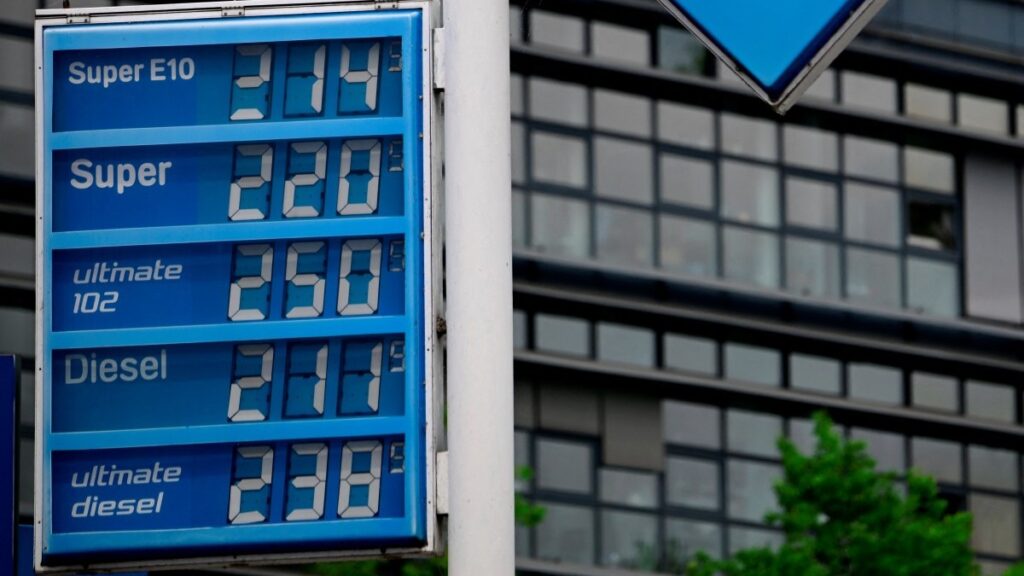
This photo taken on July 1, 2026 shows a digital display of the prices for different kinds of fuel at an Aral oil and gas station in Berlin, following an adjustment of the prices at noon after the German state’s discount fuel expired.
TOBIAS SCHWARZ / AFP
A few years ago, one of the most widely quoted lines from the television series Game of Thrones was “Winter is coming.” The phrase took on a life of its own in political discourse during the energy price surge that began gradually in the second half of 2021 and then accelerated dramatically following the outbreak of the Russia-Ukraine war. By the end of the summer of 2026, the situation looks different–unfortunately, worse. As the war in Ukraine drags on and Europe’s adverse energy situation becomes increasingly entrenched, tensions in the Middle East and the extreme summer weather have added further pressure. As a result, the question Europe now faces is no longer what will happen when winter comes. Europe first has to make it through the fall.
‘Energy is at the heart of today’s geopolitical tensions,’ says the International Energy Agency’s World Energy Outlook 2025. This statement is particularly true in terms of the European Union. After all, the history of Europe in the third decade of the 21st century–at least so far–has been a history of geopolitics and energy crises. In the aftermath of the pandemic and during the first years of the Ukraine war, the EU’s energy bill doubled to €1.8 trillion. High energy prices have reverberated across the entire economic structure of the EU, exposing the bloc’s long-standing–and increasingly visible–loss of ground in global economic competition. It was against this backdrop that the Draghi Report, named after the former president of the European Central Bank, was published two years ago. It identified high energy prices as one of the EU’s key competitiveness challenges, noting that “Even though energy prices have fallen considerably from their peaks, EU companies still face electricity prices that are 2-3 times those in the US. Natural gas prices paid are 4-5 times higher.”
This already difficult situation was hit head-on by the U.S.-Iran war that broke out at the end of February, exposing just how far Europe still has to go in addressing its structural vulnerabilities. A late-May analysis by the European Commission’s Joint Research Centre had already forecast higher energy prices in the autumn months, together with their impact on inflation and economic growth, should the conflict in the Middle East drag on. That is precisely what happened. In other words, it is difficult to claim that ‘we did not see this coming.’
And if that were not enough, heat records were being broken across Europe one after another, alongside new peaks in electricity demand. The heatwaves in June and August placed the European power system under pressure rarely seen before–while also providing plenty of ammunition for both supporters and critics of renewable and nuclear energy.
After such a dense and volatile period, Europe’s economy is now expected to regroup and head into the fall season. For the time being, the outlook is not particularly encouraging. Adam Smith’s invisible hand has left some very visible scars on Europe over the past few months. The EU paid the highest price for the supply disruptions caused by the Hormuz crisis: its energy bill increased by $78 billion as a result of the Middle East situation alone–more than twice the $35 billion cost borne by China. Eurostat recently reported that, for the first time in three years, the EU had slipped into a trade deficit. And, unsurprisingly, high energy prices were the main culprit behind the €21.8 billion deficit: the energy balance deteriorated from -€71.3 billion in Q1 to -€101.1 billion in Q2.
Meanwhile, market energy prices have remained stubbornly high. Brent crude is trading at around $90 a barrel at the time of writing, while TTF–the benchmark for European natural gas prices–stands at €66–68/MWh. For TTF, this is the highest level since March and, apart from the peaks of close to €350/MWh reached in August 2022, the highest August level since the outbreak of the Ukraine war. The significance of elevated gas prices is further amplified by the fact that European gas storage levels have been this low only once in the past 15 years: in 2021, at the beginning of the previous energy crisis. At just under 63%, current storage levels are well below the five-year average of 80% and the 76% recorded at the same point last year.
Even though the decline in EU gas consumption in recent years may somewhat mitigate the energy security and stockpiling risks associated with lower gas storage levels, this degree of uncertainty is still more than enough to counter any decline in wholesale energy prices. Goldman Sachs analysts estimate that TTF gas prices could rise above €100/MWh by the end of the year, as the EU will have to rely on LNG imports to meet its winter gas needs in the absence of other sources. But the LNG market itself remains volatile. One-fifth of global LNG trade passes through the Strait of Hormuz, while LNG imports are needed not only by European economies but also by those in Asia. And competition for scarce resources, as the iron laws of the market dictate, inevitably pushes prices higher.
Needless to say, the significance of high energy prices is first and foremost their impact on the production costs of businesses and the cost of living for households. Energy prices are ultimately a question of living standards. The memory of the historic wave of inflation triggered by the previous energy crisis has barely faded, yet storm clouds are gathering once again. According to the European Central Bank, further interest rate hikes may be needed to keep prices under control, as signs of renewed inflationary pressure are already emerging: energy inflation in the eurozone accelerated from 8.5% to 10% in the first two months of the summer. Higher interest rates, in turn, affect household mortgages, corporate loans, and the cost of financing public debt. It hardly comes as a surprise that some EU member states are already looking for ways to ease the burden through fiscal measures. The idea of taxing energy companies’ windfall profits has been put back on the agenda. Given the financial results of the major oil companies, this may offer governments at least some hope of expanding their fiscal room for manoeuvre: in Q2, Shell more than doubled its profit, while TotalEnergies posted its highest profit in three years.
There is little doubt that, after 2021–2022, Europe is facing another energy crisis–or perhaps is already in one. Every forecast points to serious challenges in the months ahead. What remains unanswered is how much the current crisis will ultimately cost Europe. To borrow the classic question from political science: “Who gets what, when, how?” Because there is little point in denying that higher energy prices will come at a cost. What matters is how the EU chooses to respond.
The EU policymakers’ response to the energy crisis triggered by the war has centred on the concepts of strategic autonomy, resilience, and de-risking. According to the EU’s strategy, moving away from Russian energy supplies and establishing new channels of procurement should provide a stable foundation for significantly reducing Europe’s energy dependence. The conflict in the Middle East is evidence that this assumption does not quite stand up to scrutiny. A war geographically far removed from Europe’s borders and immediate security environment can still cause severe supply disruptions, uncertainty, and economic damage to the bloc, at least in the medium term. Moreover, the closure of the Strait of Hormuz has demonstrated that Europe’s post-2022 drive to increase LNG imports does not actually eliminate its dependencies–at best, it reshuffles them.
None of this means that the EU’s overarching energy policy objectives are inherently misguided at a philosophical or abstract level. Who would not want affordable energy to be available in the face of extreme weather? Who would willingly pay more for energy simply because other countries and geopolitical rivals are at war with one another? And what company would not prefer energy that is produced and available locally, rather than being dependent on another country’s production, export policy or pricing?
The lesson to be drawn from recent events is rather that EU policymakers cannot behave like a runner attempting to complete a marathon without a training plan. Long-distance running is not simply about covering distances of 25, 30 or 35 kilometres. On the contrary, interval runs of one or two kilometres–and even 200-metre sprints–are an integral part of the preparation. Without them, the outcome may be little more than a poor finishing time, breathing difficulties and muscle pain–at best. At worst, there is injury, or a race that starts too fast and has to be abandoned after the first few kilometres. Unfortunately, the EU seems to be heading increasingly in the latter direction. The long-term ambitions are there–strategic autonomy being a case in point–but short-term challenges such as the current energy crisis seem increasingly capable of derailing, right from the start, the objectives so carefully packaged in EU policy jargon.
For the EU to overcome the obstacles ahead, it cannot afford to abandon pragmatic solutions that can adapt flexibly to a changing environment. Energy policy cannot be built around dogmatic and rigid expectations. Instead, it requires an effective, sensible and responsive alignment of objectives and instruments–from the short term all the way to the long term. The coming months will show whether European policymakers and institutions are capable of making the strategic adjustments necessary for success.