There is a sense of economic awakening in Europe. It is fragmented, not very focused, and in its very early stages. But important institutions are beginning to see the continent’s problems for what they really are: not just a passing recession, but a sustained quagmire of economic stagnation.
Recently, ECB President Christine Lagarde voiced her concerns and made some surprisingly candid remarks about Europe’s economic ailment. Although she did not come full circle and acknowledge the truly structural nature of the stagnation problem, she did venture further into the territory of intellectual repentance than any other influential European policy maker has dared.
Now the European Commission has made its contribution. In a report on something called the Industrial Accelerator Act (IAA), published on March 4th, the Commission recognizes one specific example of Europe’s economic stagnation: its manufacturing industry is in poor shape. With the IAA, the Commission expresses a desire to strengthen manufacturing.
Unfortunately, that is where the IAA report runs out of productive substance.
Let us get back to that point in a moment. First, we need a background on just how serious Europe’s economic stagnation problem is. Again, this is not a recession; it is a permanent condition.
In my book Industrial Poverty (Gower, 2014), I explain how advanced economies sink into such long-term states of stagnation. Government plays an essential role: no matter how well-intended a government thinks it is, it can suffocate a growing, productive economy into standstill and decline just by pursuing the very policies it deems virtuous. My book points to the Soviet economy as an example of how the heavy hand of government forces entire societies into a decades-long standstill where one static standard of living is inherited by children from their parents.
The Soviet system is admittedly a drastic image to use when discussing Europe today, decades after the Soviet system imploded. However, from a strict economic angle, the fundamental point remains valid: if government is going to be involved in the economy, it had better know what it is doing.
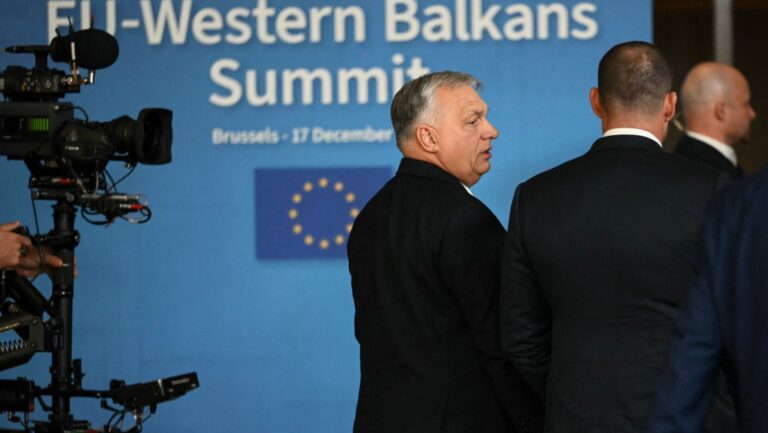
A government can be involved in the economy, but only if it puts the growth of the private sector above itself. The Fidesz government in Hungary is a good example: for 15 years, its economic policies have helped Hungary leap to higher levels of prosperity. The Hungarian economy has grown at rates few other nations have been able to match; to take one example, its manufacturing industry has grown significantly. This is all thanks to policies that are centered first and foremost around the needs and preferences of private enterprise—not the government.
This mindset, where government is viewed as a service function for the private sector and only used as such where it actually can help the private sector, is alien to the European Union. The European Commission’s report on the Industrial Accelerator Act is a case in point: just as it does in so many other policy areas—immigration, energy, social policy—the Commission demonstrates its inability to put the private sector above its own interests.
So deeply impregnated in the EU hallways is its desire to put government first that even when it makes a concerted effort to help the private sector, its own ideology takes precedence.
While marketed as a tool to strengthen Europe’s manufacturing sector, in reality, the IAA is an expression of an ill-fated will to impose government preferences on the private sector. Already in the introductory section, called “Context of the Proposal,” the Commission explains (emphasis added):
The manufacturing sector is essential for safeguarding and boosting the EU’s long-term economic resilience and to meet its climate neutrality goal.
The very concept of “climate neutrality” is an ideological one, chosen by the EU as a leading principle for all economic activity under its jurisdiction. By highlighting it already at the beginning of an effort to help the manufacturing industry grow, the European Commission effectively ties the very hands that would otherwise go to work and grow that same industry. Whenever there is a conflict between manufacturing growth and climate neutrality, the latter—being an ideological axiom—gains superiority over manufacturing growth.
As a stark illustration of how the ideological mindset gets in the way of the genuine generation of economic growth, the Context section also mentions that
the manufacturing sector increasingly faces challenges, such as high energy prices [and] high capital and operational costs for decarbonisation.
These are problems for the manufacturing industry—problems that the European Commission admits are real. Yet at no point does the IAA report address these problems.
Then the Commission moves on to explain that the decline of manufacturing as a share of GDP is a problem in itself—one that its heavy government hand needs to solve (p.2):
That is why the Industrial Accelerator Act aims to ensure that by 2035, this trend is reversed and that manufacturing represents 20% of the EU GDP.
There is absolutely no rationale in fixing a number like this, especially not as the goal for any kind of industrial policy. A free market, capitalist economy evolves organically with human, technological, and social evolution. Entrepreneurs, investors, and business leaders adapt their operations, their skills, and their products to the needs and wants of their buyers.
At one point in our history, agriculture accounted for the vast majority of all economic output. Later on, manufacturing grew to prominence, generating a surge in the generation of economic value; in the mid-20th century, the services sector began overtaking manufacturing as the dominant type of industry in highly evolved economies.
It is telling when a government report lists economic policy goals with no economic meaning to them. It reveals the lack of interest in—and, even more so, lack of knowledge about—the problem that the report is meant to address. It reinforces the impression that the report is not meant to set in motion a process for actually improving the manufacturing sector but to fold the need for such improvements in under the European Union’s own already existing ideologically motivated policy goals.
Sadly, this ham-fisted approach to industrial policy is not limited to the European Commission. It is peppered throughout the section of the report provided by the European Parliament and the Council of the European Union. Page 32 offers a representative example: in a paragraph discussing how important businesses and households are to “the demand for net-zero technologies in the Union,” the report explains that it is “necessary” with new regulations and requirements “for battery energy storage systems, solar photovoltaic technologies and heat pumps.” Then, to emphasize that this is, after all, an effort to boost manufacturing, the paragraph explains:
Such additional requirements should ensure that certain main specific components and, in some cases, the whole final product, originate in the Union.
In other words, just as the introduction of the IAA report explained so carefully, the goal here is to enhance manufacturing that is in line with the EU’s superimposed ideological goals.
To that point, the programmatic finale of the paragraph on page 32 explains that the made-in-the-EU policy
is in line with the general objective of support schemes to promote socially-desirable outcomes, in view of making progress on the ambitions of the European Pillar of Social Rights as well as environmental and climate objectives.
What would be the status of the IAA report if it were not “in line with … socially-desirable outcomes”? The answer, unfortunately, is very simple: it would never have seen the light of day.
With all that said, the Commission deserves credit for at least making an effort at recognizing that Europe has deep, structural economic problems. Hopefully, the next step—a deeper recognition of what has caused those problems—will come soon.