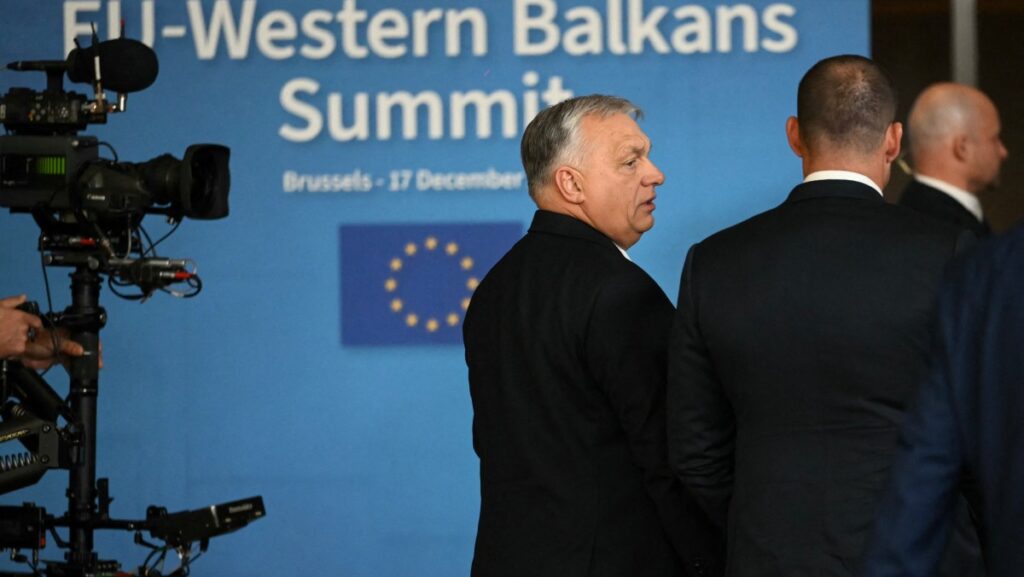
Hungary’s Prime Minister Viktor Orbán leaves after the group photo as part of the EU Western Balkans summit ahead of the European Council in Brussels on December 17, 2025.
NICOLAS TUCAT / AFP
The future of relations between Hungary and the Western Balkans is entering a period of uncertainty, shaped by shifting political dynamics. The results of Hungary’s April 12 elections have introduced a new variable into an already complex regional landscape. While the general posture of Western Balkan leaders had been largely predictable ahead of the vote, the two-thirds victory of Péter Magyar and his Tisza party came as a surprise to all.
Despite this, regional leaders appear to recognize that continuity in cooperation is both necessary and inevitable. Hungary remains deeply embedded in economic, political, and infrastructural projects across the Western Balkans, and its role as a supporter of EU integration of the region is not likely to diminish. The question is not if, but how the relationships will evolve under Hungary’s new political leadership.
For now, the only actors that offered reaction to the election results without congratulating Magyar on the win were politicians from Republika Srpska (RS). Former President Milorad Dodik—still the de facto most relevant politician in Republika Srpska—stated that he “grieves for the electoral loss of Viktor Orbán” and that he will meet and discuss further relationships with his close ally and friend Orbán. When asked about joint projects between RS and Hungary, Dodik stated that “all agreed projects have been implemented to a significant extent” and that any breakdown in relationship would be because of the will of the Hungarian side.
Nenad Stevandić, president of the National Assembly of the Republic of Srpska, didn’t congratulate Magyar either, but instead compared Orbán to the phoenix, indicating a desire for his eventual return to power. These attitudes from the most prominent political figures in Republika Srpska will undoubtedly be used by the rulers in Bosnia and Herzegovina—mainly Muslim Bosniaks—to reinstate good relations with Budapest after many years of stagnation and even regress. Bosnia and Herzegovina’s Foreign Minister Elmedin Konaković immediately congratulated Magyar on the electoral win on X, expressing hope for a better relationship between his country and Hungary.
The intentions of Croatian Prime Minister Andrej Plenković were well-known even before elections took place. He met with Péter Magyar in Munich in mid-February to discuss bilateral relations well before Magyar even won the elections. In other words, he was the only one from the region who made a bet and won. This bet will most likely bring closer ties between Zagreb and Budapest, mostly regarding strategic energy concerns and the use of the JANAF pipeline to transit non-Russian-origin oil from the Adriatic Sea port of Omišalj to the Százhalombatta refinery near Budapest. Such an agreement would benefit Croatia the most, as it would create new profits from oil transit, but it would also diversify oil sources in Hungary, which would in theory bring a more stable and secure energy supply.
Kosovo’s Prime Minister Albin Kurti was also among the first leaders to congratulate Magyar on X on Sunday evening, just after results became clear. Since Hungary officially recognizes the statehood of Kosovo, the most likely outcome will be improvement of bilateral relations, which have been in a stalemate for the past several years.
Albanian Prime Minister Edi Rama had the expected reaction, personally thanking Orbán for increasing cooperation and improving the bilateral relationship and, at the same time, congratulating Magyar, indicating his will to further increase cooperation. Hence, no significant change in the relationship between Tirana and Budapest is expected. Montenegro’s prime minister, Milojko Spajić, congratulated Magyar and also expressed his will for cooperation, emphasizing the European Union context. His very neutral stance means no significant changes are expected there.
North Macedonia offers a clear example of how political alignment has shaped bilateral ties. The close relationship between Hungary’s Fidesz government and the center-right, nationalist VMRO-DMPNE in North Macedonia facilitated a wide range of joint projects and deepened cooperation. However, despite this strong foundation, North Macedonia’s ruling party has taken a pragmatic approach, expressing readiness to work with the new Tisza government. This approach is likely to be met in kind by Hungary’s new leadership. Given the reportedly similar stance on migration as the previous Fidesz government, as well as the practical need for continued collaboration on the issue, both sides appear well-positioned to maintain their partnership.
The most notable change in bilateral relations is expected in Serbia. In light of shifting dynamics surrounding Republika Srpska and, more significantly, Croatia and Kosovo, Belgrade may begin to distance itself from its previously closer ties with Budapest. Even so, the relationship is expected to remain functional and grounded in practical cooperation. Ongoing projects—such as the Budapest-Belgrade railway, the construction of the oil pipeline between Novi Sad and Algyő, and broader energy arrangements involving Hungarian multinational energy company MOL’s acquisition of Serbia’s main oil and gas company NIS—will continue to anchor ties and ensure a level of engagement. A similar approach can be expected from the Hungarian side, as Peter Magyar is likely mindful of the continued support his predecessor received from its southern neighbor.
The first visible signs of a potential downturn in relations can be observed in Serbian President Aleksandar Vučić’s response to Magyar’s remarks regarding the explosives discovered near a gas pipeline in Serbia on April 5, just one week before the election. Magyar suggested that the new Hungarian government would examine whether the incident constituted a ‘false flag’ operation or a genuine threat. Vučić reacted sharply, asserting that Magyar has no jurisdiction on Serbian territory and emphasizing that Serbian authorities would continue conducting their own investigation. Taken together with other pointed remarks from Vučić, as well as elements of Magyar’s post-election speech, it is increasingly evident that the historically high level of relations reached during the Orbán-Vučić era has peaked.
The aftermath of the elections is already reshaping the tone and trajectory of bilateral ties, reflecting broader political shifts reverberating across the region and Europe as a whole.
Among the first to feel these shifts may be the Alliance of Hungarians in Vojvodina (VMSZ)—the political party in Serbia representing the interests of the ethnic Hungarian minority living in the autonomous province of Vojvodina—as it may find itself increasingly forced to carefully balance between Budapest and Belgrade as the regional dynamics begin to change.