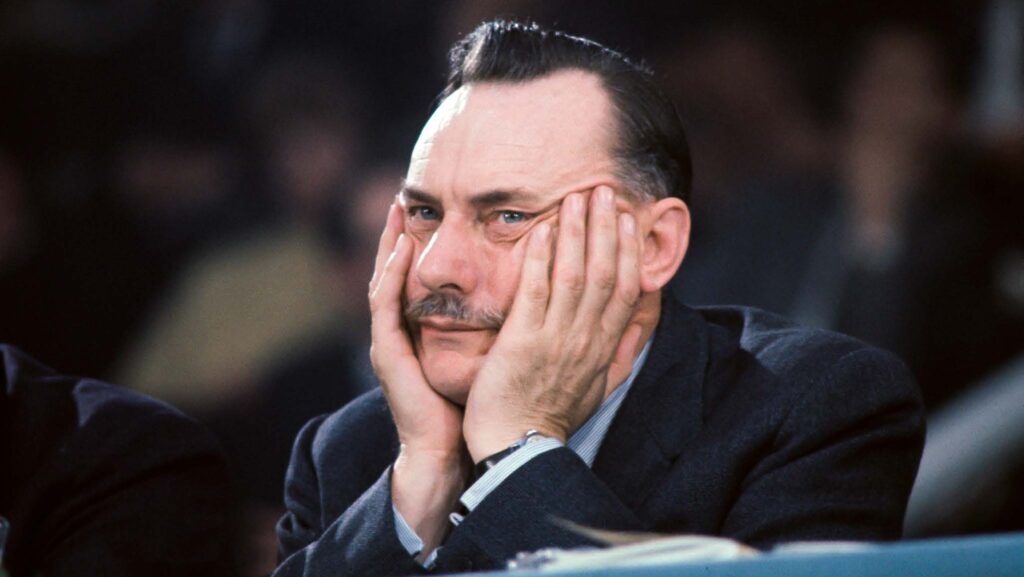
British Conservative politician Enoch Powell (1912-1998), then Shadow Secretary of State for Defence, sits listening during the Conservative Party’s annual conference in Brighton in October 1965.
Photo: Rolls Press/Popperfoto via Getty Images.
No public figure has transitioned from the status of ‘respectable company’ to ‘pariah’ faster than the British statesman Enoch Powell. On 20 April 1968, he addressed a gathering of conservatives in Birmingham on immigration:
A week or two ago, I fell into conversation with a constituent, a middle-aged, quite ordinary working man. After a sentence or two about the weather, he suddenly said: “If I had the money to go, I wouldn’t stay in this country. In this country in fifteen or twenty years’ time the black man will have the whip hand over the white man.”
Powell then told of an elderly female constituent, the last white Brit on her block, who had suffered harassment at the hands of her colored immigrant neighbors, including broken windows and excrement shoved into her mailbox:
When she goes to the shops, she is followed by children, charming, wide-grinning piccaninnies. They cannot speak English, but one word they know. “Racialist,” they chant.
When this woman fell into dire financial straits, Powell explained, “She went to apply for a rate reduction and was seen by a young girl, who on hearing she had a seven-roomed house, suggested she should let part of it.” The elderly woman explained that she had taken renters in the past, but now, “The only people she could get were negroes.” The girl replied, “Racial prejudice won’t get you anywhere in this country.”
At this time, a new Race Relations Bill was before Parliament. It would, if enacted, outlaw racial discrimination in transactions such as room letting. Powell’s elderly female constituent feared that when the Bill passed, she would go to prison. Britain’s future, according to Powell, would be hazardous enough if the inflow of immigrants were not halted and reversed, but, “To enact legislation of the kind before Parliament at this moment is to risk throwing a match onto gunpowder.”
The speech came to a climax when Powell referenced a Sybil from the Aeneid: “As I look ahead, I am filled with foreboding. Like the Roman, I seem to see ‘the River Tiber foaming with much blood.’”
The speech was shocking not only for its language but also for its source. Enoch Powell was a party insider. Indeed, he was in the shadow cabinet when he made the speech. On that day, however, Powell took a step outside establishment politics to begin his greatest role: a populist ‘short-circuit’ who was determined to undermine the false narratives of post-war consensus politics and to dislodge the elites who perpetuated them.
As a young man, John Enoch Powell seemed destined to succeed wherever he went. After a successful academic career that culminated in his appointment as the youngest professor of Greek in the British Empire, he went on to a successful military career that culminated in his appointment as the youngest brigadier in the British Army.
Powell succeeded despite his efforts. He refused several promotions in the military because he wanted to die on the battlefield. His superiors, however, found his sharp mind too useful for other purposes. This pattern persisted when he entered conservative party politics after the war.
Powell’s friend, Iain Macleod, nicknamed him “the resigner.” As a man with contrarian opinions, Powell did not enjoy the stifling responsibility of toeing the party line; therefore, he declined office or resigned from three conservative governments between 1950 and 1964.
Powell’s beef with the Tory party was that it was too similar to Labour. It needed to be more nationalistic and unabashedly pro-free market. He wanted to change his party more than he wanted to wield power; and, in the mid-1960s, he believed that his chance had come.
In 1964, the Conservatives were ousted from government after losing their majority in the House of Commons. Powell believed that the party was eager for a reset, and so he accepted a position in Ted Heath’s shadow cabinet in July of 1965.
On foreign policy, Powell attacked the Labour government both for maintaining a military presence east of the Suez Canal, and also for slavishly endorsing everything the Americans were doing in Vietnam. He even insinuated that Prime Minister Harold Wilson had a secret plan to drag Britain into the Vietnam War.
On economic policy, Powell ridiculed the government’s attempt to combat inflation by controlling prices and incomes. He mocked the government for attempting to increase exports simply by demanding that British companies export more. He opposed legal immunities that enabled large unions to strangle the British economy with official work strikes. He argued for the de-nationalization (i.e., privatization) of the nationalized industries. He proposed ditching the fixed exchange rate and floating the pound.
In shadow cabinet meetings, Powell’s colleagues, led by Ted Heath, tried to rein him in. They told Powell that party policy should be decided in private meetings of the shadow cabinet rather than in public speeches. But Powell considered this entirely inappropriate. He knew that a party outside government traditionally permits a wide variety of expressed opinions among its members, including frontbenchers, to foster a reset following electoral defeat.
Powell’s problem was that both major parties were led by elites who accepted the postwar consensus: that the economy needed to be planned by an alliance of big-government technocrats and big-union bosses. Britain was still, supposedly, a vast Empire or Commonwealth, ordained by divine providence to safeguard the free world alongside the new big Imperial power on the block—the United States.
Britain’s immigration problems arose from these post-imperial delusions of grandeur. Between 1947 and 1962, anyone from any part of the Commonwealth (Britain’s former colonies) was considered a “Commonwealth citizen” and had the right to settle in Britain. Parliament finally defined British citizenship in 1962 and restricted immigration, but the inflow continued at approximately 50,000 per year.
Powell warned his shadow cabinet colleagues that racial tensions would increase if the annual inflow of 50,000 Commonwealth immigrants were not halted and reversed by way of financial assistance to those who wished to return to their native lands (i.e., voluntary repatriation).
Powell’s colleagues largely agreed with these prescriptions and even adopted them as party policy. Heath, however, wrote to Powell that emphasizing repatriation “would encourage the racial intolerance which undoubtedly lies below the surface in many parts of the country; and this could only exacerbate the problem.” Powell replied,
I find in my constituency in the last few weeks an ominous deterioration, which is taking the form not of discrimination by white against coloured but of insolence by coloured towards white and corresponding fearfulness on the part of white. It is this which will be exacerbated by the projected legislation on discrimination and which we shall have to take into account in making up our minds on our attitude.
Powell was referring to the Race Relations Bill that was progressing through the Commons. His colleagues wanted to propose amendments to the bill and quibble over details while accepting the premise that native Britons were oppressing colored immigrants. They also sought to publicly declare their agreement with the goal of protecting colored immigrants by placing legal restrictions upon white Britons.
For Powell, the framing of the issue was detached from reality. He sought to rectify this with a countervailing narrative on the race problem. This became his ‘Rivers of Blood’ speech. Unlike prior speeches he had given, this one relied heavily on examples of white, native Britons in his constituency suffering harassment by colored immigrants (or “reverse racism,” as he termed it).
This speech shifted the framing of the immigration debate; it became common and acceptable to express concern for the native over the foreigner. Unfortunately, Heath dismissed Powell from the shadow cabinet after the speech. “I do not believe,” said Heath, “that the majority of Britons agree with the way Mr. Powell expressed his views.” Yet one Gallup poll suggested that 74% of Britons approved of Powell’s remarks.
Two days after Powell’s dismissal, a thousand London dockers walked off work to protest Powell’s sacking. They marched to Westminster holding signs saying, “Don’t knock Enoch,” “Enoch is right,” and “Back Britain, not Black Britain.”
The next day, another 600 dockers at St. Katherine’s docks voted to hold a one-day strike in support of Powell, while 600 meat porters in Smithfield left work, marched to Westminster, and presented Powell with a 92-page petition protesting his dismissal (apparently, they were unfamiliar with Powell’s stance on union immunities).
Peter Utley of the Sunday Telegraph wrote, “Powellism, or at any rate something thought to be Powellism, had ceased to be the eccentric profession of a few sophisticates and became a strong popular movement.” His rhetoric, accordingly, began to assume a distinctly populist tone, even on economic policy.
Powell told crowds of union workers that they did not cause inflation; rather, the government did so by expanding the money supply. According to Powell, a prices-and-incomes policy was nothing more than a political tool for shifting blame for inflation from the government to the working man.
Powell ridiculed business and banking leaders who dutifully implemented every directive issued by the Labour government. He derided business owners who, upon request from the Prices and Incomes Board, withheld dividends from shareholders or wages from workers. He called them “collaborators.” Those industry leaders who completed the Treasury’s surveys—intended to assist the Labour government in drawing up a Soviet-style five-year plan—he similarly ridiculed as collaborators. They were collaborating, he said, with the forces of Socialism.
Powell’s populist message continued through the election of 1970. His campaign, that summer, was almost proto-Trumpian. At a rally in Wolverhampton on 16 June, with 1,300 people in attendance, protestors began throwing chairs. Powell jumped down from the stage to prevent a steward from expelling a TV cameraman. He hopped back onstage and, while pointing at the cameras, said,
The BBC and other media are now photographing trivialities with which they are concerned, not being concerned with political reality … this is the sort of people who are in control of the channels of communication in this country—now in this room you have a very fine idea of the nature of the channels of communication upon which you are dependent.
The parallels with Trump calling out the media during his 2016 rallies for focusing on the violent disruptors while ignoring the great bulk of MAGA supporters are obvious. Attacking the media became a habit for Powell. Throughout the campaign, he referred to them as the “enemy within.”
At another rally in Wolverhampton, a young agitator interrupted Powell’s speech by giving a Roman salute and shouting “Sieg Heil!” Powell pointed at the young man and said,
You may think what you are seeing here is an exhibition of youthful exuberance and bad manners. It is not. You may think it is harmless. It is not. You may think it is aimed at me. It is not. It is aimed at all of you. They are after you. All of you are their target. Its aim is to see the day-to-day way of life, the decent things of life, that the majority want, demolished and destroyed.
This calls to mind Trump’s often-repeated line: “They’re not after me, they’re after you. I’m just in their way.”
Polling in the final days of the election indicated that Labour would win comfortably, but it proved inaccurate. The Conservatives gained 77 seats, Labour lost 75, and the Liberals lost 6. The Tories now had a 42-seat majority in the House of Commons.
American pollster Douglas Shoen and Oxford academic R. W. Johnson, in their research, concluded that “Powell had won the 1970 election for the Tories.” They estimated that Powell brought in between 2.5 and 5 million new Tory voters.
Powell had effectively dragged the conservative party across the finish line. This meant that Ted Heath would form a government and serve as Prime Minister. Ironically, if the conservatives had lost the election, Powell would have been better positioned for a run at party leadership.
Any hope of his attaining Tory leadership would soon be dashed, as Powell would finally break with the Tories over Britain’s entry into the European Economic Community (EEC). While the leaders of the major parties insisted that the EEC was nothing more than a free-trade area, Powell saw it for what it really was: A political union.
In 1970, while speaking in the House of Commons, Powell quoted a report issued by the six EEC member countries. The report called for “meaningful harmonization of policies,” which mandated that “growth targets, rates of inflation, unemployment, budgets, and taxation must eventually all conform to a community standard.” He, then, asked, “Are not social policies, growth targets, unemployment, development and taxation the very stuff of politics, about which we in this House argue day and night?”
Powell concluded that EEC membership did not mean freer trade but rather a transfer of governance from Westminster to a European Parliament. He wrapped the issue in populist rhetoric while speaking in the country, and he warned that although the British people could currently dismiss a bad government by voting for the opposition in the next election, no such avenue for redressing grievances would exist in a European parliament. Nevertheless, Heath enshrined a commitment to EEC entry in the 1974 Tory Party manifesto. In protest, Powell resigned the Conservative whip and left his seat.
When Powell was on the party’s front bench, he represented the party and therefore had to moderate his words. On the party’s back bench, he became more daring, but he still had to defend the party’s election manifesto. Now, he was entirely outside of the conservative tent. Nothing was holding him back.
Powell urged his supporters to vote Labour in 1974, because their party manifesto at least promised a popular referendum on EEC membership. As a result, Heath lost. As Powell would quip, “I put him in, and I took him out.”
Powell joined the Ulster Unionist Party in the mid-’70s and won a seat in South Down (Northern Ireland). The people of Ulster, Powell insisted, had demonstrated their desire to be a part of the United Kingdom by consistently electing Unionists ever since Lord Asquith’s Home Rule Bill of 1912. Nevertheless, full integration of Ulster had been thwarted by successive governments who relied on advice from a permanent class of bureaucrats—a British deep state—who were beholden to Britain’s so-called greatest ally, the United States.
Powell claimed that the United States was conspiring with the British Foreign Office and the Republic of Ireland to dislodge Ulster from Britain and reunify it with the Republic, so that America could eventually bring a united Irish Republic into the NATO alliance. Powell cited a U.S. State Department policy statement from 15 August 1950, which declared that “Ireland should be integrated into the defense planning of the North Atlantic area,” and that partition had been the primary obstacle toward this end.
“To the Foreign Office, the fact that five-sixths of the inhabitants of this Province are, and intend to remain, integrally citizens of the United Kingdom is less than nothing,” Powell told his constituents on 3 January 1980. “Its eyes and its affections are fixed outside the realm,” he explained, “on Washington, D.C., for whose favour and delectation this Province is to be offered up a sacrifice, if the arts of skullduggery will avail us to do the trick.”
The IRA took credit for assassinating Lord Mountbatten in 1979, but Powell claimed the CIA was responsible. He likewise blamed “an American conspiracy” for the assassinations of his two parliamentary colleagues Airy Neave and Robert Bradford.
Powell’s acid tongue was a threatening stick in the Commons, but his Unionist votes were an alluring carrot to both major parties when the Commons was almost evenly split in the mid- to late-1970s. By promising Unionist support on a bill, Powell convinced a Labour government to increase Ulster’s representation in the Commons by five seats. This achieved a long-held unionist objective and brought Ulster closer to full integration.
From the late 1960s and through the 1970s, Powell attacked the deep state for hiding the real numbers on immigration. His parliamentary colleagues in both parties dismissed his attacks as crazed speculation, but Richard Crossman, a cabinet minister in the first Wilson government, would admit in his diaries that he was, in fact, entirely right, and that Powell knew it because he had a mole in the Registrar General’s office who leaked the real numbers to him.
In 1976, another mole similarly leaked an internal immigration report to Powell. In this report, Donald Hawley of the Foreign Office detailed how some 200 travel agents in Sylhet, Bangladesh, were connecting foreign nationals with fraudulent British spouses, thus entitling them to citizenship. In many cases, according to Hawley, third or fourth spouses were admitted, and wives served as “couriers” for several sets of children.
After reading the Hawley report in the Commons, Powell predicted racial violence in British cities that would make the recent street warfare in Belfast seem trivial. The report, which Powell distributed to the press, undermined the Home Office’s widely accepted narrative that ongoing immigration was merely a matter of clearing a finite backlog. Indeed, it was (and remains) a bottomless pit.
Powell often described the politician’s task as educational. This is fitting not only because Powell was a professor but also because his provocative rhetoric attracted many students. Indeed, the Thatcher revolution of the 1980s would not likely have happened without him.
After her premiership, Margaret Thatcher bragged that she carried copies of Powell’s speeches wherever she went. She referred to Powell as “integrity writ large.”
Thatcher explains in her memoirs that, by the time she joined Ted Heath’s shadow cabinet in 1967, Powell had lost the fight for free-market policies,
But Enoch was right. He had made the two intellectual leaps in economic policy which Keith Joseph and I would only make some years later. First, he had grasped that it was not the unions which caused inflation, but rather the Government which did so … consequently, incomes policies … were a supreme irrelevance to anti-inflation policy.
Indeed, Thatcher’s economic policies of privatization and combating inflation by restricting the money supply were consistent with the Powell playbook.
When the Argentine Junta invaded the Falkland Islands—British territory populated by Britons—Powell advised Thatcher to defend the islands as though she were defending London. Against the advice of her cabinet and the wishes of the Reagan administration, Thatcher listened to Powell and took back the Falklands.
Although Lady Thatcher supported Britain’s entry to the EEC in the 1970s, she would later admit that “Enoch was on to Europe before anyone else.” She realized this late in her premiership, but just in time to refuse Britain’s entry to the European Monetary System—one of her last acts as PM.
Powell’s significance, however, goes beyond the educational. In his book The Betrayal of the American Right, the renowned right-wing economist Murray Rothbard explains that an unholy alliance of big business, big Government, big unions, and big transnational organizations came to power in the ’50s and ’60s. “In the short run, the only hope to dislodge this new ruling elite,” wrote Rothbard, “was a populist short-circuit.”
There was a vital need to appeal directly to the masses, emotionally, even demagogically, over the heads of the Establishment: of the Ivy League, the mass media, the liberal intellectuals, of the political party structure. This appeal could be done only by a charismatic leader, a leader who could make a direct appeal to the masses and thereby undercut the ruling and opinion-molding elite; in sum, by a populist short-circuit.
And, at a rally in Tamworth, in June 1970, Powell lamented that,
The party system seems no longer to do its work of offering a choice between policies, and it is not surprising to hear so many demanding that the parliamentary system itself should be short-circuited.
He was talking about short-circuiting the parliamentary system with a popular referendum on the EEC, but he could have just as easily been talking about himself.
Enoch Powell was the ultimate Rothbardian short-circuit. By going over the heads of the establishment and appealing directly to the masses with emotional, demagogic rhetoric, he successfully undermined what Peter Utley called “the imposed and artificial conformities of consensus politics.” And, in two general elections, he defeated the elites who perpetuated those conformities.
Although Powell died in 1998, his words and ideas endured. The very youth who protested his speeches grew up and voted to leave the EU in 2016. And Keir Starmer, a Labour Prime Minister, paraphrased Powell’s infamous Rivers of Blood speech when he warned that Britain “risks becoming an island of strangers.”
Today, the majority of Britons know in their hearts, though they dare not say aloud, that Enoch was right.
This essay appears in the Spring 2026 issue of The European Conservative, Number 38:54-59.