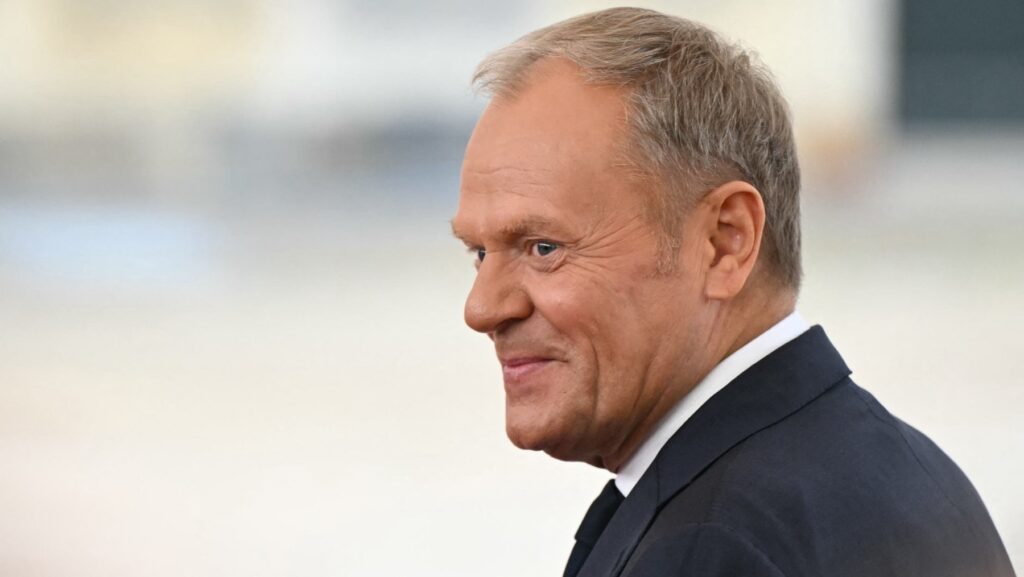
Poland’s Prime Minister Donald Tusk
Sergei GAPON / AFP
When a man is without scruples, there is no weapon he will not use to serve himself. Once the unassailable steward of Poland’s pro-Brussels establishment, Donald Tusk now finds himself in precisely that condition: cornered by a newly elected, fiercely national-conservative president and desperately shoring up whatever fragments of authority remain at his disposal, there is no hand he won’t shake and no Faustian pact he won’t get into for political gain. That has now meant propelling a former communist to the position of Poland’s second most important political figure.
These are deals with long memories and longer shadows. That the position of Marshal of the Sejm—Poland’s equivalent to Britain’s Speaker of the House—has now been handed to Włodzimierz Czarzasty, a man who once marched obediently under the banners of the Soviet puppet Polish United Workers’ Party, says far more about Tusk’s political predicament than it does about Czarzasty himself. This was the move of a prime minister who realises that, with a hostile presidency breathing down his neck and a combined right showing itself powerfully in opinion polls, he must surround himself not with the popular, but with the pliable. That is so even if they were once comfortable with being card-bearing members of the ruling party of a communist autocracy even as Marshal Wojciech Jaruzelski, ruling under martial law, ordered his troops to disperse opposition rallies by “shooting to kill.” Ninety-one Polish citizens were slain that way. Czarzasty never felt the urge to leave the party while the blood of his countrymen ran on the streets of Poland.
There is an almost amusing irony in all of this, however. For years, Tusk and his European admirers have warned that Poland risked ‘sliding back’ into its authoritarian past under conservative rule. Yet it is Tusk who is now rehabilitating the men who once enforced that past—not because he believes in them, but because they will do as they are told. In a way, both currents—Tusk’s Euroliberals and the geriatric nostalgics of communism—are united in their shared hostility to an independent Polish state and in their belief that Warsaw should offshore its sovereignty to a foreign, ideological, internationalist, and authoritarian empire. The red-yellow alliance isn’t that unnatural at all.
One should not, however, over-intellectualise this. Tusk’s decisions, of course, are not really dictated by ideology. He is a power-hungry cynic, not a man of conviction—whatever it may be. Tusk’s shameful decision is imposed by that most ancient of political instincts: survival. As President Karol Nawrocki—pugnacious, fiercely national-conservative, and alarmingly impervious to scolding from Brussels—prepares to block his government’s liberal-authoritarian project, Tusk cannot afford a Speaker with an independent streak. Czarzasty, by contrast, has candidly vowed to be an arm of the ruling coalition. It is parliamentary procedure as trench warfare.
Yet even tactical desperation can have the gravest of symbolic consequences. Poland spent decades wrestling itself free from the legacy of Bierut and Jaruzelski, martial law, the violent suppression of religion, and Party-imposed conformity. Ordinary Poles abhor the memory of those days. That the man who now controls the legislative agenda once served as a student activist for the very machinery that crushed Solidarity and had Poland in chains for forty-five long years is not a small detail; it is a collective humiliation. Even former liberal president and Tusk colleague Bronisław Komorowski says he feels “horrified” and “offended” by having Czarzasty as the second figure of the Polish State. Well, contra factum…
Czarzasty’s stunning promotion also drags back into the spotlight the quiet persistence of old-regime networks. Having abandoned the Communist Party following Poland’s transition to democracy, he later joined the organisation’s direct heir, the Democratic Left Alliance. It was through it that he later re-emerged in the powerful National Broadcasting Council, Poland’s powerful regulator, during the years surrounding the Rywin affair—the corruption scandal that exposed the murky interplay between politics, media, and influence in post-communist Poland. Though he was never charged with wrongdoing, his presence in that regulatory body at a time when media legislation was being manipulated behind closed doors cemented his reputation as a decidedly shady individual. Later, in 2021, his suspension of dissenting MPs within his own New Left party reinforced the impression that he remains instinctively drawn to top-down discipline rather than anything resembling a free, democratic debate.
Of course, there is also something depressingly predictable about the ease with which the European establishment accepted an arrangement that, in better times, would have been seen as outrageous. The same commentators performatively warning of the imminent return of ‘fascism’ whenever a conservative is voted into office are suddenly quiet when a former acolyte of an actual one-party regime becomes the second most important figure of an EU member state. Perhaps this is because both the EU’s ruling brahmins and the old communist cadre share the basic proposition that Poland is safest when it is obedient. Yesterday, the master was Moscow; today, it is Brussels. The language has changed, the uniforms have changed, the colours have changed, but the underlying assumption—that sovereignty is a problem to be managed, not a right to be exercised—remains the same.
Still, the fact of the matter is that a confident Tusk would not need Czarzasty. He would, if he could, have spared himself this embarrassment. A strong prime minister would not cede parliamentary discipline to a man tied to corruption and the shadows of martial law. A leader secure in his majority would not need to drag a dark past back into the present. But Tusk is frail. And he knows it.