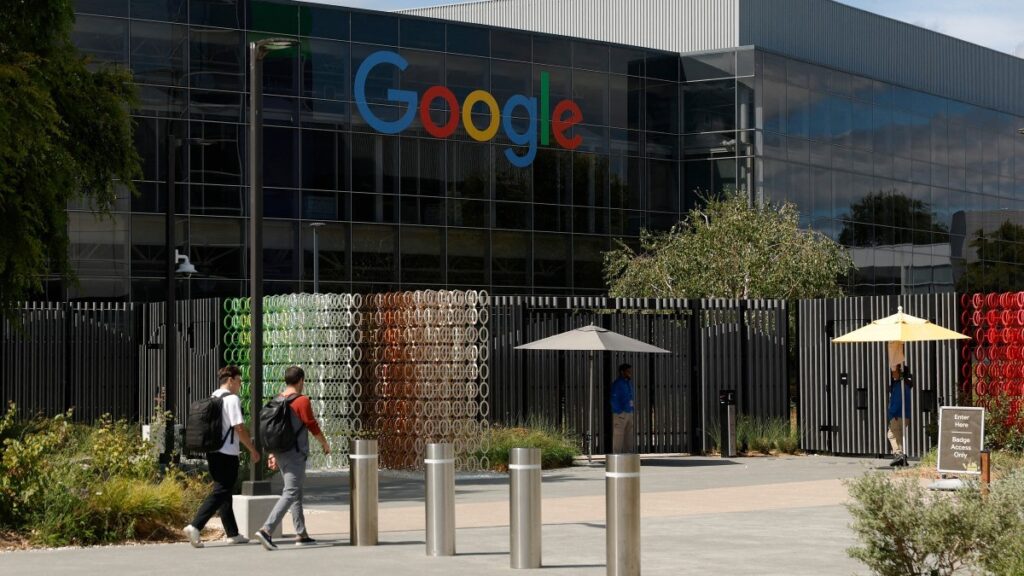
Workers enter a building on the Google headquarters campus on July 23, 2025 in Mountain View, California.
Justin Sullivan / AFP
On July 11, 2025, a prominent Catholic online publication in Italy was removed without warning from Blogger, a platform owned by Google. The blog Messainlatino.it, a key reference point for traditionalist Catholicism both in Italy and abroad, was suddenly taken offline. The site’s four curators now intend to take legal action against the Big Tech for violating their rights to freedom of speech and religion. However, beyond this specific incident lies a deeper concern: the policies adopted by major tech companies, driven by automated algorithms, reveal serious ethical shortcomings.
“Sorry, the blog has been removed. The address is not available for new blogs”—this is the terse message that readers encountered when searching for the blog. In a private email to the site owner, Google informed the site’s owner that the blog had been taken down for “hate speech.”However, it remains unclear which specific content Google was referring to. Does the tech giant believe that Catholic doctrine is a vehicle for hatred and discrimination?
Troubling signals had already emerged in recent months. Google had previously removed—without providing any explanation—several highly sensitive articles from the blog: an interview with Joseph E. Strickland, one of the bishops most critical of Pope Francis during his pontificate, in which he outlined the reasons why women should not be admitted to the diaconate in the Church; an essay on the history of Catholic condemnations of Freemasonry; an in-depth analysis of official Church doctrine concerning same-sex relationships; and finally, a post dating back more than ten years featuring a video of Kiko Arguello, founder of the Neocatechumenal Way, in which he expressed the hope that Pope Benedict XVI would die soon.
All these posts were eventually reinstated following a formal appeal submitted by the blog’s administrators. But the harm had already been done.
It is noteworthy that the shutdown of Messainlatino.it occurred shortly after a recent journalistic scoop that sparked strong indignation in certain circles within the Vatican Curia. Journalist Diane Montagna had publicly released a previously confidential dossier containing bishops’ responses to a questionnaire circulated in 2020—an initiative of the Congregation for the Doctrine of the Faith—among episcopal conferences worldwide. The aim was to assess the pastoral effectiveness of Benedict XVI’s motu proprio Summorum Pontificum. Despite the overwhelmingly favorable feedback from bishops around the world, the findings were later reinterpreted in a way that justified the promulgation of Pope Francis’s motu proprio Traditionis Custodes, which was oriented in a direction diametrically opposed to that of his predecessor.
On the day before its removal, an exclusive interview was published on the blog with Fr. Nicola Bux, author of the controversial book La Liturgia non è uno spettacolo (‘Liturgy Is Not a Spectacle’). The book serves as an ideal continuation of Diane Montagna’s scoop, as Bux retraces—through historical and theological lenses—the sequence of events that led to the publication of Traditionis Custodes. In this interview, Pope Francis was explicitly accused of having misrepresented the bishops’ true intentions.
In this context, the sudden removal of the blog raises serious questions. Naturally, it’s hard to believe that Google deliberately chose to censor a site primarily focused on Catholic liturgy. It seems unlikely that a tech giant like Google would arbitrarily target an Italian blog devoted to missals, rubrics, and the history of divine worship. The move rather bears the signs of an internal conflict within the Church itself—a dispute rooted in the pontificate of Pope Francis and now, under the papacy of Leo XIV, appears headed toward a final reckoning.
It’s also hard to believe that a blog could be removed in such a drastic and definitive manner without a series of repeated—perhaps coordinated—reports. This is the real ethical shortcoming that deserves to be highlighted. Can a private company—responsible for managing a public digital space—take such drastic action based solely on quantitative criteria, without any qualitative assessment or verification against primary sources? It’s as if a court were to hand down a sentence based solely on the number of complaints received, rather than the actual guilt of the accused.
Two potential “offenses” may have triggered the censoring algorithm’s attention. The first is the accusation of falsehood and manipulation by the late Pope—an allegation made explicitly in the interview with Fr. Nicola Bux and echoed in other articles that questioned even the transparency of the synodal process, much-celebrated by the former Argentine Pontiff.
The second “offense” is the accusation of homophobia, stemming from the blog’s repeatedly stated condemnation of gender ideology in schools and even within the Church—positions consistent with the Catholic official teaching. The blog has frequently denounced the influence of what Benedict XVI and even Pope Francis have referred to as the “gay lobby infiltrated in the Vatican,” citing names and specific cases. These denunciations have inevitably sparked strong reactions from those advocating for a more “inclusive” Church, even at the expense of doctrine.
It is therefore not out of the question that both elements may have contributed to the site’s removal. This would make the case all the more serious: it would amount to an ideological exploitation of the digital system, whereby certain factions within the Church weaponize platform policies to silence unwelcome voices, outsourcing the “dirty work” to blind and impersonal mechanisms.
The issue was apparently resolved peacefully on July 24, 2025. After a thorough review of its content, the Blogger-Google team confirmed that the site in question did not promote hate or discrimination. Nevertheless, the twelve days of suspension meant twelve days of unjust censorship.
The case of Messainlatino.it also unsettled Italian MP Maddalena Morgante, who initiated a parliamentary inquiry into the matter. Previously, a similar inquiry demand had been submitted by Italian MEP Paolo Inselvini to the European Commission, as Google’s conduct appears to have violated the Digital Services Act.