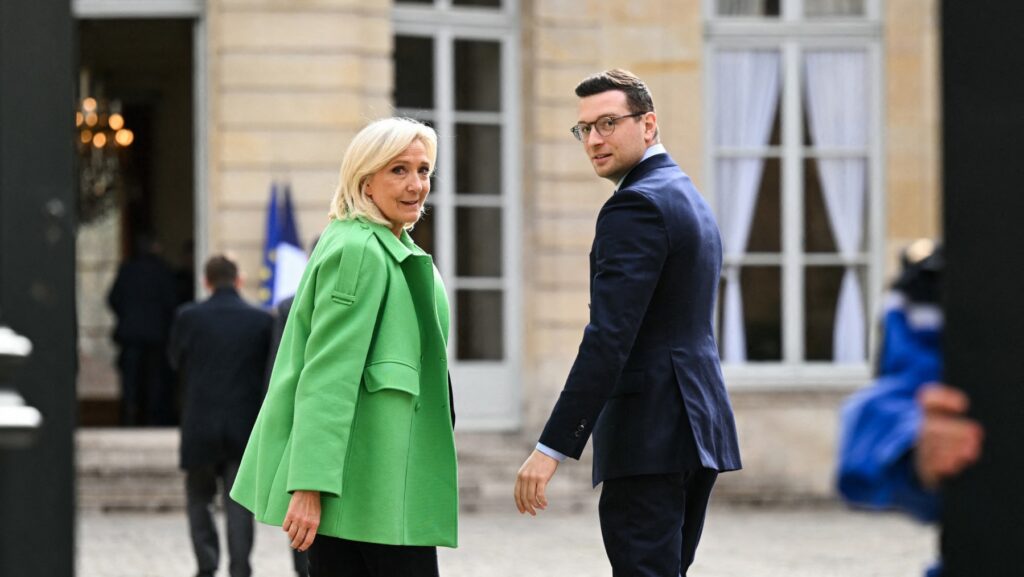
Less than a month remains before the much-feared verdict in the case concerning the Rassemblement National (RN)’s alleged use of fictitious European parliamentary assistants, a verdict that will determine Marine Le Pen’s fate and whether she can stand as a candidate in the 2027 presidential election. In political circles, people are reluctant to rule out this scenario entirely. If not, Jordan Bardella will take her place: with this in mind, he is building a presidential persona, including by taking positions at odds with those of the RN’s long-standing candidate, such as on pensions, where he intends to defend a stance further to the Right and less ‘socialist’ than his boss.
On July 7th, the judges of the Paris Court of Appeal will deliver their verdict in a case that has kept French political circles on tenterhooks for months. Two outcomes are possible: either a heavy sentence of ineligibility, which would definitively prevent Marine Le Pen from standing, for the fourth time, in the presidential election, or a light sentence, such as a fine or even an acquittal.
Within the RN party, some are displaying unshakeable optimism. Among them is Renaud Labaye, secretary-general of the RN parliamentary group, who remains hopeful until the very end. Within Emmanuel Macron’s inner circle as well, the possibility of Le Pen’s return is not ruled out as a matter of principle: the judges could choose to clear her to avoid being seen as responsible for a judicial ‘censorship of the electorate’, something that would be highly unpopular.
In the public eye, Bardella is breaking popularity records, which attacks from the left—targeting his potential incompetence or his flashy relationship with Princess Maria-Carolina of the Two Sicilies—have failed to dent. But in political circles, there is greater concern about a return of Le Pen, who is seen as a far tougher opponent in a campaign where no favours will be granted to the enemy. “Le Pen seems unbeatable to me. She gives an impression of competence that she didn’t have before. If she can stand, she will be a woman who has healed, returning from an injustice, and that appeals,” a worried close associate of former prime minister and centrist candidate Gabriel Attal told Le Figaro. The same sentiment is shared by Attal’s rival, Édouard Philippe, who says he fears Le Pen far more than Bardella.
On the Left, both Socialists and supporters of Jean-Luc Mélenchon are equally wary of a potential return of Le Pen to the fray. Bardella strikes them as easy prey, prone to making mistakes, given his youth and inexperience. Le Pen, for her part, is well-versed in weathering every low blow, and if she emerges from her trial cleared of all charges, she will be able to play the extremely effective card of the political martyr rising from the ashes despite the system’s attacks.
What these rumours tell us is that if Bardella were to end up standing, he could not rely on his popularity in the polls alone to win. And he is perfectly aware of this, as evidenced by his latest public stances on a politically explosive issue: pension reform. Bardella knows that his inexperience and youth work against him. He enjoys popularity among the working classes, but he cannot hope to win without also winning over the right-wing elites. To do so, he must shake off the label of a ‘left-wing programme’ or ‘socialism’ that main voices from the governing right within Les Républicains have been striving for years to pin on him. This is why, in a major strategic shift, he has just spoken out in favour of a pension reform plan that runs counter to the line defended by Marine Le Pen for years. The aim would be to remove the cap on the statutory retirement age—which Marine Le Pen has called for to be set at 60, contrary to current legal provisions, which stipulate retirement between the ages of 62 and 64—in order to focus on the length of contribution. Bardella has also spoken out in favour of introducing a funded component into the retirement system, allowing people to build up retirement savings through capital investment—a taboo in France, where the concept of pay-as-you-go pensions is regarded as a sacred dogma.
This high-profile stance is not the first to break with the positions championed by Le Pen. A few weeks ago, striking a different note from Le Pen’s—which resulted in a somewhat chaotic media coverage of internal party contradictions—Bardella opposed a tax on the super-profits of major oil companies. He is thus signalling his strategic priority: to engage more with business circles than with the RN’s traditional working-class base, which is normally assumed to be firmly behind him.
Le Pen has been tirelessly emphasising the common ground that supposedly exists between her and her heir apparent—separated by “less than the thickness of a cigarette paper”, in her own words—yet the differences between the party’s two leaders are substantial. Within Le Pen’s inner circle, there is concern about losing the party’s social credentials. Bardella’s supporters, for their part, are convinced that the electoral base must be broadened, particularly in urban areas and among the affluent classes who remain reluctant to vote for the RN—a strategy once championed by figures on the fringes of the party such as Marion Maréchal and Éric Zemmour.
The verdict on July 7th is therefore eagerly awaited for more than one reason: it will decide not only who will be the lead candidate for the next campaign but also the direction of France’s main opposition party.