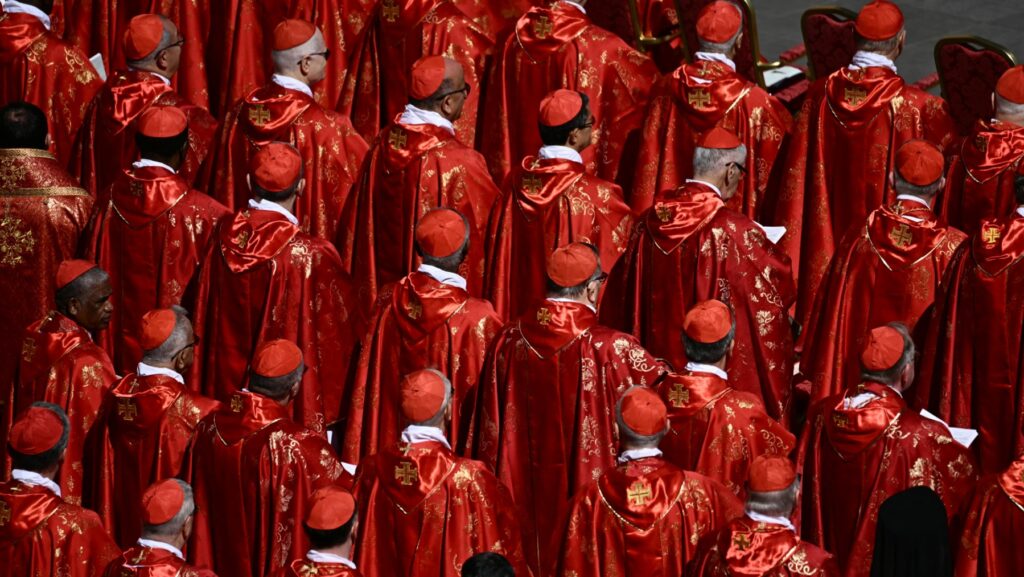
Cardinals attend the late Pope Francis’ funeral ceremony at St Peter’s Square at the Vatican on April 26, 2025.
FILIPPO MONTEFORTE / AFP
The crisis of the Catholic Church is, first and foremost, a crisis of authority. Authority does not concern only the doctrinal and moral sphere but, above all, the form and manner in which power is exercised. Every institution is sustained by a power structure that ensures its unity and continuity. In the case of the Church, this structure is a mixed regime of divine law: monarchic, because the Pope exercises supreme, full, and immediate power over the entire Church, guaranteeing the unity of faith; aristocratic, because the bishops—ideally chosen among the ‘best’ (aristoi)—govern the dioceses with real autonomy, while remaining in communion with the Pope; and ‘republican’ (in the classical sense of the term), because power does not belong to a dynasty or a caste in the Hindu style but can be conferred, through election or appointment, to anyone—regardless of social origin—who meets the conditions required for access to the hierarchy.
Moreover, it is traditionally a subsidiary regime: the higher level should intervene only when the lower level of the hierarchy is unable to provide for itself or in matters concerning the Church as a whole, transversally, as universal. Consequently, those at the top intervene far less than those at the bottom.
In recent decades, however, a different approach has progressively taken hold, a true process of subversion of the traditional regime: from a mixed regime to an increasingly democratic-parliamentary regime, from a subsidiary regime to a centralist regime.
The pontificate of Jorge Mario Bergoglio—Pope Francis—represented a genuine ‘transition dictatorship.’ The post-conciliar Church presented a model still monarchic in structure but no longer such in the perception and exercise of power; it was moving toward a new configuration that many wish to establish in a democratic sense. As often occurs in historical transitions from monarchy to democracy, this transition was marked by a power vacuum, symbolically and effectively represented by Benedict XVI’s resignation in 2013. This vacuum was filled by Francis, who exercised highly centralized authority—a ‘dictatorship’ in the Marxist sense of the term, that is, extraordinary and direct power, but temporary—to guide the Church from one model to another, effectively dismantling the previous structure.
From this perspective, Leo XIV is not in opposition to Francis’s pontificate, as many continue to assert, but in coherent continuity in the form of synthesis. It is no coincidence that Leo, from the beginning of his pontificate, repeatedly exalted the role of the Curia—the administrative apparatus of the Vatican—at times presenting it as effectively superior to the pope himself (“Popes pass, the Curia remains”), over whom it should instead exercise power in a vicariate form. Leo does not perceive himself as an authority placed above the Curia but as a figure inserted and almost ‘embedded’ and temporary within it.
One of the main instruments of this process initiated by Pope Francis has been the paradigm of “synodality.” Formally, it is presented as a recovery of ancient practices of the Church. In reality, the implicit idea is that the entire people of God—and not only the ordained clergy—participate in determining the life of the Church, not only in pastoral or disciplinary matters but also on doctrinal and moral issues.
The method adopted is always the same. One does not proceed through an explicit revision of doctrine, which would create a friction that is difficult to manage. On the contrary, traditional principles are often verbally reaffirmed. Simultaneously, however, innovations are introduced in practice that, over time, end up normalizing principles previously considered unacceptable.
A significant example concerns the question of the female diaconate. On December 4, 2025, the pope authorized the publication of a study synthesis promoted by Francis, which states that such an institution cannot currently be admitted in the Church. However, it specified that this judgment “is not definitive.” This formulation reveals a logic typical of gradual revolutionary processes: a position is called “non-definitive” until the change is fully consolidated or accepted by the majority; it becomes “definitive” when the transformation is already accomplished and irreversible on an institutional level.
Numerous signals that have emerged in recent months seem to confirm this dynamic.
One element is the recent statements of Cardinal Reinhard Marx, promoter of the German Synodal Path, who proposes extending the German synodal model to the universal Church.
Another signal concerns the ongoing theological debate on the nature of the power of governance. In November 2025, Cardinal Francesco Coccopalmerio, in a new book, suggested modifying canon law to stabilize greater lay participation in Church governance. On February 16, Cardinal Marc Ouellet proposed developing a more “charismatic” vision of church governance, according to which baptism—and not holy orders—should enable the faithful to participate stably and properly in ecclesial governance. This perspective conflicts with the traditional conception, according to which only the sacrament of orders enables governance, while the laity can exercise power only in a delegated form—that is, not as their own power, but as a received assignment, limited in time or scope.
Recently, some study group reports commissioned by Francis and working on the Synod on Synodality were also published. These reports consolidate the same direction. The report of Study Group 4, dedicated to priestly formation and published on March 3, proposes a broader presence of women in formation processes and in the admission to orders of candidates for the priesthood. The report of Group 5, published on March 10, explicitly addresses the “woman question,” which in reality functions as a battering ram for the broader change previously mentioned.
This report, dedicated to the role of women in the life and governance of the Church, explicitly speaks of the need to “overcome mindsets,” asserting that many so-called gender roles would be “cultural products,” historically modifiable. Taken to its logical conclusion, such an approach can only dissolve the complementarity between man and woman, reducing it to a purely biological function devoid of normative significance. In this framework, it would become easier to legitimize, at least implicitly, the normalization of irregular relationships and the claims of so-called LGBT Catholics—a phenomenon already occurring in the Catholic Church.
This analysis is further confirmed by episcopal appointments promoted by Pope Leo in recent months. Vaticanist Sandro Magister recently published an article identifying a recurring pattern in episcopal appointments made by Pope Leo XIV. According to Magister, Leo’s bishops are distant from internal polarizations, missionary, and conciliatory. The analysis, however, appears overly optimistic, especially if limited to the individual cases presented—Ronald A. Hicks (New York), Manuel de Jesus Rodriguez (Palm Beach), Stanislav Pribyl (Prague).
However, even analyzing the profiles of the latter and ignoring many others, interesting data emerge, as in the case of the new Archbishop of Prague, Pribyl, who appears perfectly aligned with the agenda set by Pope Francis and, not coincidentally, was significantly present at the episcopal consecration ceremony of Josef Grünwidl, the new Archbishop of Vienna, openly favorable to the most radical synodal-democratic revolutions of the Church, and not coincidentally supported in his ministry by priests who not only theorize—for example—the overcoming of celibacy but already practice it, disregarding ecclesial discipline. europeanconservative.com analyzed this worrying appointment at the time.
Another critical element, in particular for recent episcopal appointments in the United States, concerns the growing spread of the so-called “consistent life ethic.” This tends to place very different issues on the same level; thus, there would be no difference between defending abortion or euthanasia, on the one hand, and regulating immigration or pollution, on the other. This approach appears more compatible with a democratic-parliamentary conception of the Church, where sins are primarily reinterpreted as ‘social evils.’
Furthermore, the objection of many that, even if the bishops are mostly progressive today, as long as they do not dare to speak openly against the pope, there would be nothing to fear, is unconvincing. First, because they talk anyway. Second, because episcopal appointments do not concern only the present but determine the future composition of the College of Cardinals and, therefore, the next conclaves. Recent history is clear: cardinals considered conservative during the pontificate of Benedict XVI, such as Ouellet and Odilo Scherer, later proved markedly progressive.
Further developments are expected in the next extraordinary consistories convened by Pope Leo, the next scheduled for late June 2026. Leo has already indicated that these consistories, although formally extraordinary, will in reality become the norm of his pontificate. Among the planned topics is also the relationship between the Holy See and local churches in light of the apostolic constitution Praedicate Evangelium. Essentially, this will be a discussion on the power structures of the Church, that is, on how authority should be distributed between the center and the peripheries. The direction is clearly defined.
Bishops and cardinals of a more conservative orientation face a delicate task: not simply to oppose individual reforms but to provide coherent theological and juridical arguments defending the traditional conception of authority.
The difference between the German Synodal Path and the synodal reform initiated by Francis at a more universal level appears today, more than ever, a mere difference of speed. Germany proceeds more rapidly, while Bergoglio’s Curia adopts a more cautious pace. Otherwise, it would be difficult to explain the substantial silence of the Holy See in response to German initiatives—openly contrary to canon law—while severe (and noisy) threats of sanctions are directed at the Society of St. Pius X (SSPX). It is on this institutional ground that the future configuration of the Catholic Church will be played out in the coming months and years: a gradual transformation of the Church’s material constitution that could occur without any major modification of its juridical constitution.