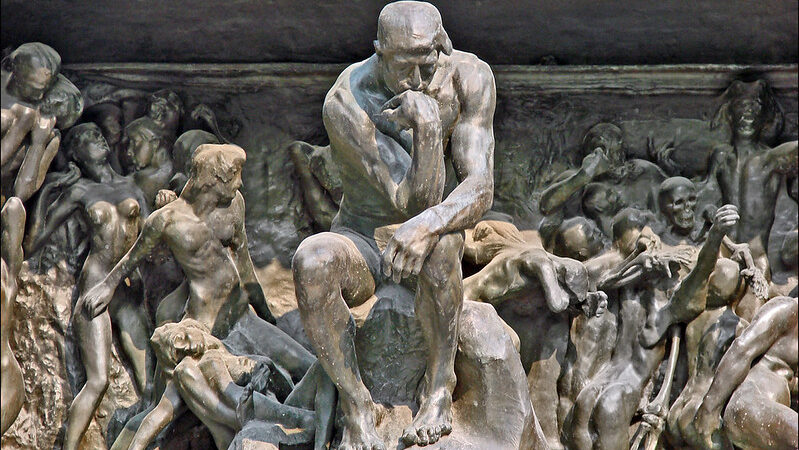
“Le Penseur de la Porte de l’Enfer” (The Thinker at The Gates of Hell) (appr. 1890) by Auguste Rodin (1840-1917), at the Musée Rodin, Paris.
Jean-Pierre Dalbéra from Paris, France, CC BY 2.0, via Wikimedia Commons
Before Europe became a collection of nation-states, it was a civilization bound together by scholars, shared learning, and the pursuit of truth. As our capacity to communicate has expanded beyond imagination, the intellectual culture that sustained that world has steadily eroded.
When Russian tanks crossed the Ukrainian border in February 2022, many European leaders described the invasion as the event that shattered peace on the continent. The assumption behind this narrative was clear: Europe had been stable, prosperous, and secure until an external aggressor disrupted the post-war order.
Yet this interpretation overlooks a more uncomfortable reality. Europe did not become weak when the war in Ukraine began. By then, the weakening had already taken place. The conflict merely revealed a crisis that had been developing for decades beneath the surface of prosperity and institutional confidence.
Wars rarely emerge in a vacuum. They are often the final manifestation of deeper political, cultural, and civilizational transformations. The tragedy unfolding in Ukraine should therefore be understood not merely as a geopolitical confrontation but as a symptom of a broader European condition.
The question that Europeans should ask themselves is not simply why Vladimir Putin invaded Ukraine. The more fundamental question is why Europe found itself so vulnerable when the challenge arrived. The answer lies in a long process of civilizational erosion that accelerated after the cultural revolution of 1968.
For many commentators, May 1968 remains a romantic episode of youthful idealism. Students challenged authority, demanded freedom, and sought to modernize societies that appeared rigid and outdated. Certain aspects of that movement undoubtedly reflected legitimate aspirations. Yet history often judges movements not by their intentions but by their consequences.
The events of 1968 represented something far deeper than a student protest. They marked the beginning of a profound anthropological transformation that altered the relationship between individuals and the institutions that had shaped European civilization for centuries.
The family ceased to be viewed as the fundamental cell of society and became an object of suspicion. Religious belief was increasingly marginalized. National identity was recast as a source of exclusion rather than belonging. Tradition itself became something to overcome rather than transmit. Authority was no longer expected to guide; it was expected to justify its existence continuously.
The cumulative effect of these developments was not liberation in the classical sense. Rather, it was the gradual dismantling of the cultural frameworks that had given Europeans a sense of continuity and purpose.
A civilization cannot survive solely through economic growth. It requires a shared understanding of who its people are, where they come from, and why their common life deserves preservation. Europe increasingly abandoned these questions. In their place emerged a vision of society organized around consumption, individual self-expression, and administrative management. The citizen slowly became a consumer. Political participation was replaced by market participation. The pursuit of meaning gave way to the pursuit of satisfaction.
Paradoxically, this transformation occurred while Europe celebrated itself as the most advanced expression of human progress.
Economic integration expanded. Supranational institutions accumulated authority. Technological innovation accelerated. Yet beneath these visible achievements, a less visible process was unfolding. Europe was losing confidence in the very civilization that had made those achievements possible.
This contradiction remains one of the defining paradoxes of contemporary Europe. A society can survive temporary economic hardship. It can recover from military defeat. It can rebuild cities destroyed by war. What it cannot easily recover from is the loss of civilizational self-confidence.
The philosopher Rémi Brague has repeatedly emphasized that civilizations depend upon their ability to recognize and transmit what they inherit. Once inheritance itself becomes a source of embarrassment, decline becomes difficult to avoid.
This helps explain why Europe entered the twenty-first century with unprecedented wealth but increasing uncertainty regarding its identity.
Demographic decline accelerated. Religious practice collapsed. Trust in institutions weakened. Social fragmentation expanded. Mental health crises became commonplace despite rising material prosperity. Political polarization intensified throughout the continent.
None of these developments were caused by the war in Ukraine. They preceded it. The war merely exposed the fragility that already existed.
While Europe increasingly embraced the belief that history had ended, other powers continued to think in historical terms. Russia, China, Turkey, and numerous regional actors never abandoned concepts such as sovereignty, national interest, strategic influence, and cultural continuity. Europe, by contrast, often behaved as though geopolitics had become obsolete.
Military capabilities were reduced. Strategic dependence increased. Energy security became secondary to ideological priorities. Questions of culture and identity were frequently dismissed as relics of the past.
The result was predictable. A civilization uncertain about its own legitimacy inevitably struggles to defend itself.
This does not mean that Europe should imitate authoritarian powers or abandon its commitment to liberty. On the contrary. The challenge is to rediscover the foundations that originally made European liberty possible.
Freedom did not emerge in a vacuum. It emerged within cultures shaped by Christianity, classical philosophy, national traditions, local communities, and institutions capable of transmitting moral responsibility across generations.
The tragedy of modern Europe is that it increasingly seeks to preserve the fruits while neglecting the roots. A tree can survive for some time after its roots begin to decay. Its leaves may remain green. Its branches may appear healthy. But deterioration is already underway. Eventually, an external storm reveals what internal weakness had concealed. The war in Ukraine has become such a storm.
For decades, European leaders focused on managing prosperity rather than preserving civilization. Political discourse became dominated by technical questions, regulatory frameworks, and administrative solutions. Meanwhile, the deeper foundations of social cohesion received far less attention.
The consequences are now visible everywhere. Citizens distrust institutions. Young people struggle to find meaning. Birth rates continue to fall. Cultural confidence has been replaced by cultural uncertainty.
Large segments of society no longer share a common narrative about their past or future.
A civilization without memory becomes vulnerable to manipulation. A civilization without confidence becomes vulnerable to intimidation. A civilization without purpose becomes vulnerable to despair.
This is why the debate about Europe’s future cannot be reduced to military spending, economic competitiveness, migration policy, or institutional reform, important as those questions may be. The deeper issue is civilizational.
Does Europe still believe in itself? Does it still recognize the value of its inheritance? Does it still possess the cultural confidence necessary to defend the principles upon which it was built?
These questions will determine the future of the continent far more profoundly than any election cycle or policy initiative.
The conflict in Ukraine may one day end through negotiation, exhaustion, or military resolution. Yet even when the guns fall silent, Europe will continue to face the challenge that existed long before the first shot was fired.
The greatest threat to Europe does not originate outside its borders. It originates within the loss of civilizational confidence that has characterized much of the Western world for more than half a century.
If Europe wishes to secure its future, it must do more than strengthen its armies. It must recover the cultural, spiritual, and historical foundations that once made its civilization resilient.
Before Europe can successfully defend its borders, it must first rediscover its center.
I develop this argument at greater length in my book War in the Name of Peace: The ’68 Revolution and the Disintegration of the West. The book has already been published in Slovenian, Croatian, Ukrainian, and English. The French edition will be released in September, while the Polish edition is currently in preparation.
Europe’s renewal is not only necessary—it is possible. Across the continent, a growing number of citizens, thinkers, and even political leaders are awakening to the realization that a civilization cannot live indefinitely on borrowed time and exhausted ideas. In churches and universities, in families and local communities, in the quiet resistance of parents defending their children’s education and in the renewed interest in Europe’s classical and Christian heritage, the first signs of a spiritual and cultural reawakening are already visible.
If Europeans have the courage to honestly confront the failures of the past half-century and rediscover the sources of their own greatness, this crisis can become the catalyst for a profound civilizational renaissance. A Europe that once again knows who she is, what she stands for, and why she is worth defending will not only secure her borders—she will once more offer the world an example of ordered liberty, beauty, and human flourishing. The hour is late, but it is not too late. The future of Europe will be decided not by those who abandoned her roots, but by those who choose, with clarity and conviction, to reclaim them.