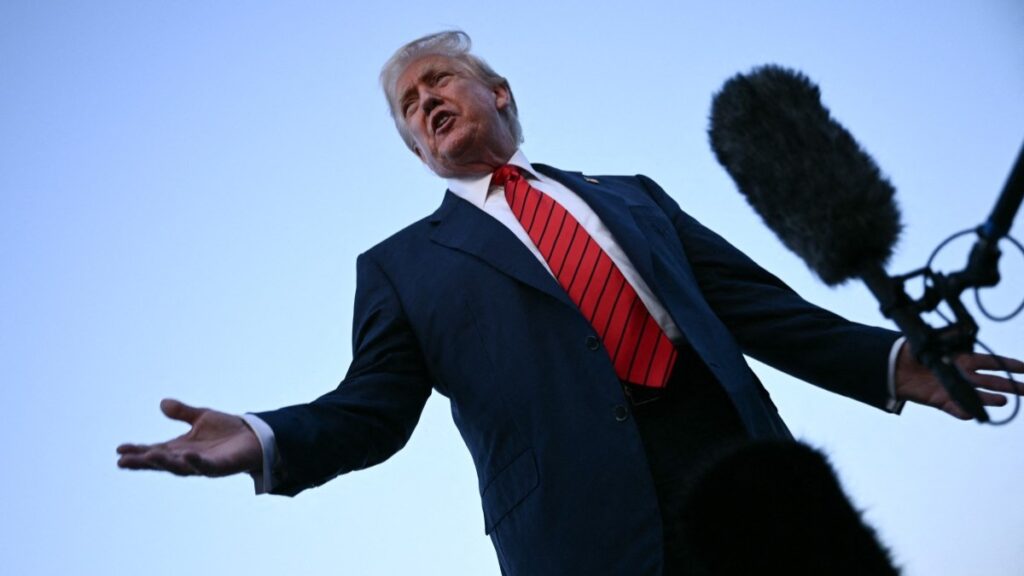
U.S. President Donald Trump speaks to journalists at Lehigh Valley International Airport in Allentown, Pennsylvania, on August 3, 2025.
Brendan Smialowski / AFP
Donald Trump’s return to the White House is beginning to impact the world in general, and Europe in particular. Back in November, I predicted that a change in tariffs and trade conditions could pose serious challenges. The newly inked trade deal between Washington and Brussels proved me correct on that point.
It looks like I am also going to be proven right on my one positive point for Europe, namely that a Trump presidency would ‘export’ lower interest rates from America to Europe. However, given the aggressiveness with which Trump is pursuing lower rates, I am going to modify my positive outlook for how a cut in American interest rates would affect Europe.
As I explained recently, President Trump wants to replace Jerome Powell, the current chairman of the Federal Reserve, with someone who is willing to aggressively drive U.S. interest rates down. In a delusional comparison, Trump claimed that if Switzerland can have interest rates in the 1-2% range, so can America.
If he were to succeed in pushing the Fed’s policy-setting funds rate down to that range, it would have drastic consequences not only for the U.S. economy, but also for Europe in general—and the euro zone in particular. So far, Trump has not won the battle against Powell, but with more and more of his allies joining the posse to tar-and-feather the Fed chairman and drive him out of town, I fear that Trump will win the showdown long before May next year, when Powell’s term expires.
There are also rumors that members of the Fed’s policy-making Open Market Committee are beginning to warm up to an aggressive pursuit of low interest rates. This means that they have reasons to believe that Powell is on his way out prematurely.
Once that happens, there is a significant risk that the Fed will embark on a spree to cut interest rates quickly and substantially. With the federal funds rate currently at 4.33%, a new leadership at the American central bank would have a lot of cutting to do in order to get the funds rate to Trump’s Swiss dream level.
Such big rate cuts in America will no doubt affect Europe, and not in a good way. The most problematic consequence will be negative interest rates in the euro zone—and possibly elsewhere in the EU.
To explain how this can happen, let me share two figures comparing the policy-setting interest rates of the Federal Reserve and the European Central Bank. First, the two rates as they have looked over the past quarter century:
Figure 1

Next up is a simple subtraction of the two. Figure 2 reports the Federal Funds rate minus the Deposit Facility. This gives us a kind of ‘net funds rate’ which illustrates an interesting phenomenon, namely that America for the most part has higher interest rates than the euro zone:
Figure 2

In addition to the fact that U.S. interest rates are typically higher than the euro zone’s rates, we also learn from Figure 1 that the leading interest rates for both economies have a tendency to vary in a coordinated fashion. This is no coincidence: the ECB is the most important central bank outside of the Federal Reserve; together they represent monetary policy for the two biggest economies in the world and the currency supply for each of those two economies.
With financial capital moving in the blink of an eye between continents, it is essential for monetary policymakers to make decisions in close coordination. If they do not coordinate, financial investors will be lightning-quick to exploit speculative opportunities in the currency and financial markets left open by the central banks.
For the very reason of policy coordination, as well as for the reason that Europe tends to have lower interest rates than America, it is quintessential for European policy makers—monetary as well as fiscal—to prepare for the repercussions of a power shift at the top of the Federal Reserve. Given that the ECB currently holds its deposit facility at 2%, the impact of aggressive rate cuts in America would be harsh and—in a worst-case scenario—the destabilization of the European financial system.
It looks like the ECB is already preparing for a fight with the Fed over ‘going low.’ On July 24th, the European Central Bank made an important announcement:
The Governing Council today decided to keep the three key ECB interest rates unchanged. Inflation is currently at our two per cent medium-term target.
After cutting its benchmark policy-making rate—the deposit facility—from 4% to 2% over the past year, the ECB believes that it has done enough cutting. I would not be surprised if the decision last week was meant as a bulwark message across the Atlantic Ocean: by keeping its rates unchanged, the ECB declared that it will stand its ground if the Federal Reserve pursues a rate at, or even below, the ECB’s interest rates.
Should they give in and follow the Fed downward, they would have to make painful cuts to the deposit facility. As Figure 2 shows, the federal funds rate is supposed to be 1.5-2 percentage points higher than the rate on the deposit facility. Simple arithmetic therefore yields a troubling conclusion: the ECB would have to cut its deposit facility to zero, and probably to -1%, to maintain its margin to the federal funds rate.
Negative interest rates are never good for any economy. From 2014 to 2022, the ECB held its deposit facility below zero; at its lowest it was -0.5%. In other words, if pushed by the Federal Reserve, the ECB might have to lower its deposit facility to the lowest level it has ever been.
There are two major reasons why negative interest rates are bad. The first has to do with household financial planning: when you de facto get paid by the bank to take a loan, as opposed to having to pay the bank for the loan, then you will inevitably go deeper into debt than you otherwise would. Whenever the economy snaps back into positive interest rate territory, this exposure to debt obligations can easily inject considerable stress into the banking system.
The second problem with negative rates is that investors will prefer to put money in the financial markets instead of productive, long-term investments. The reason is simple: because of the negative interest rates, financial institutions are discouraged from depositing excess reserves with the central bank. Instead, they increase lending to private customers. At some point, this rising supply of money exceeds the need for all profitable, productive investments in the economy.
Once we get to that point, the excess liquidity will be diverted into equity markets, primarily stocks and real estate. The rest, sadly, is a history Europe has been through one too many times before.
To sum up, once President Trump has replaced Jerome Powell as chair of the Federal Reserve, there will be an elevated risk that the Fed, in aggressive pursuit of very low interest rates, forces the ECB to cut its rates sharply. This, in turn, can set in motion a process in the European economy that leads to financial instability.