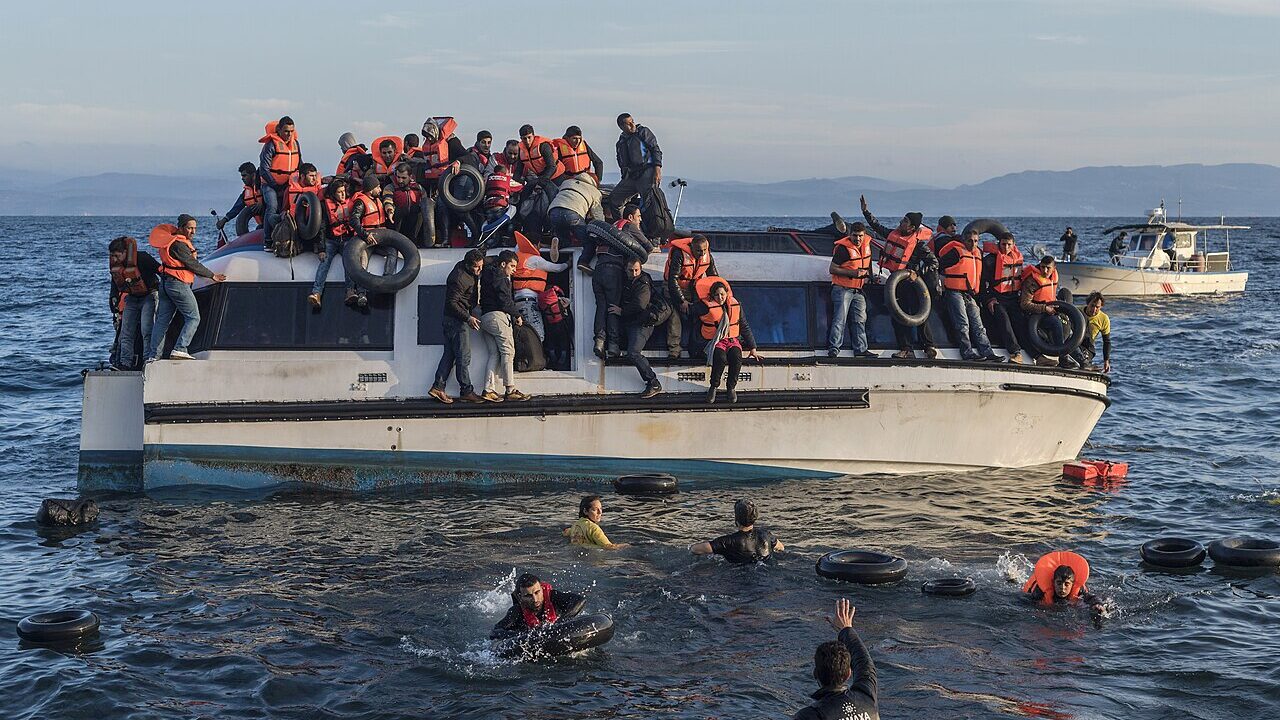
Syrian and Iraqi refugees arrive from Turkey to Skala Sykamias, Lesbos Island, Greece.
Ggia, CC BY-SA 4.0, via Wikimedia Commons
Ancient Greek philosophy contributes to the very foundations of Western civilization. Enriched by the Byzantine (Eastern Roman) philosophers, it became the spark that ignited the Italian Renaissance. Its core principles are indelibly replicated in the U.S. Constitution.
Much wisdom is to be found when reflecting on the profound ontological crises confronting the West today, says Rafail Kaliviotis, a journalist, academic researcher, and political advisor who resides in Athens. He explains:

Socrates declared that “the unexamined life is not worth living.” The moral force of this statement remains undiminished: it rests on the conviction that ethics is the supreme measure of human dignity, that right and wrong exist, and therefore that good and evil are real. Not everything is relative.
In addition, Aristotle, one of the true founders of political science, observed that for a polity to be strong and prosperous, it must possess a robust and numerous middle class. For it is the middle class that neither covets the wealth of the very rich nor provokes the envy of the lower strata. Had today’s elites internalized these timeless truths, we would not have reached the perilous juncture in which we now find ourselves.”
Rafail Kaliviotis is the editor-in-chief of the news portal newsfire.gr and host of a notable online podcast. He has served as campaign manager in multiple national election campaigns, held senior executive positions in major shipping companies, and regularly contributes both political and geopolitical analyses to Greece’s leading media outlets.
Kaliviotis is currently completing his doctoral thesis on the geopolitics of migration at the University of Athens under the supervision of one of the most significant figures in the field, Professor Ioannis Mazis.
Through his Ph.D. research on the geopolitics of migration, Kaliviotis examines the complex and often conflictual interaction between European elites and citizens regarding the migration phenomenon. He further analyzes the profound geopolitical transformations taking place across European countries as a direct consequence of this tense and confrontational relationship.
In an interview with europeanconservative.com, Kaliviotis analyzed some of the urgent issues facing Greece.
Greece experiences major challenges, many of which are shared with other European countries. The migration crisis is a prime example, given Greece’s position as a primary country of entry. This reality necessitates the allocation of significant budgetary resources to border protection and the deployment of modern surveillance systems designed to deter illegal migratory flows. Yielding to migrant-smuggling networks constitutes not only a crime against human life—tantamount to complicity in human trafficking—but also a profound offense against the very essence of the nation because it entails the systematic violation of state borders.
This issue is inextricably linked to another degenerative phenomenon: Greece’s demographic collapse. Many voices, particularly within European elites, argue that the demographic crisis can be reversed through mass immigration. Should this dangerous perception prevail, it would logically and inevitably lead to the cultural erosion of nation-states and, by extension, Western civilization itself. The comparative advantage of the West has always resided in its rich cultural capital.
Equally critical is the agricultural question. As with other European countries, Greece’s small and medium-sized farmers are largely abandoned. Preferred solutions, such as the Mercosur-type agreements, favor multinational agribusiness corporations that produce outside the European Union and then re-export to us. This exploits cheap labor and significantly lowers quality standards.
The housing crisis is no less pressing. Middle- and lower-middle-class citizens are asphyxiated by soaring rents and home prices. Once housing became an asset class for investment funds, it triggered a severe housing shortage that has, in turn, eroded the purchasing power of ordinary citizens.
In summary, ordinary, hard-working citizens are facing a systematic assault on their identity, their food security, and their fundamental right to live a dignified life.
Greek citizens who take this stance are sending a powerful and unmistakable message of delegitimization to the existing political system. In Greece, there are politicians and party leaders who effectively ‘inherit’ a parliamentary seat merely by virtue of their family name. Citizens feel they are not being heard because economic cartels continue to wield unchecked power, the citizens’ purchasing power has reached its lowest point, and the leadership of the judiciary is elected by the governing parliamentary majority.
At the same time, they feel unprotected on matters of security. Moreover, they have been repeatedly deceived by the Greek political class—leading to a belief that promises were never honored.
The next national parliamentary elections, as stipulated by law, are scheduled for spring 2027. The prime minister has repeatedly insisted that they will be held normally and on the constitutionally prescribed date. Nevertheless, reports circulating in the press suggest that he may call early elections this autumn due to the intense pressure currently facing the government following a series of scandals.
In Greece, as in most European countries, identitarian parties exist. However, the Greek media establishment—like its counterparts across most of Europe—actively combats them. European experience has shown that these identitarian parties draw particularly strong support from the most dynamic and promising segments of the youth.
In Greece, a significant proportion of young people have emigrated to other European countries, as the high level of their academic qualifications is not matched by correspondingly competitive salaries at home. This brain-drain wave was greatly intensified by Greece’s severe economic crisis.
Consequently, the pivotal voter groups that determine the formation of governments are those aged 55 and above. Citizens in the older age brackets are far less inclined to support anti-system forces. This demographic reality, in turn, largely explains why Greece has not witnessed the emergence of a dominant identitarian party, in contrast to several other European countries.
What the latest opinion polls clearly reflect is a chronic deficit of credibility and trust on the part of Greek citizens towards the political system. In the wake of the economic crisis, they turned to the establishment party called the New Democracy. They belong to the center-right political family that has, however, shifted significantly towards the center-left, just as many center-right parties have across Europe. It has now completed seven full years in power and is heading into its eighth.
After the collective trauma of the economic crisis, citizens sought to lean on a party that would offer them stability and reassurance. Instead, they have been rewarded with economic hardship, widespread corruption, and a pervasive sense of insecurity. They are now demanding political change, yet the manner in which this demand will ultimately be expressed remains unpredictable.
Under the present circumstances, the political landscape is characterized by profound fragmentation, rendering the formation of a single-party majority government highly improbable.
In my address to the United Nations, I had the honor of highlighting this very issue. Illegal migratory flows are systematically directed towards Greece and Europe along a meticulously orchestrated route in which Turkey is deeply complicit. Thousands of Pakistani men arrive in Turkey through semi-legal or wholly illicit channels. They are then channeled into smuggling networks that deliberately target the Aegean Sea and Greece’s borders. Data from the International Organization for Migration (IOM) and Frontex confirm that Pakistanis represent a significant share of arrivals in the Eastern Mediterranean.
Ankara routinely weaponizes migratory pressure as leverage against the European Union, while Pakistan reaps substantial remittances without bearing any of the associated social costs. This represents a coordinated strategy that transfers the burden onto Europe while simultaneously expanding the regional influence of both states.
In recent months, Greece has confronted a fresh wave of illegal migratory flows originating from Libya. Once again, Turkey has played an expansionist role and is an integral part of the broader problem. Revisionist powers are increasingly deploying illegal migration as a tool of hybrid warfare in order to extract concessions from the West.
Europe must now formulate a unified strategy in close coordination with Greece for the robust protection of European maritime borders. The European defense industry should be tasked with the development of agile, high-performance surveillance and interception systems capable of preventing these vessels of death from even departing the coasts where they were launched. Concurrently, binding interstate agreements must be concluded with third countries outside Europe to ensure the temporary reception and processing of migrants pending their repatriation.
Only through such resolute and uncompromising policies will human smuggling be rendered economically unsustainable for the criminal networks perpetrating these lethal operations.
The ‘Blue Homeland’ doctrine is an outrageous and provocative Turkish plan to seize half the Aegean Sea from Greece. There is no room for equivocation or diplomatic euphemism in the face of something so blatant and coarse.
Under the United Nations Convention on the Law of the Sea (UNCLOS 1982), Greece—like every other sovereign state in the world—has the full and unquestionable right to extend its territorial waters from the current 6 nautical miles to 12 nautical miles in the Eastern Aegean. In an unprecedented move, Turkey has declared this legitimate exercise of sovereign rights a casus belli through a formal resolution of the Turkish Grand National Assembly in 1995. To grasp the sheer absurdity of this decision, imagine your apartment neighbor threatening you with physical violence simply because you decide to step onto your own balcony.
Turkey is a classic revisionist power. Its actions—from Syria to Libya and Somalia and its aggressive expansionism in the Balkans—leave no doubt that its strategic objective is the reconstitution of the Ottoman Empire. It continues to illegally occupy 36.2% of the territory of the Republic of Cyprus since the 1974 invasion. That is a significant portion of European soil in open defiance of multiple United Nations resolutions.
The fact that several European countries continue to cooperate with Turkey, whether on the issue of illegal migration or in geopolitical alignment—and are even contemplating its inclusion in the European security architecture—is nothing short of delusional. The way the Turkish state manages the Turkish minority in Germany under the explicit doctrine of ‘integration without assimilation’ should serve as a stark warning to all. Yet they choose to turn a blind eye.