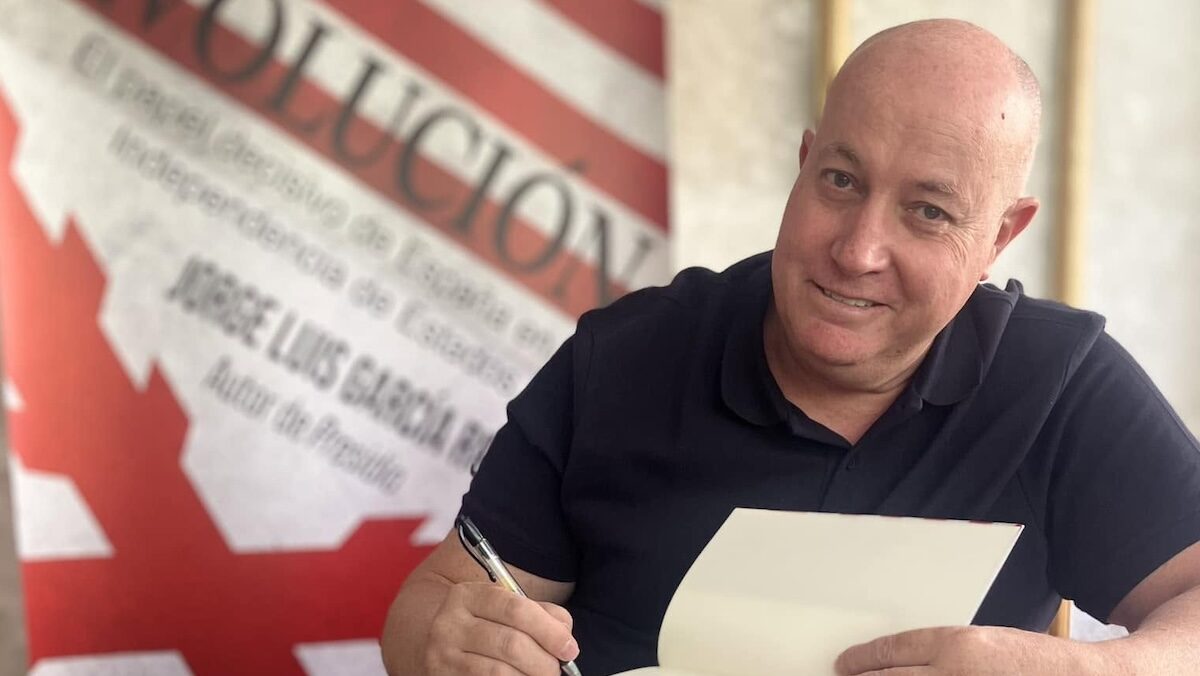
Jorge Luis García Ruiz is a professor, archaeologist, and historian. He holds a Ph.D. from the Complutense University of Madrid and is the author of the “Presidio” series, a documentary history of three centuries of Spanish presence on the northern frontier of what is now the United States. We recently spoke with him about his latest book, Revolution: Spain’s Crucial Role in the Independence of the United States—first published in English and now available in Spanish—which recovers a little-known chapter of history: Spain’s decisive contribution to American independence.
Spain’s declaration of support for France has brought immense joy to every revolutionary, while the poor Englishman withers like a flower in the setting sun.
—Letter from George Washington to the Marquis de Lafayette, 30 September 1779
The original title of Revolution was going to be “The Great Scam.” What was the reason for that?
Because when I began investigating and digging through the documents, what emerged was, in essence, a massive scam against Spain, driven mainly by France, as a result of the family pact—the Bourbon pact. At that time, France was practically bankrupt. It is estimated that Spain had a public debt of about 120 million pesos, while France’s was around 1,300 million. And yet, all the expenses—such as moving the fleet to the Caribbean Sea—were borne by Spain: that alone cost about two and a half million pesos. But France has gone down in history as the great liberator of the United States, when in reality much of the economic and military effort came from Spain, channeled through the favors that Charles III granted to his nephew. Spain’s entire ruin stems from those alliances with the French.
We tend to focus on 1783, when the peace treaty was signed, and to portray it as a victory. But if you look at it in perspective, it is also the moment when Spain began to lose its empire. If we consider that much of that process was financed with Spanish money, the conclusion changes quite a bit: rather than a victory, it ends up looking like a scam. A key figure emerges in the peace talks: John Jay, whose role was decisive and who pressured Spain to continue financing the Americans. The Spanish government agreed to continue providing aid but made the payments contingent on certain deadlines. This angered Jay, who left for Paris, where he began negotiating directly with the British. From that point on, a new dynamic emerged, leading even to British military actions against Spanish positions in the south, such as Pensacola, and the refusal to pay the debt to Spain.
In other words, the United States had an ally who was supporting them, covering their expenses, and yet during the peace negotiations the Americans betrayed them. Spain was betrayed by France, but also—outright—by the Americans. After more than 400 pages of research, the impression I was left with is very clear: Spain was the one who suffered the most from that alliance. Although as a historian I try to remain objective and detached, as an author it’s inevitable that, chapter after chapter, a certain weariness—even anger—begins to surface. And that’s where the title comes from: The Great Scam.
And why did you end up calling it Revolution?
First, because the original title was too aggressive for American audiences. And so, the first English-language edition was published as Revolution. There are many things in the book that may surprise Spanish readers, but American readers will likely be completely shocked, because they don’t know the context: they don’t understand what’s being discussed when the book explains the scam perpetrated on Spain by France, nor that American independence was largely financed with Spanish money.
Spain paid for what France is given credit for doing.
Exactly, down to the last cent. In fact, in the first chapter of the book, we included a compilation of quotes from Americans of the time, explicitly thanking Spain for the contributions it had made. Curiously, all of that was later forgotten.
The French were the inventors of propaganda—though the Soviet Union later perfected the art. This was one of the first major examples of systematic propaganda: France, which had always lagged behind powers like Spain and England in the Americas, set out to prove that it was their equal. You can even find fake maps created by the French in which Spain or England disappear from the American continent and France appears as the owner of almost everything when, in reality, France had lost practically everything.
Was the money given to the insurgents as a grant, or did they have to pay it back?
No; in principle, they had to pay it back. When I reviewed the documentation, I saw that the debt amounted to between 15 and 20 million pesos, not to mention the enormous expenses incurred by the Spanish Crown in its conflict with England. For example, at that time, transporting the fleet from Spain to the Caribbean Sea—some 140 ships with all necessary supplies—cost around 8 million pesos. That’s a huge figure considering that the annual operating costs of the entire Spanish Empire were around 30 million.
The problem is what happens next. When the United States asked exactly how much it owed, it took Spain nearly two years to crunch the numbers. By then, the Americans were either no longer in a position to pay, or simply had no intention of doing so. And that is where another key mistake was made by the Council of the Indies: they agreed to let them repay the money “when they could.” A formula so ambiguous that, in practice, it could mean anything—even never paying. And that is what ended up happening. They never paid the debt. And the bill could amount to twice our current GDP. With that money, we could easily pay off our current public debt.
You mentioned the family pacts with France. Is that why Spain decided to get involved in the conflict by sending weapons, financing operations, and deploying its fleet?
Spain supported independence for a combination of reasons. The negotiations between the French and the Spanish—of which documentation and transcripts survive—reveal a complex process. France was coming off a major defeat in the previous war and was in a very precarious situation, practically bankrupt. In that context, the French king needed a political catalyst to strengthen his domestic position and prevent his head from being cut off. That catalyst was entering the American War of Independence. But doing so alone was suicide. So, the French government ended up maneuvering to drag Spain into a conflict that Spain, in reality, did not want. Neither the king nor the ministers were in favor of entering that war. However, at a certain point, the young French king announced that he had already signed the alliance treaty with the United States to intervene in the War of Independence. And since France and Spain were bound by the Family Pacts, this forced Spain to participate.
Once they got involved, it was like a card game. They started by putting in a little money, then a little more, and a little more, while trying not to lose what they had already invested. Spanish aid grew progressively because of that dynamic. Spain, moreover, had no wish to get involved, fearing it would be dragged into a war with England, especially given the risk that England would consolidate its union with the colonies, as had already happened in other contexts. In practice, it faced two fronts: Europe and the threat to its overseas empire in the Americas. The situation was tremendously difficult, and I believe any decision that was made would have turned out badly.
Was there anything or anyone that drove that decision?
There is one very interesting point here. Today, in Spain, there is a noticeable anti-British sentiment; everything is blamed on England, as if England were the cause of all problems. And that same sentiment was already present in Spanish politics at the time. A very prominent figure in that context is the Count of Aranda, who harbored a profound hostility toward Britain and who sent numerous reports to the Crown, influencing the decision-making process regarding entry into the war.
So, is that Anglophobia—now closely linked to the English role as purveyors of the ‘Black Legend’—playing tricks on us?
If you flip the question around and look at the situation with some perspective, interesting things emerge. For example, Portugal has no ‘Black Legend’ despite having been the largest trafficker of slaves. Why? Because it has always been an ally of the English. In the case of Spain, there was a moment in our history when Spain became an Anglophobic country and didn’t know how to simply be Spain; now we’re going through something similar. There are people who know more—and wrongly—about the history of England than about the history of Spain. People must keep an open mind, conduct rigorous research, and review testimonies from the time; that’s what helps people shed their prejudices. We are always complaining that the British have done this or that to us, but we’ve never had the courage to say, “Hey, we have a civilization that for centuries was the greatest empire in the world. Why don’t we believe it?”
For example, it’s often claimed that the English taught indigenous people to scalp, and that’s false: there are archaeological records dating back thousands of years showing that some tribes were already doing it. But if people challenge that narrative, they get canceled. The truth doesn’t matter. Another example is Francisco de Miranda. In Spain, there are people who present him as a major figure in the American Revolution, when in reality his role was very minor. But today, people don’t go to the sources; they consume simplified versions, memes. In Revolution, I cross-reference sources from the United Kingdom, France, Spain, and the United States—that is, from all the parties involved. Because if we only read one version, we’re left with a partial picture.
Speaking of scalps, what was the relationship like between the various colonial powers and the indigenous populations?
In the case of Spain, the model was based on evangelization and integration into a more structured system. That meant replacing indigenous beliefs with Catholicism, altering their social structures, or restricting certain customs. England, on the other hand, had a different relationship. In many contexts, it did not seek to integrate or evangelize, but rather to establish specific alliances with indigenous groups, especially for military purposes. In fact, there are interesting documents, such as a letter from Bernardo de Gálvez to British commander John Campbell, in which he raises the possibility of leaving the indigenous people out of the conflict and limiting the war to the European powers. He proposed this because England had a force of 1,200 Englishmen and more than 1,000 Indians, while Gálvez had only a dozen indigenous people at his disposal. As expected, Campbell said no.
France adopted a model that was more focused on trade, particularly in regions such as the American interior. In some cases, there were also religious missions, but their presence was more flexible and based on economic relations with various tribes. And then there is the case of the United States. During the War of Independence, many indigenous communities sided with the British, partly because they saw them as people just passing through, whereas the Americans had come to stay, and their experience with the latter was one of expulsion and extermination, as they were displaced from their territories.
Was it a sound strategic decision to aid the independence effort; or, viewed in hindsight, was it a mistake?
When we look at it with the benefit of hindsight, many questions arise. Those who contributed most to driving the Spanish American independence movements were the United States itself, more so than the British. The British, once the process was already under way, adopted a more pragmatic attitude: they tried to benefit from the situation, as is customary in their foreign policy. And what I explain at the end of the book is that, barely thirty years after independence, Spain had lost practically everything. If we also broaden the focus and look two hundred years ahead, it makes even more sense: we can see how a clearly anti-Spanish narrative is constructed from the United States. In the end, the United States not only grew on territory that had been Spanish but did so with Spanish money and support. That is why one of the inevitable conclusions is that perhaps Spain should not have supported that independence.
So, would it have been better to support the other side?
I think that if, at that time, someone had suggested, “What if, instead of allying with the revolutionary colonies, we allied with England?” then history might have turned out very differently. Perhaps we would have managed to crush the rebellious colonies and, in the process, weaken France as well. It’s even possible that the Bonapartes would have stayed in Corsica, tending to their vineyards, and wouldn’t have played a leading role in everything that later happened in Europe. England, moreover, at that time had a certain respect for Spain, even admiration, since if a Spaniard gives his word, he tries to keep it at all costs. For an Englishman, this was a virtue. That was not the case with the French. That perception began to deteriorate precisely when Spain aligned itself with France through the Bourbon Family Pacts. In that sense, one might wonder whether another strategy would not have been more favorable: an alliance with England rather than a confrontation. Perhaps, in that scenario, the independence of the United States would have been delayed by decades, as would the independence movements in Spanish America.
How has Revolution been received by the American public?
It depends a lot on the reader’s background. There are people who, when presented with the evidence, react openly and say, “We need to analyze this.” But most people reject it outright; they don’t want to get into it and prefer to stick with the version they already knew. For a large part of the American public, Spanish support for independence doesn’t exist, as such. That’s the prevailing perception. That’s why what I do is reconstruct everything Spain did for independence, both before and after the process.
The book challenges a certain deeply entrenched paradigm in parts of the English-speaking world. When one explains, for example, that many names, place names, or cultural references in the United States have Spanish origins—and that in many cases they are simply adaptations into English—people are surprised, because that knowledge isn’t widespread. Even the presence of Spanish on their own soil is not fully appreciated. In some cases, that lack of recognition is accompanied by a sense of cultural superiority.
Was the American public’s perception that the Spanish presence was almost folkloric, and are they now realizing that it was much more decisive?
Yes, exactly. And they’re having a hard time coming to terms with it. Something similar happened with Bernardo de Gálvez: a few years ago, people began to recognize his role, but the process of acceptance was slow. The problem is that the true magnitude of Spanish aid to the cause of independence is not fully appreciated. In many cases, it has been believed that Spain acted solely out of an interest in reclaiming Florida—or even against American interests—which has contributed to cementing an image of Spain as an adversary.
We’ve seen that, unfortunately, a single movie can have more influence than a hundred books. Do you think real change is possible, or is it, for now, a lost cause?
I believe it’s practically a lost battle. We don’t have much room to maneuver. In general, most movies are quite questionable from a historical standpoint. And honestly, I don’t think that’s going to change. Quite the contrary: Hollywood has been transforming over time, shifting from classic cinema to films with an indigenous focus.
However, there are exceptions, such as Mel Gibson’s film The Patriot. If you analyze it from a historian’s perspective, it is relatively accurate, but you also have to keep in mind that it depicts a part of the war in which Spain had no direct involvement. And who appears in it? The Marquis de Lafayette—which is fitting, since for years he was France’s only prominent figure in the war. That said, it’s also true that his role has been greatly exaggerated. George Washington took him under his wing and eventually gave him command, although many historians agree that his military abilities were quite limited. Nevertheless, the recognition he has received is enormous. Just look at how many public spaces in Washington are named after him. That gives you an idea of the impact that the narrative has had.