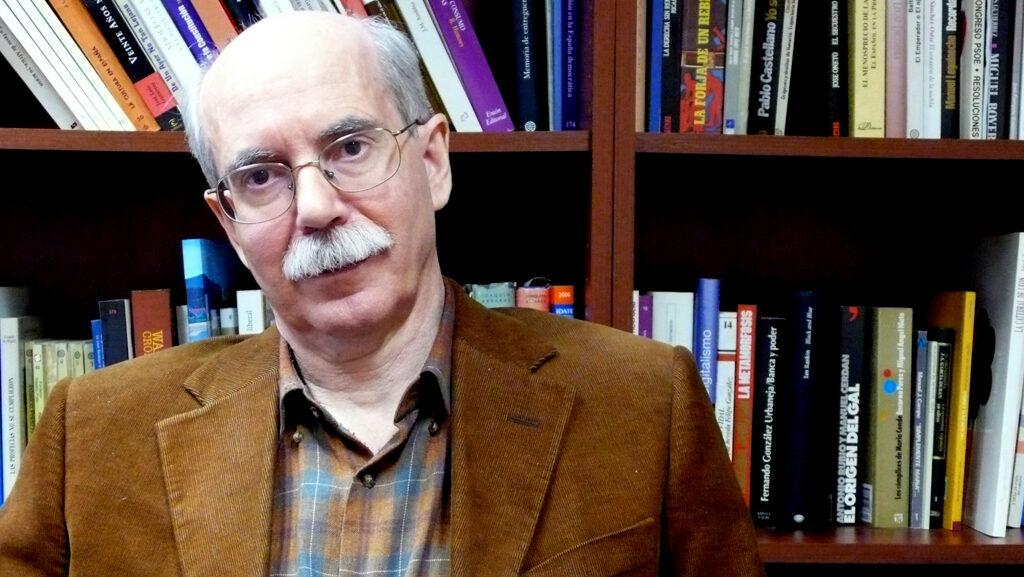
Pío Moa recounts to me in an interview exclusively for europeanconservative.com how his (now notorious) book The Myths of the Spanish Civil War came at just the right time to unsettle both the leftwing and rightwing political establishments:
It’s important to remember that my book [Los Mitos de la guerra civil]came out in 2003, and just the year before the Spanish Right (Partido Popular) had acquiesced, purely out of political opportunism, to condemning the nationalist side in the [Spanish Civil] war.
Renowned historian of Spain professor Stanley Payne in an interview for this article reaffirmed Moa’s account of the work’s impact and impeccable timing:
It appeared at exactly the right time to challenge the dominant narrative, which it seemed no one else dared to challenge and which it exposed head-on with very good writing and lots of strong evidence.
According to Pío Moa, his book—or “rather its publication and dissemination”—was a prime motivation for Spain’s Orwellian laws of “democratic memory” in 2007 and 2022, of which I have written about for this publication.
Pío Moa is, by his own admission, a revisionist historian:
Revision is necessary in any study, whether scientific or intellectual, but here and in France they became enraged because they believed their dogma to be beyond reproach.
The recent publication in French of Los Mitos de la guerra civil (The Myths of the Civil War) provoked an open letter of protest which was signed by over 100 academics. When France’s Le Figaro defended its decision to interview Moa and publish a translation of his work, the video went viral, evoking comparisons of Moa and another historian deemed by the media establishment to be beyond the pale, Éric Zemmour.
A favorite term of the academic left—particularly in anglophone academic circles—is the “pact of forgetting,” psychoanalytical academic jargon for the so-called forgetting of the Franco regime’s crimes. Few leftists remember that the amnesty law, created in 1978 during Spain’s transition to democracy, also pardoned communists and separatist terrorists. Nonetheless, the moniker could be applied to Pío Moa’s own work. Instead of engaging in rigorous academic debate, the establishment media—both of the Left and of the Right—have simply pretended that Moa’s work doesn’t exist.
Why are Pío Moa’s ideas so dangerous? Because they disrupt the foundational narrative upon which Spain’s socialist party has cemented its status, from the lofty peaks of the moral high ground.
Behind all this [opposition to my work] is the supposition that the Spanish Republic was a model [democratic] regime destroyed by Spanish Fascists with the help of Hitler and Mussolini. The truth, as soon as one pays attention to the facts, was that the Republic was destroyed by two coups: The first, in October of 1934, attempted to impose a ‘dictatorship of the proletariat,’ by means of a civil war (completely documented in the archives, by explicit instructions that I’ve analyzed for the first time). The PSOE [Spain’s “moderate” Socialist party, according to the official narrative] allied itself with Catalan separatists which advocated an odd kind of racism according to which the Catalans formed a superior race to the rest of Spaniards. That coup resulted in 1,300 deaths and large-scale destruction, above all in Asturias. The second coup was the proven falsification of the 1936 elections, after which the ‘Popular Front’ imposed a regime of terror culminating in the assassination of the [conservative] opposition leader, Calvo Sotelo.
Moa makes a crucial distinction between fascist support for Franco’s cause and Stalin’s support for the Popular Front:
On Franco’s side there were some Fascists, but they were never the decisive factor … And it’s true that Hitler and Mussolini helped Franco, just as Stalin did with the Popular Front. But at that time Hitler had not yet committed acts of genocide whereas Stalin had already left a mountain of corpses in his wake. And, no less important, neither Hitler nor Mussolini established any preconditions on aid to the Franco regime … while Stalin became the Popular Front’s true leader, especially once the Spanish Republic gave them the bulk of Spain’s financial reserves. It wasn’t the communists who gave Stalin Spain’s gold reserves, but the socialists themselves.
Spain’s current prime minister, Pedro Sánchez is a member of the same party.
A “democratic” opposition doesn’t gel with a Stalinized one—least of all with an immaculate Spanish Republic overrun by the forces of fascism. As Moa explains:
The biggest problem most ‘academic’ historians have with my books is that I cite very little from the personalities and critics on the Right, and instead focus on exposing what the leftists at the time were doing and saying, along with the rationale they gave for their actions at the time.
Part of Moa’s research, he tells me, was based on over three years of archival research “at the Pablo Iglesias Foundation, the archives of the socialist party, and in particular of Largo Caballero.” Caballero has a dedicated monument in Madrid, despite his embrace of the nickname “The Spanish Lenin” and, as Moa’s book The Myths of the Spanish Civil War consistently demonstrates, his advocacy for the cause of violent proletarian revolution as key to Spain’s betterment, even prior to the coup of 1936. Indeed, through my own investigations—including interviews, research, and email exchanges that spanned the course of weeks—it became clearer to me just how much the communists had invested in Spain.
Stalin, Moa explained to me, believed that a war among the capitalist powers of the West was only a matter of when, not if.
“His strategy was to ensure the war was between fascism and democracy, thus occurring in Western Europe, and not between Germany and the USSR. He saw in the Spanish war an opportunity for the Franco-British alliance to directly clash with the German-Italian one. It was the failure of this strategy that led to Stalin seeking a rapprochement with Germany … Where Stalin did [eventually] succeed was in his hopes that the war would start in the West, not the East. Stalin had envisioned his role as that of an arbiter, thus extending the revolution across a European continent that would be in ruins,” and hence more susceptible to communist subversion.
If nothing else, Moa’s scholarship helps place the so-called populist movements of today in context: the failed cancellation of the National Conservatism Conference shows what’s at stake for the left-leaning establishment narrative of WWII and postwar Europe; it’s the Historikerstreit of the 21st century: a battle for the moral high ground that the Left has not had to fight since 1945, when ‘antifascism’ became the rallying cry of Left and Right alike.